
EDM for aero-engine production

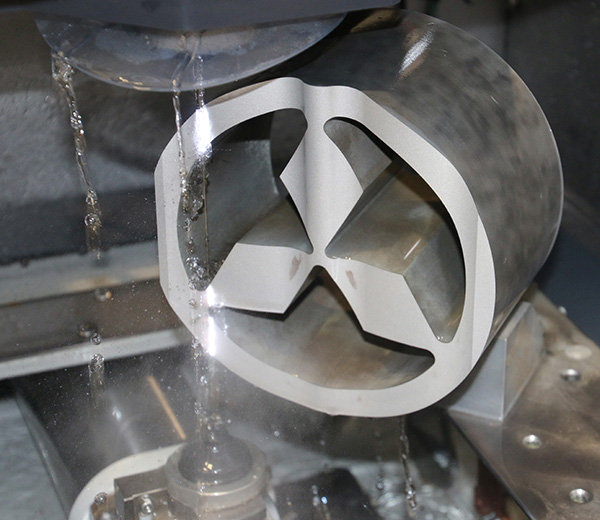
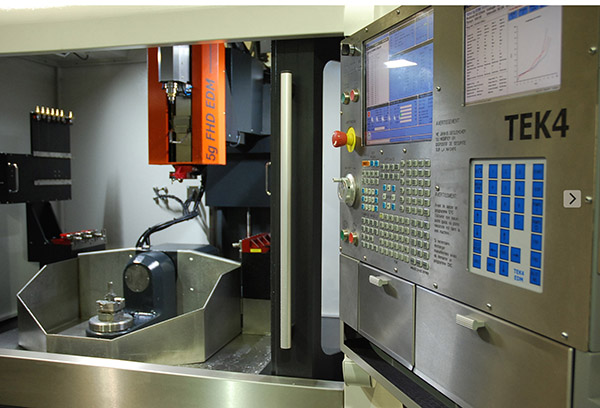
TEK4 recently introduced what it describes as a world first, an EDM machine dedicated to producing aerospace engine blades and vanes. As a specialist in cooling hole drilling technology for jet engines and gas turbines, TEK4 has launched its 6G FHD SA (Small Aerospace), a fast-hole EDM drill specifically for industrial turbine production.

The TEK4 6G FHD SA incorporates full six-axis simultaneous machining and intelligent probing, as well as pre-breakthrough and breakthrough tool detection. These features are essential for machine shops in this sector as it enables them to avoid the risk of back wall impingement. The machine is fitted as standard with an automatic electrode guide changer and automatic electrode changer, which can accommodate electrodes up to 600 mm long for extended autonomy.
According to TEK4, the EDM generator works in combination with the in-house developed software. This compatibility allows for excellent metallurgical results, says the company, which is another critical parameter for this high-tech industry. In addition, the TEK4 6G FHD can be integrated in an autonomous robot cell with automatic part loading for unmanned operation. A laser ablation head can be incorporated in TEK4 FHD machines for the removal of the ceramic protective barrier. Having the EDM head and laser head on the same platform avoids positioning issues and offers reduced capital investment.
The TEK4 5G FHD machine has an X, Y and Z axis of 300 x 300 x 400 mm, with 360° rotation in the A (±180°) and C axes (360° continuous), a 600 mm drill stroke, and a maximum work part weight of 20 kg. This flexibility enables the machine to process holes from 0.25 to 10 mm diameter, and up to 200 mm deep.
For further information www.tek4.co.uk
EDM used on live nuclear reactor pipeline

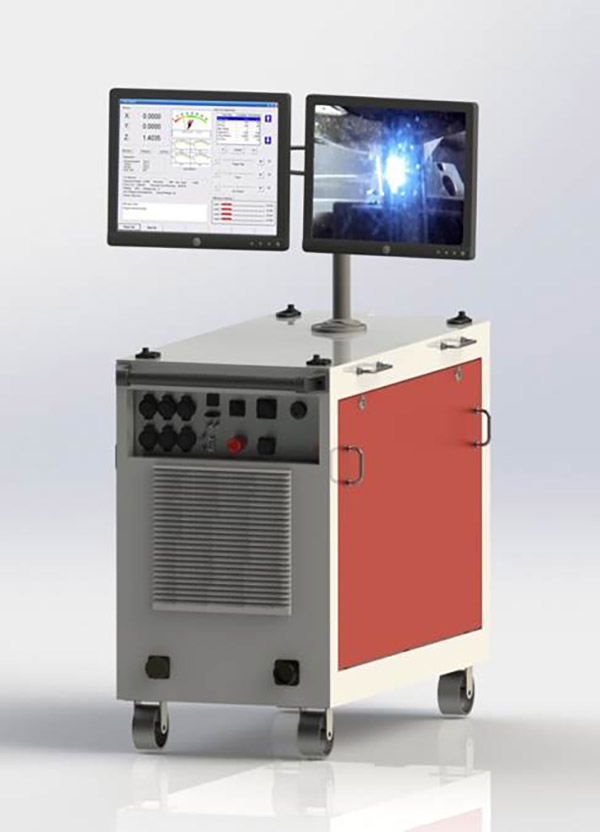
Machining specialist Hydratight says it has become the first company to use EDM for maintenance work on a live nuclear reactor pipeline system.
The company completed the technically challenging campaign for a major energy company at a US power station as part of post-Fukushima upgrades.

Using EDM avoided an expensive unplanned shutdown of the reactor, and took 48 hours off the reactor outage schedule.
The process used a heated solid electrode to cut a hole (featuring 0.05 mm tolerance) within the reactor feed water line. Microscopic cuttings were then removed using back-flushing and vacuums. Hydratight’s process prevented 99.5% of foreign material exclusion particles, such as drill cuttings and debris, from entering the reactor.
Mike Riordan, Hydratight’s nuclear speciality services manager, says: “This was a milestone achievement on a live nuclear reactor pipeline system, and resulted in safety enhancements in line with the industry’s post-Fukushima requirements. The work has created another way to feed water into the main line if there is ever a power loss to the reactor.”
The line had water pressure of 8.3 bar and electrical conductance exceeding 3,500 micro-siemens. Hydratight’s speciality services deployed customised tooling to negotiate a 380 mm long, 25 mm wide pipe as an entry point to reach the spot where the 19 mm EDM penetration was to take place.
“Material contaminations are a major concern for most facilities, and EDM is a highly accurate and safe way of machining,” says Riordan. “Tool pressure was also a concern on this particular project, so we were able to use a method which was completely contactless.”
Hydratight has offered its services to the nuclear and power-generation industries for more than 30 years.
For further information www.hydratight.com

A&M EDM showcases engineering

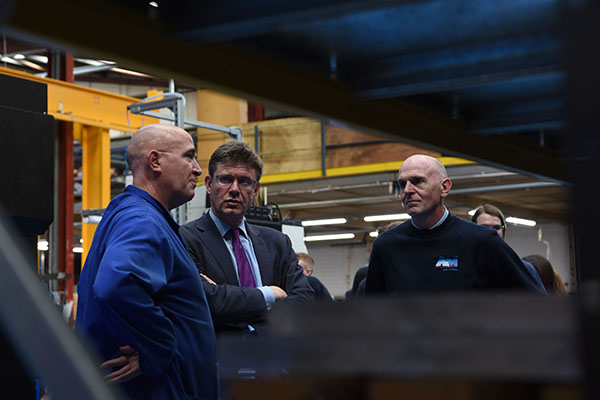
Greg Clark, Secretary of State for Business, Energy and Industrial Strategy, recently visited precision engineering company A&M EDM in Smethwick, West Midlands to understand what drives growth and the issues facing a manufacturing SME.

The Business Secretary met some of A&M’s current and recent apprentices, speaking to individuals about their motivation to take up an apprenticeship, the work they undertake and the skills they are developing by working with experienced engineers. All of A&M’s apprentices study for academic engineering qualifications at Dudley College.
Mark Wingfield, managing director of A&M EDM, said: “We had an informed discussion with the Business Secretary on how the Industrial Strategy can accelerate West Midlands manufacturing and A&M’s initiative to develop its own apprentices.”
Added Clark: “The Industrial Strategy for the West Midlands will harness its distinctive strengths to unlock greater growth and earning power across the region’s cities and towns.”
A&M showcased engines and components manufactured for aerospace and automotive customers. In addition, Clark saw a new high-speed CNC machining centre and handheld alloy analyser in action; these were part funded by a Black Country Local Enterprise Partnership (LEP) grant to create new manufacturing jobs.
The Business Secretary discussed the practical implementation of the Industrial Strategy with senior representatives of the Black Country Chamber of Commerce, Black Country LEP, Dudley College and the EEF.
A&M has grown from a two man start-up in 2002, to 67 staff and sales of over £6m in 2018. This has been achieved using EDM and CNC machining to design and manufacture precision components and tooling for a range of UK and international customers.
For further information www.amedm.co.uk

Mitsubishi adds spark to MACH

Mitsubishi Electric used the recent MACH 2018 as the platform to introduce its latest CNC control unit on the company’s established MV series of EDM machines. The Mitsubishi EDM stand at MACH was furnished with MV1200S and MV2400R machines.

Advanced technology and a new user interface can be a daunting prospect for any machine operator; Mitsubishi Electric has overcome this by offering both the new and established interface in a single control. With the flick of a switch, the new CNC interface can revert to either type.
The machine operator has a large screen monitor and modern gesture controls with a configurable interface that supports the user by allowing the main function elements to be freely arranged for daily work. Furthermore, the step-by-step dialogue guidance pilots less experienced operators through the entire process with checklists taking operators from programming through to machining.
Tailored to the needs of the end user, the interface has an easy-to-grasp display with all the machining parameters in configurable form to make everything visible. For scheduling, support is provided with an overview of remaining wire, filter cartridge state and other parameters. Complete documentation for the machine, including maintenance instructions and manuals, are integrated into the software with 3D diagrams and images also included to guide the user through every facet and process of the machine.
To put the user in charge of the Mitsubishi EDM machine at all times, the interface allows operators to monitor the machine portfolio from anywhere at any time. Powered by Teamviewer, customers can access their machines via mobile technology such as phones and tablets with direct status reports available
via email.
For further information www.mitsubishiedm.co.uk

EDM family offers improved software

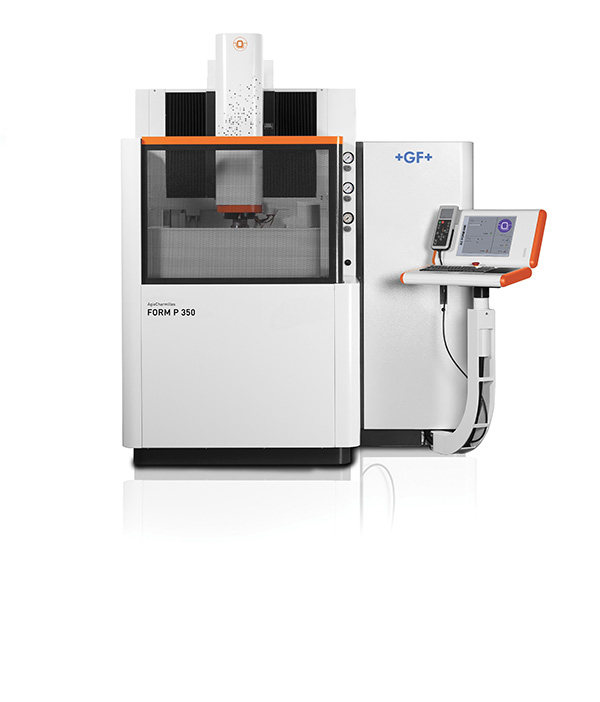
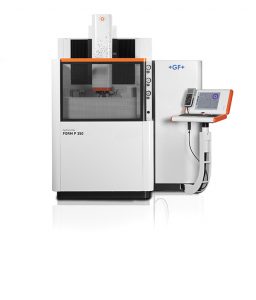
The Form family of die-sink EDM machines from GF Machining Solutions features improved software and a range of technical innovations aimed at precision mould makers and component manufacturers. The series includes the AgieCharmilles Form X, Form S, Form P and Form E models.

Form machines provide customers with Econowatt technology to save energy, a variety of Industry 4.0-oriented connectivity features to help support the digital transformation of manufacturers, and e-Tracking software for EDM process monitoring and full traceability.
From faster rib machining to micro-machining, the AgieCharmilles Form family is the outcome of GF Machining Solutions’ continued investment in die-sink EDM research. The result is that AgieCharmilles Form series users are able to achieve better performance in machining with either graphite and/or copper electrodes, says the company.
Form series machines are said to allow for repeatable machining of micro-cavities, while on-board ‘iGAP’ technology guarantees the rigidity of injection-moulded plastic products featuring deep ribs. According to GFMS, the technology also ensures fast, accurate machining of rib cavities with respect to the required de-moulding taper and VDI (Verein Deutscher Ingenieure) homogeneity throughout the cavity surface.
Additionally, manufacturers can exploit the range’s eConnectivity features and MTConnect capability to stay informed of the machine’s status and machining process.
For further information www.gfms.com