
Injecting certainty into the moulding process

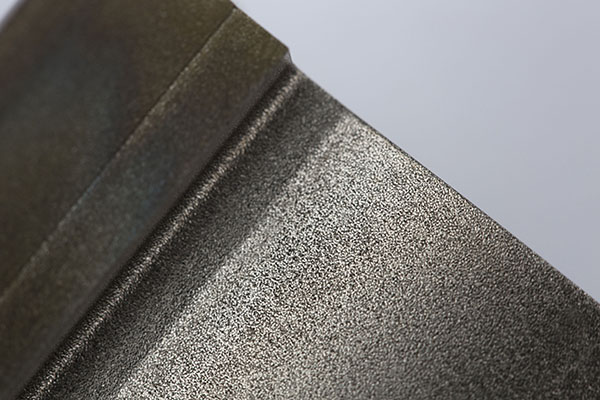
GF Machining Solutions’ die-sink machines are equipped with 3DS, an intelligent surface texturing technology that reduces friction on the surface area of moulds and, as a consequence, enables injection-moulded parts manufacturers to improve their productivity and performance.

Injection moulding process productivity can be compromised by de-moulding issues caused in many instances by increasing part and polymer complexity. An effective and traditional way of overcoming these issues is to apply coatings to the mould surface, which reduce adhesion and friction, enabling moulded parts to be ejected quickly. This coating process occurs after the machining operations have been completed and, as such, adds time and cost to the whole manufacturing process.
A new, less time-consuming approach using advanced EDM die-sinking technology has been developed by GF Machining Solutions. In essence, the new approach can be adopted by mould makers with access to the company’s latest AgieCharmilles Form P and Form X die-sinking machines, which are equipped with the high-performance and digital Intelligent Speed Power Generator (ISPG) and 3DS, an on-board, intelligent surface texturing technology that can be accessed directly from the machines’ HMI control.
3DS technology smoothes the distance between the peaks and valleys on the mould surface, but not to a point where the peaks are eliminated. The technology stretches the surface RMS (root mean square) value without affecting the Ra value and, because the peaks are more evenly spread on the surface that is created in the mould, prevents sticking.
Owing to the reduced surface friction, moulds can be filled faster (shaving seconds off the moulding process) and moulded parts can be ejected quickly and effortlessly.
For manufacturers that make millions of injection-moulded parts, this capability enables significant cycle time reductions and the potential to make hundreds of thousands of additional parts.
For further information www.gfms.com
Sodick selection boils down to performance

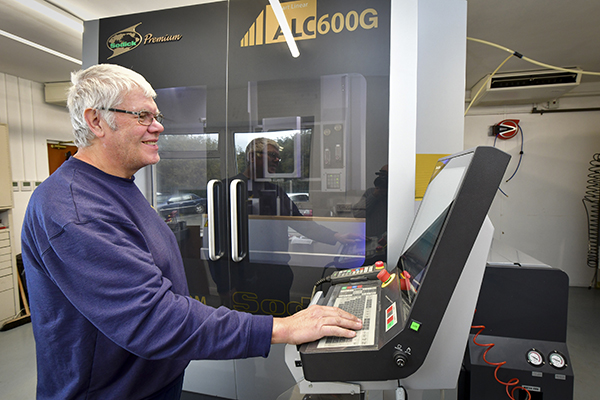
The world leader in kettle controls, Strix Ltd, has invested in the latest Sodick ALC600G wire erosion technology from Sodi-Tech EDM.

MANX THEMED PICTURE LIBRARY

As a result of its investment, the 800-employee company has improved cutting speeds by 20-30%, saved significant sums in consumables and achieved far higher levels of reliability.
Global headquarters is near Castletown on the Isle of Man, which is supported by a manufacturing site just up the road, at Ramsey, and a manufacturing/assembly facility in Guangzhou, China.
“We’ve had two wire EDMs working 24-7 for the past 18 years, so the time had come to consider making the leap to the latest technology,” explains toolroom manager John Roy. “All of our press tooling is made from carbide, so wire EDM is the only realistic way
of manufacturing.”
The new ALC600G has replaced one of the older wire EDMs on site at Strix, and been set to work producing the press tooling – punches and dies – required to produce electrical components such as the bi-metal discs that respond to steam and switch off the kettle. Press tools are often manufactured to produce two or three different components simultaneously.
“Our new Sodick wire EDM is also used to produce replacement punch and die inserts for existing press tools,” says Roy. “We certainly have no shortage of work for the machine. It now runs 24 hours a day, seven days a week. Our new Sodick has benefitted the toolmaking operation at Strix in so many ways. Not only is the cutting speed 20-30% faster than our previous machine, but it is a lot more reliable and uses far less wire.”
For further information www.sodi-techedm.co.uk

Design services available from Erodex

Paul Tardif, design manager at Erodex, explains the role that the company’s design team plays in providing design solutions to a range of engineering challenges posed by clients.

“Primarily, we are a tool design office, specialising in aerospace tooling and the design of EDM electrodes, to make various jet engine components and enable the mass production of parts. We are currently working on a range of new engine projects and new part introductions for some of our major customers.
“The designs are primarily one-off, unique designs – almost like prototype tooling, meaning that we specialise in working on new parts that are being introduced, new engines being developed, or modifications to improve existing tooling,” he adds. “Once we have designed the tooling and it has been manufactured, it can be in service for up to 20 or 30 years.”
Much of the ‘added value’ created by the Erodex design team includes developing solutions to complex problems, finding new ways to make existing processes more efficient, and designing solutions that enable a high degree of accuracy and repeatability to be achieved. Tardif adds that “the accuracy required for grinding tooling, for example, is to grind within ±0.025 mm in terms of mass production tooling, requiring around ±0.01 mm in terms of accuracy from our tooling. The customers are then able to use semi-skilled labour to load components into the tools, and can expect a really high level of repeatability, always knowing exactly where the part will sit and how it is going to clamp. The component would often be expected to repeat to that same position within 0.02 mm every single time.”
For further information www.erodex.com

A&M EDM achieves record £6m sales

Midlands-based A&M EDM propelled itself to record sales of £6.1m in 2018, a 32% increase on 2017. The company is attributing the feat largely to its investment of £750,000 in CNC machinery and equipment.

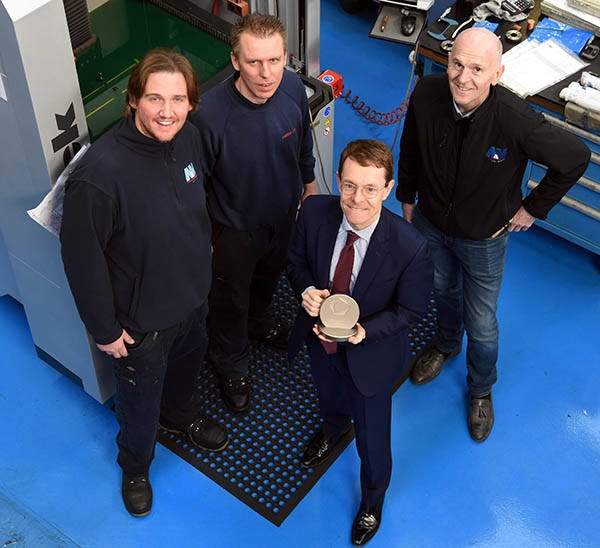
Headquartered in Smethwick, A&M EDM provides precision engineering and EDM capabilities. West Midlands Mayor, Andy Street, was invited to commission new equipment from an investment of £0.75m in 2018. Arrivals included a five-axis Hurco CNC machining centre, two spark eroders, a Hitachi handheld analyser for alloy identification and Renishaw laser calibration equipment to enable the preventative maintenance of 22 CNC machining centres. The investment was part funded by a £50,000 grant from the Black Country LEP Growing Priority Sectors fund. A&M also recruited 10 extra staff in 2018, taking the current workforce to 67.
Mayor Andy Street saw demonstrations of A&M’s CNC machining, quality inspection, and spark and wire erosion capabilities for aerospace, automotive, Formula One and production assembly customers. He commissioned the five-axis Hurco machining centre, met apprentices at work, discussed skills development and the role of advanced manufacturing and engineering as the dynamo of the West Midlands Industrial Strategy.
Street was presented with a memento of his visit, which was produced using A&M’s manufacturing capabilities. Electrodes were wired to cut the lettering, while an embossed West Midlands Combined Authority logo was created by spark eroding the required shape.
Managing director of A&M, Mark Wingfield, says: “It was a privilege to host the Mayor and discuss the importance of supply chain SMEs to competitive manufacturing in the West Midlands. We value working in partnership with the public sector; the Growing Priority Sectors grant enabled us to accelerate investment and create new engineering jobs. We will continue investing in our capabilities, skills and apprentices.”
For further information www.amedm.co.uk

University installs Excetek wire EDM

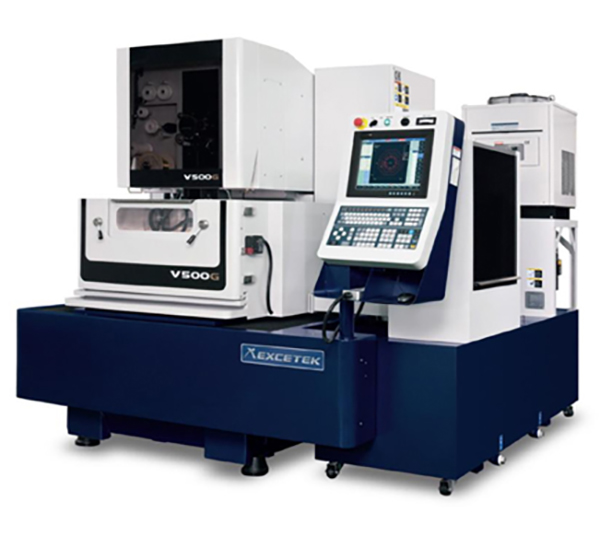
Supplied by Warwick Machine Tools, an Excetek V650 wire EDM has been installed at the University of Wolverhampton.

Graduates working on the UWR Racing team at the university, which runs a competitive car in the Formula 3 series, are using the machine to produce critical parts.
At the University of Wolverhampton, the Excetek V650 is used primarily to remove printed parts, created using additive manufacturing technology, from their supporting structures. An accurate cut must be provided in demanding conditions, with raw un-sintered powder material often left within cavities inside the component, which presents further challenges. The Excetek V650G was chosen because it can meet all these demands.
A non-contact process, wire EDM does not induce stress into the raw material; it will cut anything that is conductive. Even super alloys can be cut as easily as mild steel. Using 5-axis cutting allows different profiles to be created on the top and bottom side of the part. Components measuring up to 1000 mm can be cut on the Excetek V650.
Versatility of process is another benefit of wire EDM. For example, users can produce a gear on an Excetek EDM machine to an ‘as-ground’ finish. Conceivably, this means that users could load a heat-treated blank on the worktable, and cut the internal spline and outside gear profile such that the part would come off ready to use. For the students at Wolverhampton, this flexibility allows them to think outside the box.
For further information www.warwickmachinetools.co.uk