
GBM opts for Mitsubishi EDM

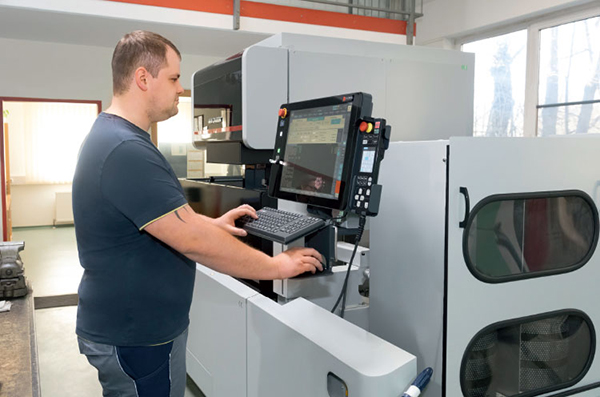
At Mattighofen, Austria-based GBM Kunststofftechnik und Formenbau GmbH, a newly installed Mitsubishi MV2400R Connect is making a genuine difference to this forward-thinking mould shop. Mitsubishi EDM machines are available in the UK from HK Technologies.

In total, some 35 injection moulding machines can be found in the halls of GBM. Be it parts for cars, medical devices or telecommunications equipment, there is very little that GBM cannot mould in plastic.
“Among the areas that is currently developing very strongly is vehicle charging equipment,” reveals managing director Roland Barth. “Extremely complex shapes are created for this, to produce wall boxes for example.”
As a result, the company recently purchased a Mitsubishi MV2400R Connect with travels of 600 x 400 x 310 mm in X, Y and Z, which is being used almost exclusively to produce injection moulds. In addition to machine’s fast cutting speed, the quality of the surfaces is an important factor for the Austrian firm.
“For us, the investment was important so that we could produce moulds faster than ever before, with surfaces that do not have to be reworked,” says Barth. “We want to continue growing and the machine will support us in our efforts.”
Barth deliberately opted for a larger machine, which is also equipped with the new D-CUBES interface. “Here I see a lot of potential for exploiting totally new possibilities in the future, particularly when producing moulds for our injection machines.”
For further information www.mitsubishi-edm.de/en
Enhanced Erowa LoadMaster range

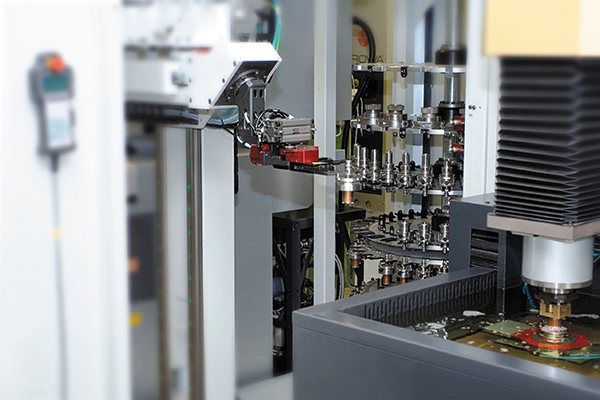
Erowa’s recently enhanced LoadMaster range, which is available in the UK from REM Systems, builds on the ability to offer the automatic loading and unloading of workpieces up to 4000 kg.

Equipped with a 360° swivel function, any position in the magazine and on the machine tool table can be reliably reached. According to the company, customers equipped with an Erowa system can typically increase productivity by a factor of five using various manufacturing technologies, including die-sink EDM.
Raw material billets, part-machined components and cast workpieces can be transferred using LoadMaster thanks to its novel kinetic system with very limited space requirement. The magazines are designed to stack vertically, with the storage positions arranged over two, three or four levels, saving on floor space and subsequently cost. Each level is optimally configured for typical workpiece sizes.
REM Systems’ managing director Ian Holbeche says: “The new LoadMaster allows manufacturing businesses that produce larger, and therefore heavier components, to increase their productivity. Typically, this might be large press-tool plates, multi-cavity injection moulds, valves and pipe fittings, as well as structural and propulsion components for aircraft.”
Operator set-up stations are integral components of LoadMaster production lines, with access via sliding doors or walk-in stations. Versions are available featuring lifting units, with rotating and tilting table, or with indexing table. The set-up positions are also accessible via overhead crane.
Erowa’s overall process control system assists the operator in the daily production flow, with clear displays of system status. Notably, the transfer unit moves between the magazines and machines on solid rails, while the grippers optimally support various application scenarios: ‘TwinFork’ double grippers for faster chip-to-chip times or ‘MultiFork’ end effector for the loading and unloading of different pallet sizes.
For further information https://remsystems.co.uk/

TEK4 building new technical centre

TEK4 plans to open a brand new, purpose-built technical centre in late summer 2019.

The facility is located in Blaby, Leicestershire, just six miles from the company’s current site. TEK4’s new centre will offer good accessibility, with the M1 motorway just 10 minutes away.
Enhanced customer facilities will be at the heart of the operation, which is set to be five times larger than TEK4’s existing site, providing the capacity to deliver up to 10 machines per month. Among specially designed areas will include those for research and development, and another for running trials and demonstrations. A temperature-controlled inspection area will also feature. The new development will facilitate continued growth at TEK4, enabling it to exceed customer expectations.
TEK4 was founded by Jason Duffin in 2002, who continues to run the business alongside a team of engineers and support staff who have underpinned the company’s success. Duffin has spent his working life developing special process technology for gas turbine component manufacture. He co-founded MJ Technologies Ltd, and was MJT’s managing director until 2001 before he left to establish TEK4. MJT subsequently became the Winbro Group.
TEK4 specialises in fast-hole drill (FHD) or high-speed drill (HSD) EDM machines for drilling straight and shaped cooling holes in aero and IGT blades, vanes, segments and other components. Solutions combine EDM and laser systems for FHD and ceramic coating ablation; laser for drilling and cutting operations; and ECM for the STEM drilling of deep cooling holes in gas turbine components.
For further information www.tek4.co.uk

EDM set to feature at gear machining event

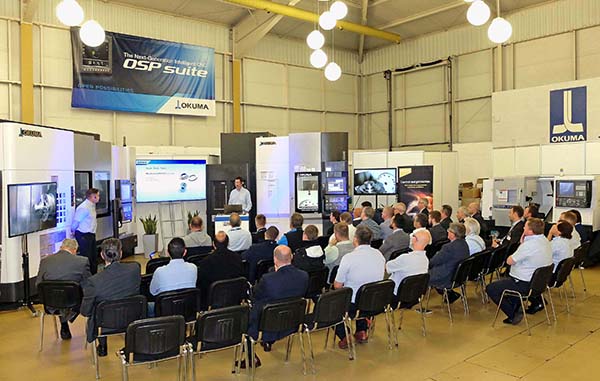
A one-day seminar and open house on the manufacturing of gears will be held at NCMT’s Coventry technical centre and showroom on 9 July.

Various production methods will be demonstrated on Japanese-built Makino and Okuma machining centres, as well as on one of the latter’s multi-tasking turn-mill machines.
Methods covered will include hobbing, power skiving and ‘InvoMilling’, which is capable of producing different gears using the same standard machine platform. Gear grinding will also feature, involving the use of NCMT’s proprietary EasyGear grinding software. Wire-cut and die-sink production solutions demonstrated on Makino EDM equipment, will be among further highlights.
The main message during the event will be the flexibility, productivity and relatively low investment cost offered by producing external and internal gear types on five-axis machining centres, multi-tasking lathes and EDM machines, coupled with short lead-times, and high levels of accuracy and repeatability.
A further focus will be the inspection of gears to verify their accuracy. Measurement will be performed in-cycle via a touch probe on an Okuma Multus multi-tasking lathe, supported by off-line inspection on a Hexagon Metrology Leitz CMM equipped with Quindos software.
Completing the exhibits will be an automated system configured for gear-blank production based on an Okuma Genos L3000 lathe fitted with a Cellro robotic system for automatically loading billets and unloading components.
Proceedings will include guest speakers such as Dr David Curtis, senior technical fellow from the Advanced Manufacturing Research Centre, and Dr Rob Frazer, head of the gear design unit at Newcastle University, who will be present on behalf of the British Gear Association.
For further information www.ncmt.co.uk

PCD package offers improved performance

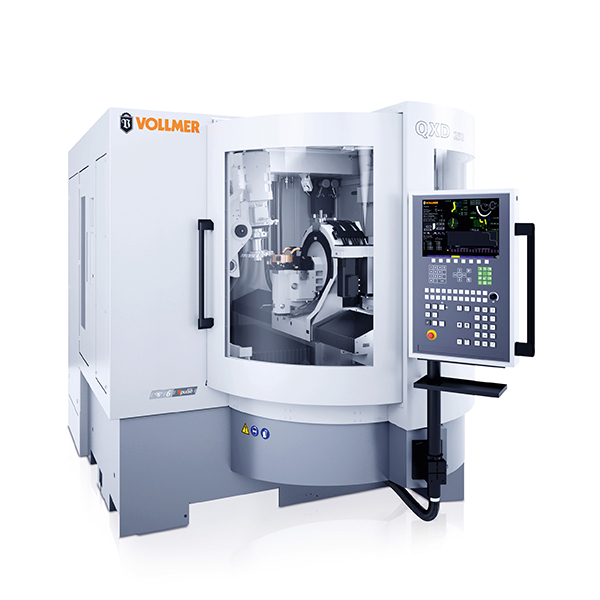
Vollmer has further optimised the machining processes for PCD (polycrystalline diamond) tools produced on its QXD 250 erosion machine.

With the company’s new performance package, Vollmer is reducing machining time and therefore increasing the efficiency of the QXD 250, largely through seamless interaction between generator technology, process parameters, gap evaluation and drive technology. The company is offering a new payment model for the package, which can be individually adapted to customer requirements.
With the QXD 250, different PCD tools can be sharpened accurately in a single set-up. The VPulse EDM generator technology ensures high surface quality at maximum material removal rates. In addition to the software available for PCD tools with inserts, the ExLevel Pro software permits hybrid sharpening (eroding and grinding) of cylindrical slugs with sintered or soldered-in PCD to produce drills, mills and reamers.
Vollmer can retrofit the package, consisting of a software and hardware component, on any QXD 250 that is being used by a customer. Implementation is performed on-site by a service technician, who checks the machine’s condition and technical requirements. Vollmer’s service also includes a test phase, during which users can test the efficiency of the performance package for their application areas on the QXD 250 without high costs or risk.
The performance package is one of the first products from Vollmer’s new V@dison digital initiative, which aims to integrate the company’s grinding and erosion machines in an IoT environment in order to help tool manufacturers implement their Industry 4.0 projects.
For further information www.vollmer-group.com