Isembard, a manufacturing start-up producing high-precision machined components for a growing number of critical industries, has recently opened a new machining facility in Milton Keynes under its franchise model.
Owned and operated by franchisees Muhammad Altalib and Guglielmo Salvatore Pellegrino, the facility opened for business in October 2026, following the installation two months earlier of two advanced multi-axis machine tools from Mills CNC.
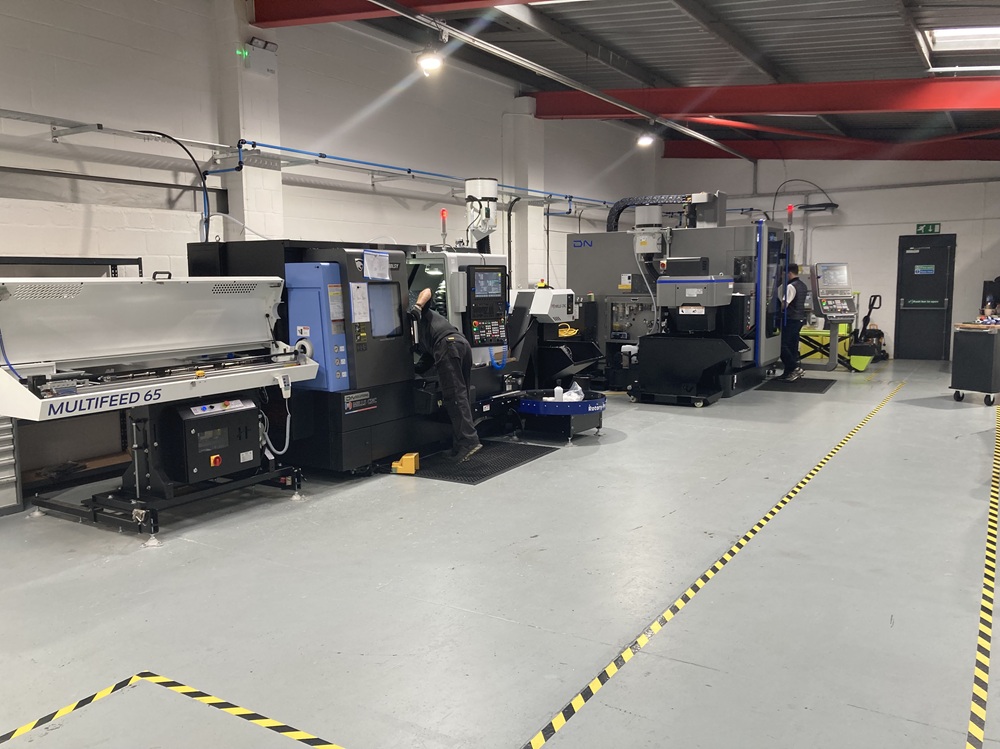
The investment comprises a DN Solutions DVF 4000 simultaneous five-axis machining centre and a Lynx 2100LSYB long-bed, sub-spindle Y-axis lathe. Both FANUC-controlled machines were installed at the company’s 2100 sq ft facility in August and, following CNC programming and applications training from Mills CNC’s technical team, are now producing high-precision components for a range of demanding, high-tech industries.
To date, components have been machined in batches of up to 50, using solid billet and bar stock to achieve tight geometrical tolerances and exacting surface finishes. Although still in its early stages, the Milton Keynes operation is already looking towards further technology investments and recruitment to increase capacity and strengthen its position within the supply chains of aerospace, defence, space, green energy and robotics customers.
Founded in 2024 by entrepreneur Alex Fitzgerald, Isembard has ambitious plans to help revitalise advanced manufacturing in Western economies. Its strategy centres on building a software-driven network of highly automated manufacturing facilities, with CNC machining at their heart, across the UK, Europe and the US.
The objective is to establish resilient, high-tech manufacturing infrastructure that offers customers a credible alternative to outsourcing production to lower-cost economies. By prioritising quality, speed and cost efficiency, Isembard aims to make domestic supply chains more responsive, competitive and dependable.
Its franchise model is important. Individual operators can establish and run their own automated machine shops, investing in equipment and recruiting local talent while benefiting from Isembard’s central resources, purchasing power, technology and commercial reach.
For Muhammad Altalib, the arrangement offered an attractive opportunity to establish a manufacturing business with the backing of a much larger organisation: “Although we have the freedom to make our own decisions, the Isembard franchise arrangement provides us with significant advantages and opportunities. Being part of the Isembard family, so to speak, not only gives us access to centrally secured machining contracts, low-cost finance and cheaper raw materials, but also enables us to tap into Isembard’s technology and applications support infrastructure when we need to.”
Altalib and business partner Guglielmo Pellegrino met Isembard founder Alex Fitzgerald in 2024. Sharing a passion for advanced manufacturing and more efficient supply chains, the three quickly recognised the potential of working together. Following a series of discussions, Altalib and Pellegrino decided to establish their own Isembard franchise.
“I’ve always had a passion for advanced manufacturing and making supply chains more responsive, efficient and resilient,” says Altalib. “The accelerated rise of artificial intelligence has put advanced manufacturing and CNC machining back on the map. From self-driving cars and customised medical devices to automated warehouses, intelligent defence systems and socially assistive robots, manufacturing plays a critical role in designing and producing the products and components that go into them. This is where the future of manufacturing is heading, and I wanted to be a part of it.”
The ambition for the Milton Keynes operation is to establish a reputation for quality, efficiency and flexibility, producing precision components significantly faster and more cost-effectively than traditional suppliers.
Isembard Milton Keynes is one of five operational UK franchises, alongside facilities in Southwark, Exeter, Portsmouth and Swindon. Further sites in Leicester, Leeds and Ossett are planned, while operations in the US, France and Germany give the wider business an increasingly international footprint.
Getting the Milton Keynes facility up and running required considerable planning and preparation. Combining the owners’ business and technology backgrounds with Isembard’s manufacturing expertise enabled the franchise to move from concept to operational status in a relatively short period.
Location was one of the first major decisions. Milton Keynes offered a strategically advantageous position, with convenient access to London, the Midlands and the universities of Oxford and Cambridge. Its proximity to the UK’s Motorsport Valley, a concentration of high-tech engineering businesses across Oxfordshire and Northamptonshire, was another important consideration.
“We planted our flag in Milton Keynes owing to the high concentration of advanced manufacturing companies already located there,” explains Altalib. “Being geographically close to a large group of potential customers made commercial sense. It would allow us to supplement the machining work and projects we receive from Isembard with other high-value, high-precision machining contracts. Access to a highly skilled labour resource, including CNC programmers and machinists, was also important for our future recruitment requirements.”
Having settled on Milton Keynes, the partners selected modern premises in Wymbush. The 2100 sq ft facility offers good accessibility, sufficient space for the initial installation and, importantly, room for future expansion.
Selecting the right machine tools was another critical decision. Rather than rushing into an investment, Altalib and Pellegrino undertook extensive research, attending exhibitions, evaluating suppliers and speaking directly to precision manufacturers about their experiences.
“We needed to get it right first time and, as a consequence, did our homework,” explains Altalib.
Mills CNC ultimately emerged as the preferred technology partner, with its reputation for customer service, technical expertise and aftersales support proving influential. The performance, precision and reliability of the DN Solutions machines it supplies were also key considerations.
The investment was particularly significant because Milton Keynes was among Isembard’s first UK franchises to become operational. Consequently, the selected machine tools have helped establish a technology blueprint for other franchisees to follow.
Following detailed discussions with Mills CNC’s sales and technical teams, alongside visits to existing Mills customers, the partners settled on the DVF 4000 and Lynx 2100LSYB. One important decision was to invest in two dedicated machines rather than a single mill-turn solution.
“Our objective throughout was to have world-class turning and milling capacity and capabilities at our disposal,” states Altalib.
The franchise model encourages operators to invest in innovative multi-tasking machine tools and integrated automation wherever possible. The aim is to consolidate operations, reduce unnecessary handling and enable components to be produced in a single set up, helping to improve productivity and shorten lead times.
The DVF 4000 is a compact simultaneous five-axis machining centre designed for complex, high-precision component production. Its specification includes an 18.5 kW, 12,000 rpm spindle, a 400 mm rotary tilting table offering a B-axis range of -30° to +110° and 360° C-axis rotation, and a 60-tool automatic tool changer.
The machine supplied to Milton Keynes is equipped with Renishaw probing systems for tool setting, in-process measurement and tool breakage detection. An automatic door also provides the potential for future automation integration.
Complementing the machining centre is the Lynx 2100LSYB, an 8-inch chuck, 65 mm bar capacity long-bed lathe. Its specification includes a 15 kW, 4500 rpm main spindle, a 12-station turret, a 5-inch sub-spindle running at up to 6000 rpm, and a Y-axis offering ±52.5 mm of travel. Driven tooling also operates at speeds of up to 6000 rpm.
To further enhance productivity, the lathe was supplied with a Hydrafeed bar feeder and rotary parts accumulator.
“We’re delighted with our investment in two state-of-the-art machines, and since their installation have been putting them through their paces,” declares Altalib. “Both machines deliver exceptional part accuracies and fast processing speeds, and are ideal for small-part production. Furthermore, owing to their multi-tasking and multi-axis capabilities, components can be made in one hit. This eliminates stop-start production and helps ensure lead-time fulfilment.”
Although still a relatively new operation, Isembard Milton Keynes is already looking beyond its initial investment. Machining processes are being continually developed and refined to improve efficiency, while further technology investments are in the pipeline to increase production capacity and capabilities. Additional recruitment will also help the business respond to growing demand.
For Altalib and Pellegrino, the combination of Isembard’s connected manufacturing network, Mills CNC’s machine tool technology and the skills of their growing team provides a solid foundation for expansion.
With its first machines now producing components and its customer base developing, the Milton Keynes franchise is taking its first steps towards a much bigger ambition: making advanced, high-precision manufacturing faster, more accessible and more competitive.
More information www.millscnc.co.uk