
Beckwood Bolsters Support With New Maintenance Programme

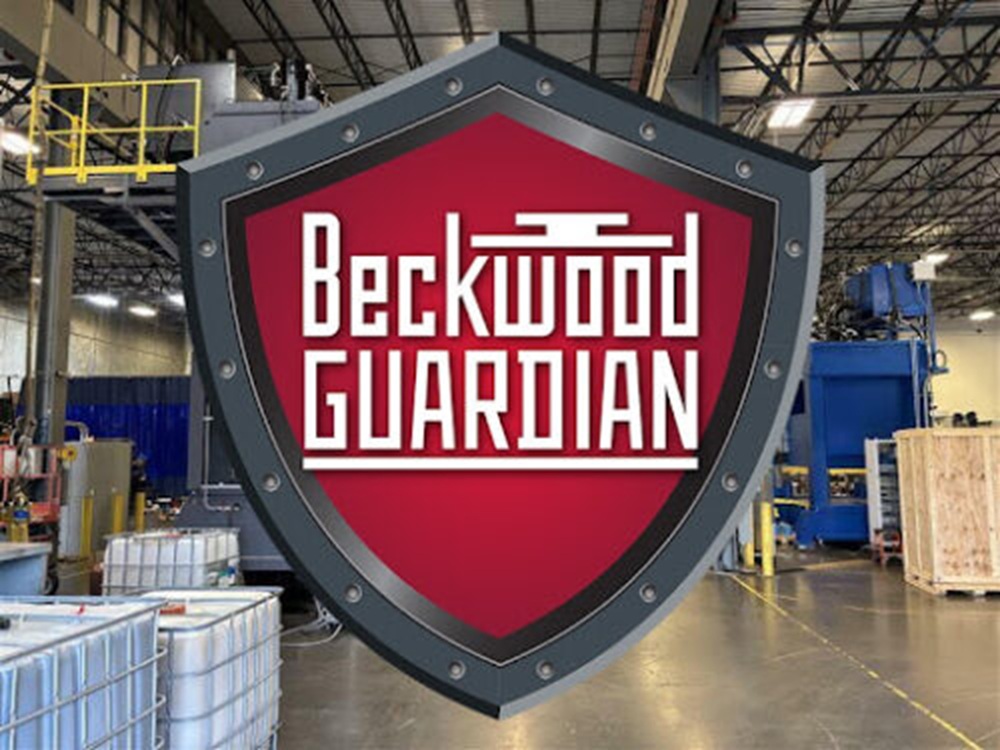
Innovations in service have always been a key focus area at Beckwood. First, there was the integrated Pre-Preventative Maintenance system. Next there was PressLink, the remote support module that allows technicians to access customer presses from anywhere in the world. Now, Beckwood has launched Guardian, describing it as the greatest defence against unplanned customer downtime.

Guardian is an all-new programme that features a selection of preventative maintenance plans, built around press service needs expressed directly by customers. To determine which packages would best bridge any existing service gaps, Beckwood customers were surveyed for their expectations, challenges and feedback on preventative maintenance programmes to date.

As a result, three new maintenance plans have been carefully crafted: a ‘Preventative Maintenance Contract’, a ‘Support Contract’ and an ‘Extended Warranty’.

The Preventative Maintenance Contract and Support Contact will each serve as tailored entry points into the Guardian ecosystem. Notably, the Preventative Maintenance Contract is geared toward a proactive approach to press health, while the Support Contract is focused on lightning-fast response times – both provided by technicians who know the specific presses of customers inside and out. Once a customer has enrolled in both programmes, they unlock access to the Extended Warranty plan which covers the cost of all replacement parts through the duration of their contract.

This new branch follows a facility expansion which added 36,000 sq ft to Beckwood’s previous work space of 56,000 sq ft. This expansion facilitated the formation of the Services and Operations department, which oversees all Guardian contracts and activities. Through a continuous investment in service capabilities, Beckwood strives to provide all customers with not just value, but peace of mind that lasts a lifetime.
More information www.beckwoodpress.com
Aerospace Forming Technology Showcased At Advanced Engineering

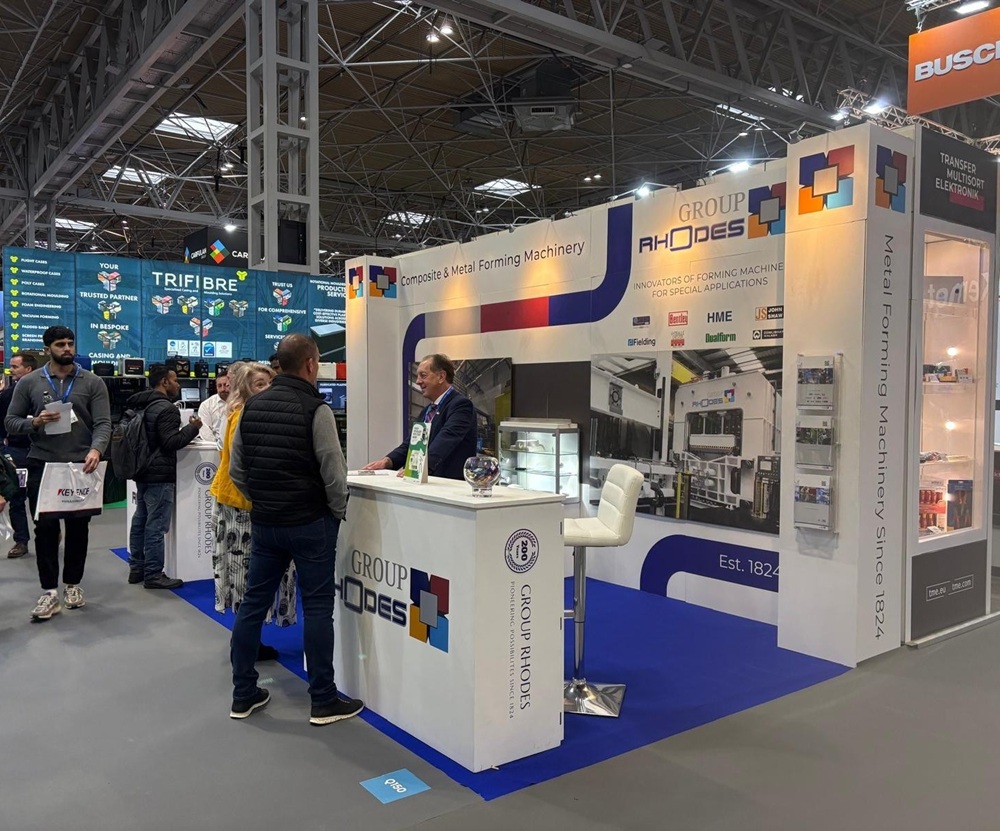
Group Rhodes, a manufacturer of hot and cold forming machinery for metals and composites, showcased its aerospace capabilities at the Advanced Engineering exhibition in Birmingham earlier this month, highlighting how its Rhodes Interform division helps manufacturers produce lighter, stronger and more complex components.

The UK-based company presented its patented superplastic forming and diffusion bonding (SPF/DB) technology alongside bespoke press solutions for composite and metal forming.

Weight reduction is a key priority for aerospace manufacturers seeking to improve fuel efficiency, reduce emissions and increase payload. Rhodes Interform designs, builds and commissions specialist forming equipment for producing lightweight structures from advanced composites, titanium and aluminium alloys, meeting the demanding tolerances of flight-critical components.

Mark Ridgway OBE, CEO of Group Rhodes, says: “Aerospace is under constant pressure to take weight and cost out of every structure, and that’s where our forming technology can really make the difference.”

Recent projects include a multi-million-pound contract to design and manufacture three bespoke hydraulic presses for forming advanced composite components used in lightweight aircraft structures. All three machines were engineered, built and commissioned by the company’s Wakefield team.

Rhodes Interform’s portfolio ranges from heated platen presses for thermoset and thermoplastic composites to high-tonnage hydraulic metal-forming presses, with options including automation, robotic handling and turnkey integration.

The company’s SPF/DB technology combines the forming and molecular bonding of titanium and aluminium alloy sheets in a single high-temperature process. Eliminating rivets, fasteners, adhesives and welds reduces component numbers, assembly costs and weight while producing strong, integrated structures.

Involved in SPF/DB since its commercialisation in the mid-1970s, Group Rhodes is now one of only a handful of companies worldwide supplying these presses. Its latest patented innovation improves forming accuracy, reduces scrap and increases productivity.
More information www.rhodesinterform.co.uk

Press Helps Sona Speed Make Flight-Critical Aero Parts Faster

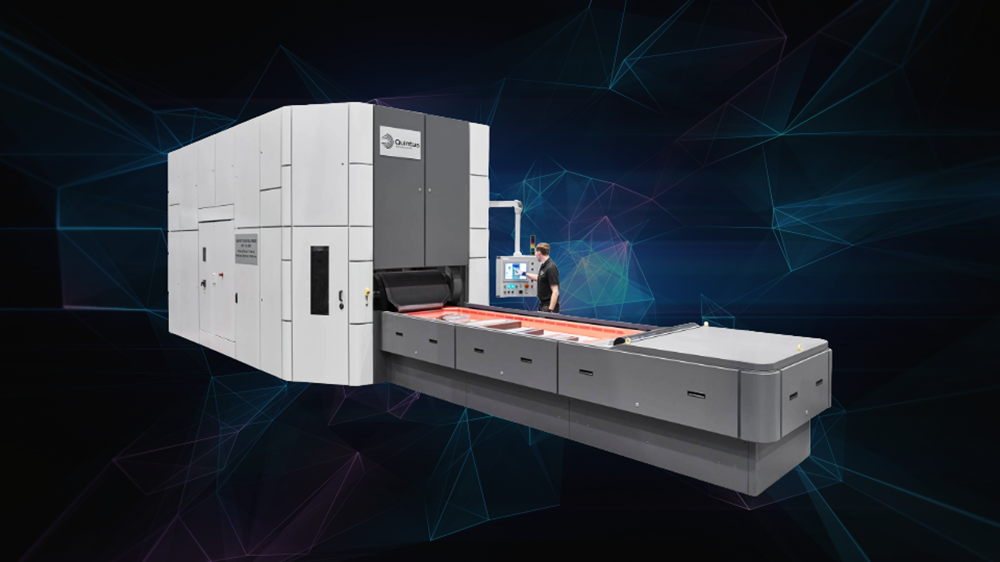
Sona Speed Pvt Ltd, a specialist in precision mechatronics manufacturing solutions, has invested in a Quintus Flexform fluid cell press to expand its capabilities in producing high-precision prototype and low-volume components for aerospace and other demanding industries. The new press will support the company’s growing role as a supplier of flight-critical components for global customers.

Reflecting rising demand for lightweight, high-strength structures used in aircraft, satellites and launch systems, Sona Speed is strengthening its forming and structural assembly capabilities.

Says general manager Bart Korff: “We’re expanding our metal forming and structural assembly capabilities to support next-generation aircraft, satellite and launch vehicle programmes. Quintus Technologies brings proven expertise in high-pressure forming solutions that meet the stringent standards required for aerospace applications. Their technology enables us to deliver consistent quality, performance and reliability to customers operating in mission-critical environments.”

The investment reflects broader industry trends toward lighter, stronger materials and faster development cycles across aerospace, defence and high-performance industrial sectors. Advanced forming technologies such as the Flexform process enable manufacturers to reduce tooling complexity, improve structural performance and accelerate product development timelines.

Sona Speed selected the Flexform press model QFC 1×3-800, capable of applying up to 800 bar of forming pressure across a 1000 x 3000 mm work area. This performance is enabled by Quintus’ wire-winding pre-stress technology, which allows consistent pressure distribution across large forming surfaces.

“Flexform is a versatile solution for manufacturing complex sheet metal components, particularly in industries where precision, speed and cost control are essential for maintaining global competitiveness,” explains Peter Henning, chief commercial officer at Quintus Technologies.
More information www.quintustechnologies.com

Die Clamping And Changing Technology For Deburring Presses

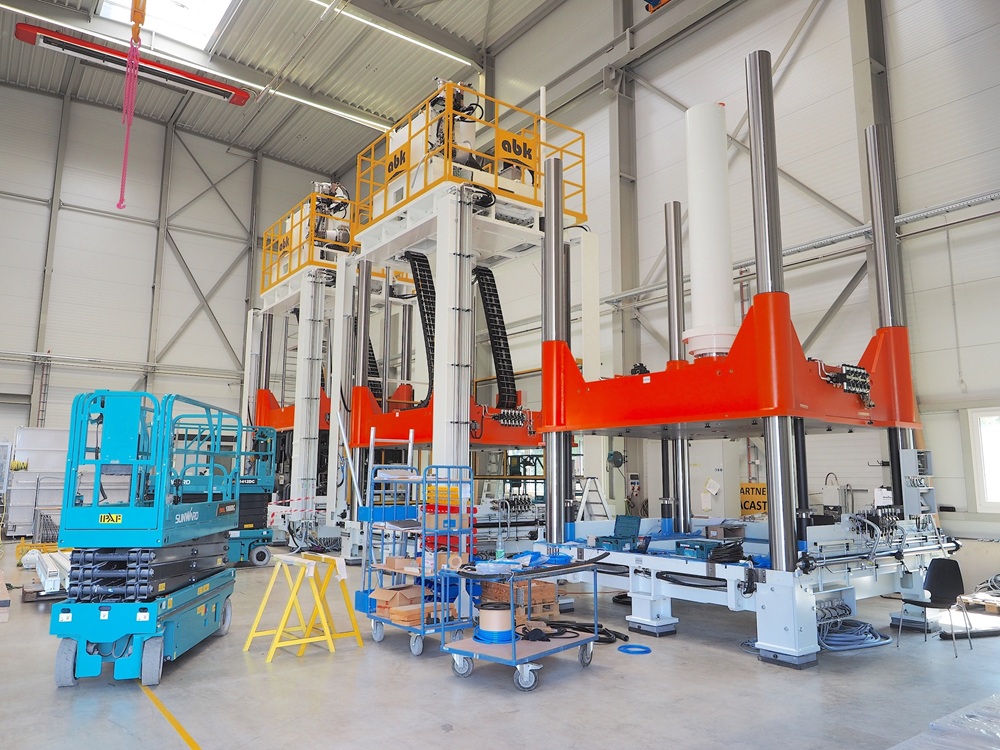
Aulbach Automation abk Pressenbau, a specialist manufacturer of deburring presses for large castings, has relied on die clamping and changing systems from Roemheld for more than a decade. The technology plays a key role in the safe and reliable post-processing of mega and gigacastings measuring several square metres.

Used by auto manufacturers including Tesla and Volvo, megacasting replaces hundreds of individual components with single-piece aluminium structures, such as vehicle underbodies and battery housings. While simplifying production and reducing weight, these large, heavy castings place considerable demands on deburring technology.

Based in Mömlingen, Germany, Aulbach Automation employs 70 people and has specialised in deburring presses for the foundry industry since 2021. By September 2025, it had delivered 23 presses for megacastings measuring more than 3 x 2.5 m.

Aulbach specifies powered die changing systems, ball and roller bars and clamping elements from Roemheld as standard on its large-format presses.

André Pfeifer, technical project manager at Aulbach Automation, lists their benefits as precision, reliability, durability, short delivery times and co-ordinated operation, alongside the supplier’s service.

Automated die changing reduces set-up times, improves process reliability and enhances operator safety. Accurate positioning and secure clamping are essential to prevent die damage, defective components and costly production interruptions.

Hydraulic double-acting swivel clamps on the press table deliver clamping forces from 60 to 412 kN, while accommodating clamping-edge tolerances of ±1.5 mm. Their pistons rotate through 45° during the clamping stroke, allowing dies to be retracted without interference.

Inductive sensors monitor release, changeover and clamping positions, while spring-loaded overload protection and manual emergency controls provide additional safeguards. Similar 90° swivel clamps secure the press ram.

All elements are centrally supplied by a Roemheld hydraulic unit, which automatically switches to energy-saving standby during production interruptions.
More information www.roemheld.de/en

Haco Group And Yawei Unveil Strategic Industrial Partnership

The Haco Group and Jiangsu Yawei Machine Tool Co Ltd officially presented their strategic industrial partnership at the EuroBLECH exhibition in Hanover last month, following a letter of intent signed earlier this year.

The agreement will see Yawei become the majority shareholder, bringing together Haco’s European engineering expertise, established brands and local market presence with Yawei’s global manufacturing scale, technology and resources.

Haco Sheet Metal and BlissBret Presses will retain their identities, market positioning and customer relationships. European engineering, automation, local service and technical expertise will remain central to the strategy, alongside continued investment in European manufacturing.

Kurt Havegeer, CEO of Haco Group, says: “This partnership gives Haco the scale and resources to accelerate what we’ve been building for decades, without losing what makes us strong.”

A key development will be the transformation of Haco’s site in Mouscron, Belgium, into the European headquarters and centre of excellence for the new Yawei-Haco industrial platform. Several activities currently spread across Belgium will be consolidated there, including R&D, engineering, management, international service, robotics and automation.

The site will also house a new international Experience Centre featuring showroom, demonstration and training facilities. The initial development phase is expected to create approximately 50 jobs, with the potential to reach 120 to 150 employees by 2029.

Notably, the partnership will serve to strengthen Haco’s existing European manufacturing base, including its major production facility in Liptovský Mikuláš, Slovakia, where production, assembly, quality control and commissioning will continue locally. The company’s plan is to expand European capabilities, not relocate production to China.

The partnership combines complementary expertise in engineering, product development, manufacturing, automation and international service, giving customers access to a broader portfolio of sheet metal processing solutions.
More information www.haco.com