
LATEST TOOLING SOLUTIONS HELP MAKE DIFFICULT MATERIALS ROUTINE

Industry research from Deloitte shows that manufacturers continue to invest heavily in improving efficiency and resilience, with greater attention on productivity, process stability and making better use of existing capacity. For global cutting tool and machining solutions specialist Sandvik Coromant, this supports its approach of working closely with customers to improve performance directly within production. The company’s ongoing partnership with Merx, a precision subcontract manufacturer based in Söderköping, Sweden, is a case in point.

Fortune Business Insights reports that the global superalloys market is projected to grow significantly from $8.78bn in 2026 to $22.44bn by 2034. As demand increases across sectors that rely on high-performance components, manufacturers require specialist knowledge, stable processes and the confidence to work with these challenging materials, something Merx has been building for decades.

Since Hans Hammargren and his co-founder started Merx in 1989, the company has grown from a small operation into an established high-precision manufacturer, supplying customers across the energy sector and other demanding industries.

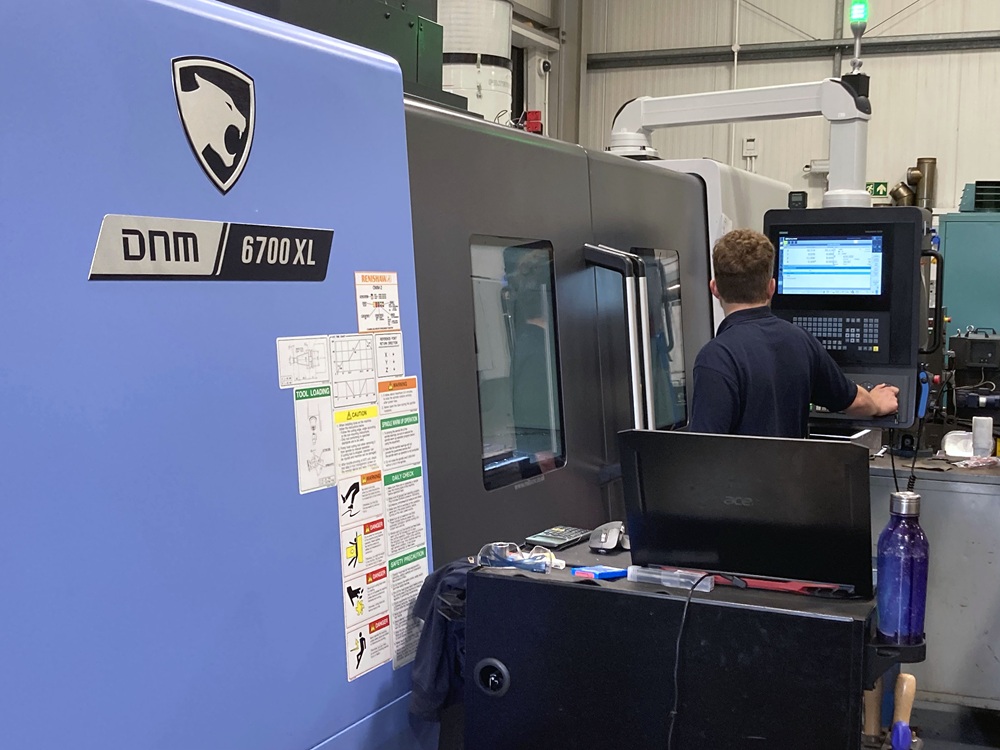
Today, Merx employs around 75 people and operates a growing number of CNC machines, producing components where reliability is critical and tolerances are often measured to the thousandth of a millimetre. The company is now preparing for its next phase of growth, with plans to expand its facility by around 1000 m² and add more machines to increase production capacity.

“We’re growing, and we need to keep improving at the same time,” says Hammargren. “That applies to both production and how we work with our partners.”

A key part of Merx’s offering is its ability to machine complex materials that many subcontract manufacturers choose not to work with. One of the most demanding materials is Inconel 718, a heat-resistant superalloy widely used in turbine and energy applications, and where components need to perform reliably under extreme conditions.

The material’s strength and resistance to heat make it suitable for these environments, but the same properties create challenges in machining. Cutting forces are high, heat builds quickly at the cutting edge and tool wear occurs quickly, often reducing tool life to only a few minutes. This places pressure on both process stability and cost, where even small inefficiencies can have a significant impact on overall production.

“It’s a material many companies say no to,” adds Hammargren. “For us, it’s part of what we do, but it requires the right approach.”

Merx has worked with Sandvik Coromant in different ways since its early years, initially through distributors and later through direct collaboration. In recent years, the relationship has developed further, moving from a traditional supplier setup to a more integrated partnership.

Long-term relationships are important in this industry,” remarks Haris Karsic, account manager at Sandvik Coromant. “It’s through ongoing collaboration that you build an understanding of the customer’s production and can make improvements that actually hold up over time.”

This evolved collaboration has been driven by a combination of improved agreements and increased technical involvement. Engineers from Sandvik Coromant now visit the site regularly, working directly with Merx’s production teams to test tools, optimise parameters and identify improvements.

“It’s a very hands-on collaboration,” explains Hammargren. “They’re here in our production environment, working with our people and helping us solve real problems.”

The impact of this partnership is particularly clear in the machining of Inconel 718, where the introduction of Sandvik Coromant’s CoroDrill DE10, an exchangeable-tip drill for high-volume hole making, has led to measurable improvements in performance. Trials carried out in production showed a 48% increase in productivity, alongside a 32% reduction in cycle time per component.

What’s more, the total cost per component was reduced by approximately 51%. This saving was achieved through a combination of longer tool life, improved cutting data and more stable machining conditions.

Tool life doubled during testing, increasing from 20 to 40 components per cutting edge, while engagement time per component decreased from 1 minute 31 seconds to 0.93 minutes. These changes allow more parts to be produced in less time, improving both output and cost efficiency.

“When you look at the total economy, it becomes very clear,” says Hammargren. “It’s not about the price of a single tool, but how much you can produce and how stable the process is.”

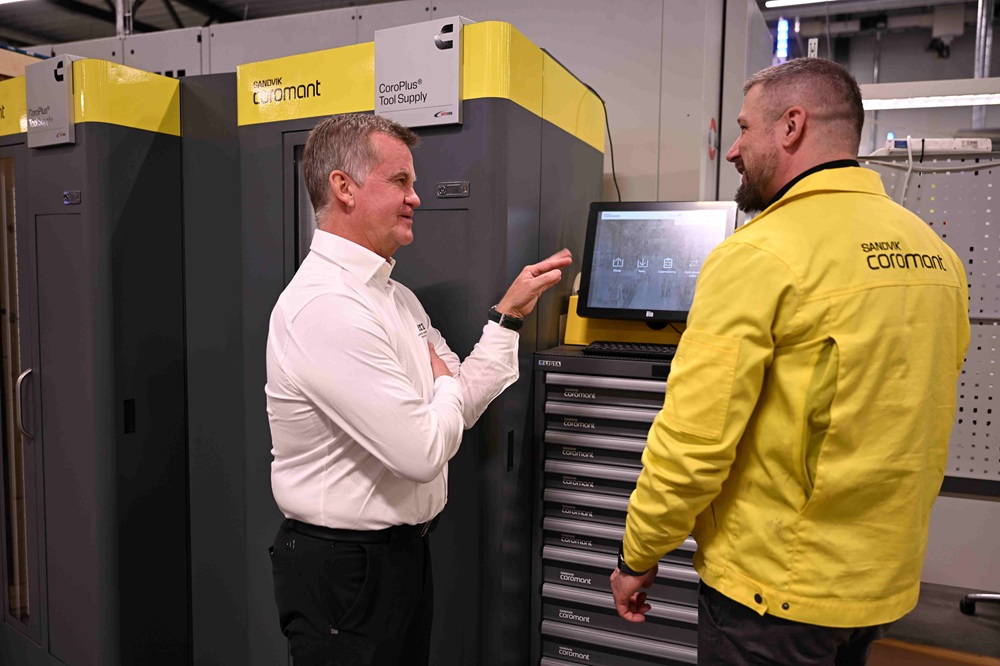
In addition to cutting performance, the collaboration has focused on improving how tools are managed and used within production. One of the changes has been the introduction of Sandvik Coromant’s CoroPlus Tool Supply tool inventory system, which provides controlled access to tools and detailed usage tracking.

The system has improved organisation on the shop floor by allowing operators to access specific tools quickly and efficiently. Unlike previous solutions, where entire drawers were opened, the new system provides access to individual compartments, making it easier to locate the correct tool and reducing unnecessary handling time.

“It’s much clearer and easier to use,” adds Hammargren. “Our operators prefer it, and it saves time in daily work.”

The system also provides more detailed reporting, giving better visibility into tool consumption and usage patterns. This capability allows Merx to monitor costs more closely and make more informed decisions about inventory and process improvements.

The collaboration has also introduced measures that contribute to more efficient use of materials and resources. Through Sandvik Coromant’s buyback programme, used carbide tools are returned and reprocessed, reducing waste and supporting a more circular approach to production.

Reconditioning services are also used to extend tool life, allowing tools to be reused without compromising performance. While the focus remains on efficiency and cost, these steps also help reduce waste and lower the overall environmental impact of machining operations.

“Sandvik Coromant has encouraged the recycling of cemented carbide for several decades,” notes Karsic. “Recovering and reusing materials is a practical way to reduce waste while maintaining performance, and it’s something we continue to develop together with our customers.”

Merx is continuing to expand its operations, with increased production space and additional machines planned over the coming years. As capacity grows, maintaining consistent performance across all processes becomes increasingly important.

The company is therefore continuing to work closely with Sandvik Coromant to evaluate new tooling solutions and refine existing processes step by step. Changes are introduced only when they deliver measurable improvements, ensuring that production remains stable while performance improves.

For Merx, the relationship with Sandvik Coromant is based on ongoing cooperation rather than individual projects. The combination of technical support, on-site collaboration and proven results has helped strengthen production in some of the most demanding applications.

“The technical competence and the support we receive are the most important factors,” states Hammargren. “That’s what helps us move forward.”

As manufacturing requirements continue to evolve, this type of collaboration is becoming increasingly important. For Merx, it provides a practical way to improve performance while supporting long-term growth in a competitive and demanding industry.

With the global superalloys market continuing to grow, manufacturers working with demanding materials like Inconel 718 will face increasing pressure to deliver both precision and efficiency. Success depends not only on the right tools, but also on specialist knowledge, stable processes and the right people behind them, exactly the kind of long-term partnership Merx has built with Sandvik Coromant.

More information www.sandvik.coromant.com

Funding for project to 3D-print superalloy jet engine parts

Alloyed Ltd has secured funding from the Aerospace Technology Institute (ATI) Programme for a £1m project to accelerate development of ABD-1000AM, a next-generation nickel-based superalloy designed specifically for additive manufacturing.

The project, delivered in collaboration with aircraft engine specialist ITP Aero and Cranfield University, aims to further enhance the material’s performance and manufacturing readiness. ABD-1000AM has been engineered to withstand the laser powder bed fusion process without cracking, overcoming a key challenge associated with high-temperature nickel alloys.

The material is expected to play an important role in future ultra-efficient jet engines, where complex, lightweight components must operate reliably in the extreme temperatures and harsh conditions found within combustion systems.

Support from the ATI Programme will help accelerate adoption of high-performance 3D-printed aerospace components and strengthen the UK’s position in advanced manufacturing technologies.

“Alloyed has been fortunate to partner with the ATI in several key technology areas, ranging from new material design to digital software platforms that support additive manufacturing adoption,” says Dr David Crudden, chief metallurgist and head of new market development at Alloyed. “ABD-1000AM is the world’s highest-temperature nickel-based superalloy designed for additive manufacture. We’ve identified significant demand for the material and believe it has the potential to be a game-changing technology for gas turbines in aerospace propulsion and industrial power generation.”

Cranfield University will contribute its expertise in high-temperature materials degradation and protective coatings, while ITP Aero will provide specialist knowledge in advanced combustor technologies for commercial and defence aviation applications.

Rob Mitchell, director of engineering at ITP Aero UK, says the project demonstrates the value of collaboration between academia, SMEs and industrial partners in shaping the future of aerospace technology and accelerating the development of next-generation propulsion systems.

More information www.alloyed.com

HII places order for second Nikon SLM Solutions NXG 600E

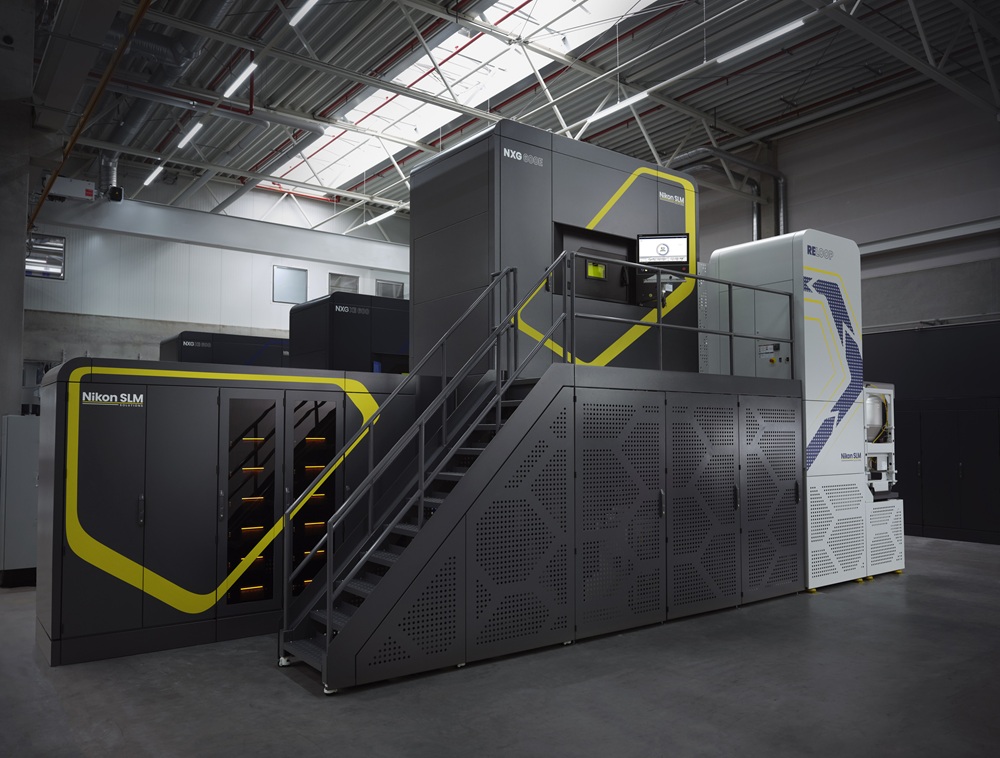
Nikon SLM Solutions, a global specialist in laser powder bed fusion (L-PBF) metal additive manufacturing and a unit of Nikon Advanced Manufacturing, reports that HII’s Newport News Shipbuilding (NNS) division has placed a second NXG 600E order. The move further strengthens its advanced manufacturing capabilities in support of US Navy shipbuilding and the Maritime Industrial Base (MIB).

The order builds on a previously announced NXG 600E acquisition and reflects HII’s continued investment in large-format metal additive manufacturing to enable production of large, complex components and replacement of legacy castings for critical naval applications. Through close collaboration with HII, Nikon SLM Solutions will lead parameter development and process maturation for L-PBF production of NiAlBr components, expanding material capability for additive manufacturing within US Navy supply chains and supporting long-term maritime readiness.

“This second NXG 600E order reflects HII’s leadership and long-term commitment to advancing the maritime industrial base through additive manufacturing,” says Hamid Zarringhalam, CEO of Nikon Advanced Manufacturing and chairman of the board at Nikon SLM Solutions.

He adds: “Expanding critical materials capabilities such as nickel-aluminium-bronze is a foundational part of Nikon Advanced Manufacturing’s holistic approach, combining scalable platforms, material and process development, and US-based production and support. Together with HII, we’re enabling additive manufacturing to move from isolated applications to a repeatable, industrial capability that supports US Navy shipbuilding at scale.”

More information www.nikon-slm-solutions.com

Snowbird Technologies integrates Meltio Engine Blue

Snowbird Technologies and Meltio have unveiled a next-generation containerised hybrid manufacturing system designed to produce and repair critical components directly at the point of need for defence applications.

The solution combines Snowbird’s deployable SAMM Tech platform with the Meltio Engine Blue, creating a ruggedised manufacturing cell that integrates additive and subtractive processes within a transportable container. Designed for rapid deployment, the system enables military personnel to manufacture, repair and replace components in remote and austere environments, reducing reliance on traditional supply chains.

Compatible with existing military logistics infrastructure, the platform is engineered to operate in challenging land and maritime conditions. It supports a wide range of industrial metals, including aluminium, titanium and marine-grade bronze, allowing the production and repair of structural and functional components essential to defence and naval operations.

The hybrid system combines metal and polymer processing capabilities while providing the safety, reliability and flexibility required for deployed environments. By bringing manufacturing closer to the point of use, it helps reduce lead times, minimise material waste and improve operational readiness.

The collaboration builds on proven field experience. Snowbird’s technology has already demonstrated its value during naval operations, including the repair of a reverse osmosis pump aboard a US Navy vessel, restoring freshwater generation capabilities within hours and avoiding an early return to port.

“This collaboration further validates the role of laser-wire directed energy deposition technology in demanding defence environments,” says Scott Morse, chief executive of Snowbird Technologies. “By integrating the Meltio Engine Blue into our next-generation SAMM Tech platform, we can deliver reliable hybrid manufacturing where traditional infrastructure is unavailable.”

Gabriel Ortiz, Americas Channel Manager at Meltio, adds: “Defence organisations require manufacturing solutions that are reliable, flexible and deployable. This collaboration demonstrates how additive manufacturing can strengthen operational readiness in the field.”

More information www.meltio3d.com

Stratasys helps Subaru cut 50% from tool development time

Stratasys reports that Subaru of America is accelerating automotive tooling development using the new T25 High Speed Head for the Stratasys F770 3D printer, cutting development times by more than 50% while reducing costs.

Among the first companies to adopt the technology, Subaru’s engineering teams use the T25 high-speed head to support the development of accessories and installation tooling. By bringing more production in-house, the automaker has reduced overall prototyping and tooling costs by 70%, while a 36-inch tool can now be produced almost twice as fast compared with the standard print head.

The increased throughput has enabled Subaru to consolidate tooling production on its Stratasys F770 platform, improving repeatability and part quality while providing a faster response to urgent manufacturing requirements.

“Being able to get the enhanced throughput with the F770 has made for a more reliable and robust operation,” says Matt Daroff, project engineering manager at Subaru of America. “Getting parts to our internal customers earlier gives them an opportunity to identify things we may not have caught in development, helping us make corrections sooner and minimise wasted time and material.”

Subaru’s experience highlights the potential of the T25 high-speed head, which delivers print speeds up to 2.3 times faster on large-format components while maintaining the quality required for industrial applications. The technology is designed to help manufacturers accelerate tooling production, shorten lead times and improve flexibility across prototyping and production workflows.

It also offers an alternative to traditional tooling methods, which can involve lengthy lead times, high machining costs and reliance on external suppliers.

“Our customers want the ability to move fast without sacrificing quality or incurring unnecessary costs,” says Rich Garrity, chief industrial business officer at Stratasys. “The T25 High Speed Head delivers exactly that.”

More information www.stratasys.com