
Rising to the occasion

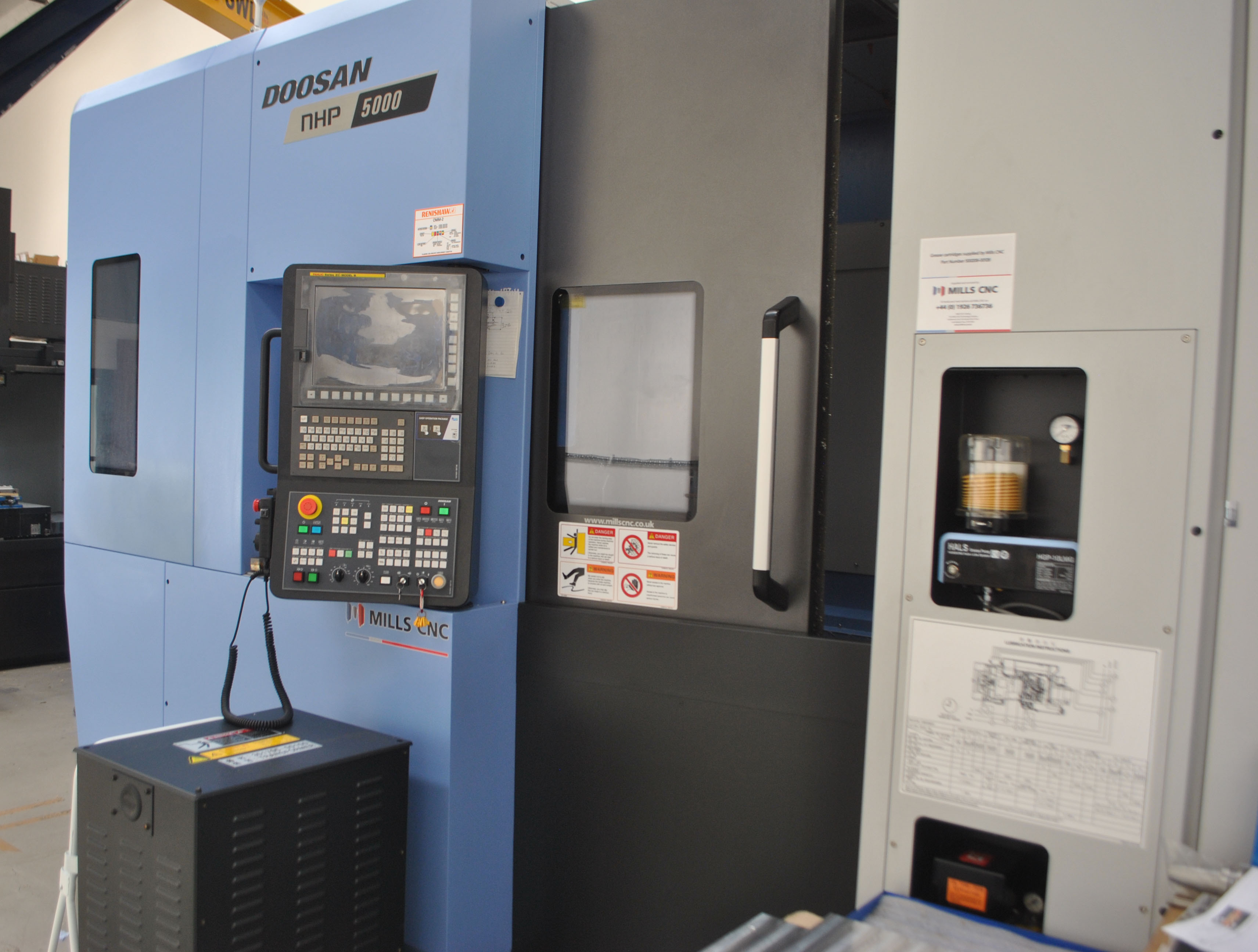
Mills CNC, the exclusive distributor of Doosan machine tools in the UK and Ireland, has recently supplied Peterborough-based PJ Innovations Ltd, a leading bakery equipment manufacturing specialist, with three new vertical machining centres and a new multi-tasking lathe.

The four machines, now installed at the company’s 7500 sq ft facility in Market Deeping, comprise a large-capacity DNM 750 II machining centre, a Puma GT 3100LM lathe equipped with a C axis and driven tooling capabilities (both delivered to the company in March 2019 as part of a turnkey solution) and two DNM 6700 machining centres that were acquired in October 2020 and June 2021 respectively.

The four machines provide PJ Innovations with state-of-the-art machining capabilities and are the centrepiece of the machine shop facility that was established in 2019 with the primary purpose of enabling the company to machine a range of specific parts for its heavy-duty Dough Divider Rounder machines.

Explains Peter Jackson, PJ Innovations’ owner and managing director: “PJ Innovations was established in 2014. In the early days we focused our efforts and resources on the design and assembly of our Dough Divider Rounder machines; as a consequence, we outsourced all of our machining requirements to a number of precision engineering specialists.”

While this arrangement proved satisfactory in the short term, it did create some issues, primarily concerning quality, lead-time fulfilment and costs.

“As demand for our Dough Divider Rounders increased, not just throughout the UK but in Europe and the US, we made the strategic business decision to exercise more control over all our manufacturing processes,” says Jackson. “To ensure the ready availability of high-quality machined components for new Divider Rounder machines, and to satisfy the demands for running a responsive and ‘best-in-class’ customer spares and replacement parts operation, we decided to lessen our reliance on outsourcing and create our own in-house machine shop to meet future machining demands and requirements.”

However, as there are hundreds of machined parts in every Dough Divider Rounder, the company first identified and prioritised specific parts to machine. These parts had a number of things in common: similar size dimensions; high accuracy and exacting surface finish requirements; complex profiles and features; long set up and cycle times; and high value.

Identifying the range of parts to machine in-house was one thing. Acquiring the appropriate machine tool technologies and creating the production processes to machine them was quite another.

Remembers Nick Lormor, PJ Innovations’ general manager: “It was a steep learning curve because not only did we have to identify, and then invest in, the right machine tools, we also needed to design and develop robust and reliable processes to get the most from the machines and manufacture precision components efficiently and cost-competitively. It became evident, quite quickly, that we needed a turnkey solution and that we also needed to identify a proven partner who could help us design and implement one.”

To look at the latest and most advanced machine tool technologies on the market and help identify a suitable turnkey partner, the company attended the MACH 2018 exhibition in Birmingham. It was here that the relationship with Mills CNC began.

Says Lormor: “We approached a number of companies at the event. Not all provided turnkey/process improvement solutions but, from those that did, we preferred the proactive approach adopted by Mills CNC. We also liked the look of Doosan machine tools and, as such, we arranged to meet after MACH to discuss our requirements in more detail and to scope out the project.”

In 2019, a large-capacity, Fanuc-controlled Doosan DNM 750 II vertical machining centre equipped with a 8000 rpm high-torque BT40 spindle and a Nikken 260 rotary table with a TAT support unit was installed in PJ Innovations’ machine shop facility. Also arriving was a 12”-chuck Doosan Puma GT 3100LM multi-tasking lathe equipped with a 2800 rpm spindle, a C axis, driven tooling capability and a hydraulic steady rest.

Both machines were delivered as part of a turnkey solution designed and developed by Mills CNC’s pre-sales application engineers over a number of months in conjunction with production staff from PJ Innovations.

“We use the two Doosans to machine performance-critical core parts of our Divider Rounder machines – namely base plates [part of the top box assembly] on the DNM 750 II, and long shaft/cylindrical part segments [part of the rotating head assembly] on the Puma GT 3100LM,” explains Lormor.

The base plates and segments can vary in size and specification, according to customer requirements, but all are made from cast iron or 316 stainless steel and involve high metal removal rates achieved though high-accuracy roughing operations. These precision parts are machined to tight to tolerances, typically to a couple of thousandths of an inch.

Says Lormor: “Key elements and features in the machining processes, developed with Mills CNC, involved innovative work holding and the use of non-conventional tooling such as bespoke angled-head cutters. Mills’ knowledge and expertise has been invaluable in helping design a robust, reliable and repeatable machining process for these parts.”

The success of the first turnkey project saw the company increase its headcount and invest in two more Doosan machines in 2020 and 2021 respectively. These two new machines, both Fanuc-controlled DNM 6700 vertical machining centres with 12,000 rpm spindles and 30 position ATCs, are being used to machine different Dough Divider Rounder parts, such as hoppers.

Says Jackson: “Creating the machine shop has been a successful venture and we are looking to increase its capacity and capabilities still further in the future so that we can machine more parts in house. Watch this space.”

PJ Innovations has created an impressive, high-productivity machine shop from a standing start. To enable it to quickly exploit the new machine tool technologies, the company took advantage of the training courses provided by the CNC Training Academy – Mills CNC’s independently operated training division.

For further information
www.millscnc.co.uk
Productivity gains provided by Vericut

With an impressive machine shop that equals many of the motorsport teams it supplies, Blackmore Precision Engineering has invested in a selection of advanced manufacturing equipment to produce complex, tight-tolerance components. Helping the company achieve its promised lead times is Vericut CNC simulation and optimisation software from CGTech.

Kidlington-based Blackmore Precision’s 12,000 sq ft facility is equipped with a range of five-axis CNC machining centres: three Matsuura MAM 72 machines (each with 32 pallet stations), four DMG Mori DMU 50 modes (some of which feature automated pallet changing) and a DMU 70 for larger parts. The company’s immaculate machine shop has grown and developed rapidly since Brendan Blackmore started the business back in 2005.

“Back then,” recalls company director Jeremy Gray, “Brendan was based in a small unit where he used a machining centre and CADCAM software to successfully produce parts on a quick turnaround for Formula One teams and other motorsports customers. Due to high demand, additional staff and machine tools followed, with a move to a larger unit before relocating to our existing site in 2010.”

Bringing his general management experience to the company Gray joined Brendan Blackmore, who still owns the business, in 2008.

“Initially it was all about turning parts around very quickly; we were accustomed to having drawings arrive on a Friday and having to supply parts on the Monday,” says Gray. “We still do this today, but in addition, we go through the rigorous inspection criteria that is required in every industry sector.”

Since the business made the decision to invest in Vericut simulation and optimisation software from CGTech in early 2021, it has further improved the efficient turnaround of customer parts.

“We had looked at Vericut in the past – however, when two new team members joined, both of whom had prior experience with the software, we were persuaded that was the way forward,” explains Gray. “From a business perspective, investing in Vericut has been very impressive right from the start. Having the whole CGTech team, from sales to training, help get everything in place very quickly, has been exceptional. Thanks should also be given to technical support for getting all our machines modelled and set up in the software.”

Lead CNC programmer Jan Plovucha was a catalyst for the application of Vericut at Blackmore Precision Engineering. For CADCAM, the company uses Open Mind’s HyperMill software, which has a direct interface with Vericut to import all of the necessary detail, including the Lang high-pressure clamping system and zero-point plates used across the shop floor. The goal is to use the experience of the programmers to ‘hit’ the component in one.

Says Plovucha: “We can rely on Vericut, so our prove-out time has dropped dramatically. This is vital as we’re running small batches of components with complex geometries, and we do not keep parts on file. Each job is treated as a new job, so every part gets the Vericut treatment each time because it may not be run on the same machine or by the same machinist.”

In fact, Vericut substantiated its value in the very first week as one job planned for a DMU 50 machine was identified as exceeding the limits of the machine tool.

“Previously, the machine would have been set up with the tools and run until it encountered this issue,” says Plovucha. “Then it would need to be broken down and reset on a different machine, losing time and possibly accuracy as we try to match the datum points.”

He continues: “We use the Autodiff module to check the parts for excess stock material and eliminate gouging where the CAM program may want to go through the part stock material. Vericut is so good we don’t think about some of these problems anymore, and the technical support and training provided is first class.”

At around 25% of the company’s annual turnover, motorsport is still an important market, but the business has broadened its customer base and diversified over the years. Many businesses supplying the various Formula One teams in the UK and beyond understand the cyclic nature of the industry, which has fantastic opportunities during the ‘car build’ that lasts for about 5 or 6 months. However, for the company to remain busy throughout the year requires demand from other industries.

“We targeted work that matched our capabilities, and now supply Rolls-Royce Aerospace, Jaguar, Bentley and many tier-one automotive companies,” says Gray. “We also do a lot of scientific and instrumentation work; here in Oxfordshire there are many start-up companies that spin out of the university.”

Metallic materials cut by Blackmore include aluminium, titanium and Inconel, as well as mild and stainless steels, while engineering and glass-filled plastics are also precision machined. Cycle times vary between 30 minutes for a simpler aluminium part to around 30 hours for a complex casing cut from titanium.

Volumes are never excessive, although the automotive batches at up to 100 parts are much higher than those demanded by motorsport customers.

“We may have suspension parts for Jaguar and they could be batches of around 70, but they also do a lot of special builds and vintage cars, and that can be as low as batches of 10 or so,” explains Gray. “The work is certainly very interesting, and the rising demand of EV will bring lots of challenges, but it’s a big market going forward with lots of opportunities.”

He concludes: “We’re hungry to get bigger and carry on varying the customer base to a level we can still handle and give the service that people require. To do this we try to organise things really well, so everything is always available, like the consignment tools we hold here in a vending system. If you only have a few days to complete an order, you don’t want to spend an hour looking for a tool – so that’s all part of what we do here. Vericut has been an important link that allows us to deliver quickly when required, and always reliably. The software certainly has added benefits that we didn’t consider beforehand.”

For further information
www.cgtech.co.uk

ITC gives cutting edge to Game of Thrones

With almost 20 years in business and thousands of successful projects undertaken, Cutting Edge Designs specialises in routing, trade signage, acrylic fabrication, panelling, wood and laser cutting, printing, 3D carving, finishing, assembly, and CAD design. Since its inception, the Newry-based company has been working closely with the cutting tool experts at Industrial Tooling Corporation (ITC) to complete an extraordinary number of high-profile projects.

Founded by David Hogg, Cutting Edge Designs was set up in a small room at the back of his family’s furniture business with a single CNC routing machine. Now, the company can take credit for designing, machining and delivering unique projects for some of the most recognised brands in the world. When the first Tekcel routing machine arrived more than 15 years ago, the company turned to ITC, not only for its cutting tools, but also the company’s technical support and service.

Commenting upon the Northern Ireland company’s journey, Hogg recalls: “Prior to starting the business, I worked at a sign-making factory that was using ITC cutting tools, so I was already aware of the range of products and services available. When Cutting Edge Designs started up, we immediately turned to ITC for their expertise and extensive product ranges. The supplier of our routing machines provided alternate cutting tools when we began and, like other cutting tools that we have tried down the years, none have matched the performance of ITC.”

The company machines a vast array of materials that range from wood, veneer, MDF, plastics, metals, rubber, composite and much more. For every project and every material, Sally Hunt from ITC has been on-hand with technical support.

“During the early years of our business, Sally was fantastic at providing technical support with regard to what tools we should use on specific materials, as well as the speeds and feeds required to optimise machining performance and eliminate vibration,” says Hogg. “Over the years, our ever-increasing expertise relies less upon this technical input. While it’s always important to have technical expertise from our cutting tool supplier, nowadays the key factor is service and supply. From this perspective, ITC always has cutting tools in stock, supplied with next-day delivery. This service is absolutely first class, and it is why ITC are the best cutting tool supplier in the industry.”

Regarding some of the projects and brands the company has worked with, the list includes names like Ferrari, Guinness, M&S, Liverpool Football Club, Subway and KFC, through to famous artists and sculptors, as well as TV and movie companies. Two prestigious projects the company has worked on include the Game of Thrones television series and the Burning Temple for artist David Best – all machined with ITC cutting tools. In Derry, there has been an annual tradition for more than 40 years of burning bonfires – and in the process, protestants, catholics and the IRA would leave both their weapons and grievances outside, enter with respect and greet each other – ready to move on.

Working with show organisers Artichoke and David Best, Cutting Edge Designs was commissioned to cut 16 designs, each in a large quantity with over 1500 parts being cut from many of the 8 x 4 ft sheets of birch wood. Employing all three of its routing machines to the project and a variation of ITC cutting tools, Cutting Edge Designs estimates more than 400,000 cuts took place in the project’s three-month timeframe.

Unlike the Burning Temple that, like its name suggests, was burnt to the ground, the small business also worked with HBO Studios and Tourism Ireland in the creation of beech wood doors for the sixth series of Game of Thrones. Again, ITC was integral to the project. Produced from trees downed by Storm Gertrude in a location known as the Dark Hedges, Cutting Edge Designs produced 10 doors with each one incorporating designs, iconic symbols and references from the episodes. Receiving the artwork and 3D models, the subcontractor converted the files into CAM models and applied ITC single-flute routing tools and its Tekcel router to the task.

“We decided on using an ITC 12 mm diameter ball-nose tool for our initial rough cutting,” explains Hogg. “This removed the excess material, making it easier and more efficient for the smaller tools to do the finer details. A 90° wood-cut angle was also implemented to prevent lifting or splitting of the wood along the grain. The rough-cut cycle took about 6 hours per door. Following this, we utilised ITC’s 3 mm diameter ball-nose cutter to achieve all the important finer details, machining with a step-over rate of 0.2 to 0.3 mm. This fine detail work took an average of 50 hours per door to complete. When each door was finish-machined, it was sanded and professionally stained by one of Game of Thrones’ set painters.

For the majority of the machining, Cutting Edge Designs applied ITC’s 180 Series of solid-carbide tools, as their ability to prolong tool life, perform at higher speeds and feeds, and reduce cycle times is a huge benefit. For finish-machining, the company applied ITC’s 180-1181-10-A-XL single-flute cutting tool, a 3 mm diameter tool that is said to demonstrate exceptional tool life and rigidity. These attributes are credit to its reinforced 6 mm diameter shank, 10 mm length of cut and 30° helix geometry produced from an ultra-wear resistant micro-grain carbide.

Concluding on the relationship with ITC, Hogg says: “The ITC tools perform exceptionally well: we use everything from routers and engraving tools through to ball-nose cutters, drills, compression spirals and special tools. The range is extremely diverse, the quality is unbeatable, and the service is a cut above anything from any other tooling company. Regardless of the material we are cutting, ITC has a tool and a solution for our business.”

For further information
www.itc-ltd.co.uk

Two new machines: two turnkey solutions

Mills CNC, the exclusive distributor of Doosan machine tools in the UK and Ireland, has supplied precision subcontract specialist – NuMachine Ltd – with two new five-axis machining centres. The machines, a VCF 850LSR and a DVF 6500, are now in place at the company’s 10,000 sq ft facility in Hereford, where they are producing small-batch cast aluminium automotive components required by sister company, Coventry-based Sarginsons Industries.

Explains NuMachines’ managing director, Brandon Davies: “Although we’re an independent precision subcontract engineering company in our own right, some 30-40% of our business, year-on-year, derives from Sarginsons. The strong and mutually beneficial relationship between both companies has enabled us to build up significant in-house knowledge and expertise in machining lightweight components for those sectors served by Sarginsons, the automotive industry being particularly prevalent.

“As a company with a reputation for taking on difficult jobs we were approached by Sarginsons in 2020 to see if we could help them with a specific machining contract – one where their existing supplier was finding it difficult to meet the customer’s stringent quality and lead time requirements,” he continues. “Having looked at the parts in detail, it was clear that we would need new five-axis machining capacity to produce the parts in the quantities required.”

NuMachine is no stranger to Doosan machine tools or Mills CNC. As such, the company had, even before its most recent five-axis machining centre investments, four Doosan machine tools at its disposal – the most recent being a Puma 3100Y lathe and a large-capacity DNM 750 II vertical machining centre – both acquired in 2020.

Says Davies: “Doosan machine tools deliver great performance; they’re reliable and competitively-priced. The fact that they are supplied and backed by Mills CNC is a key determining factor as we believe that Mills’ aftersales services and its applications and technical support, are among the best in the Industry.”

He adds: “The strength of the Doosan-Mills CNC partnership was the main reason we approached them with our requirement for two new five-axis machining centres.”

Since being installed, the VCF 850LSR has been used to machine long, thin and asymmetrically-shaped B-pillars, while the DVF 6500 machines performance-critical front suspension mountings. The B-pillars and suspension mountings parts have complex profiles; they are machined to tight geometric tolerances and exacting surface finishes, and feature a number of intricate details such as thin walls, multiple cavities and blind holes.

To ensure that the parts’ structural integrities are maintained during machining, and to make job set-up and cycle times as productive and efficient as possible, both machines were supplied to NuMachine with innovative and highly-customised work-holding solutions that, prior to the machines’ delivery, had been designed, developed and proven out by Mills CNC at its campus facility in Leamington.

Says Davies: “Although the machines were installed at our facility in May 2021 – the project, in reality, began some months earlier and involved us working closely with Mills and a number of the company’s technical partners to design ‘best-in-class’ turnkey fixtures for both machines.”

The work holding designed for machining the left and right B-pillars clamps each part securely in place, enabling high-precision machining operations to occur without deformation. Each part, which is long, thin and curved, is held in place by two rotary tables and a trunnion plate. The part is rotated (indexed) 90° and locked to allow the machining of each of its four sides. Only one set up is required for all machining operations, and the same fixture can machine both the left and right B-pillars. An innovative feature of the work-holding solution is the ability to machine features through apertures and spaces designed in the trunnion plate.

“To ensure we could meet our customer’s lead times and to help keep costs down we needed one work-holding solution for machining both left and right parts, and to machine the parts in one hit,” explains Davies. “It was a tall order but Mills delivered the goods.”

It was a similar situation with the DVF 6500 and the machining of the left and right front suspension mountings.
“Specific issues that Mills had to take into account with the suspension mountings were the machining of blind and angled holes, and the use of 300 mm long tools,” he says. “The solution designed by Mills and its partners involves the use of three separate fixtures – one fixture each for completing first operations on the left and right suspension mountings, and the third [shared] fixture for undertaking second operations on both mountings. There are fixture changeovers required to machine these parts but, with practice, we have got these down to a fine art.”

Doosan’s VCF 850LSR is a large-capacity, travelling column-type five-axis machining centre with a tilting B-axis head. The head can rotate 110° on either side of vertical, enabling the VCF 850LSR to machine large and complex parts in a single set up. The machine also has a large working envelope: 3000 x 850 x 800 mm (X/Y/Z).

The machine supplied to NuMachine was equipped with the latest Heidenhain TNC 640 control, a 22 kW/ 12,000 rpm high-torque spindle, a 60-tool servo-driven ATC, linear scales on its X, Y and Z axes for high positional accuracy, and a touch spindle probe and 3D tool probe package.

Doosan’s DVF 6500 is a five-axis simultaneous machining centre equipped with an oil-cooled and directly-driven BT40 spindle, a 650 mm diameter direct-drive rotary tilting table with a 1000 kg maximum table load, a servo-driven ATC, roller LM guideways and integrated thermal compensation.

The machine supplied to NuMachine was also equipped with the Heidenhain TNC 640 control, as well as a 12,000 rpm spindle and a touch spindle probe and 3D tool probe package.

“The capacity and capabilities of both machines were exactly what we required for machining the automotive castings,” states Davies.

The arrival of the two new machines in May 2021 necessitated the craning in of both machines through the roof.
“The roof needed to be lifted and almost all our other machines needed to be moved or repositioned in order to site the two new Doosans,” says Davies. “Thankfully, this was all accomplished with minimal disruption thanks to Mills’ operations and logistics team.”

He concludes: “We’re a company committed to continuous improvement and the recent investment in the two Doosan five-axis machines is further evidence of this. By constantly investing in our people, equipment and processes, we’re determined to be the best we can possibly be.”

For further information
www.millscnc.co.uk

CMMs PROVIDE FLEXIBLE APPROACH TO MORE PRODUCTIVE QUALITY CONTROL

Two CMMs manufactured by LK Metrology have largely superseded the use of a pair of smaller capacity, 15-year-old machines in the inspection room at contract machining specialist WLR Precision Engineering of Wilford, Nottinghamshire. To enable production operators, as well as quality inspectors, to operate the new CMMs and access the measurement reports easily, the machines feature LK Launchpad, an icon-driven, touchscreen operator menu, and a network of viewing screens and tablets. The simplified operator menu lists all the available inspection programs and the exact component placement position on the machine table for inspection, giving operators the confidence to perform measurement tasks in just a few clicks. It is possible to share measured results and automatically generated reports between screens, tablets and other networked devices for easy access and viewing from any location.

WLR is widely regarded by its customers as an all-encompassing service provider, as in fulfilling virtually every contract it manages the entire production process. A proportion of the value of each part is rigorous metrology, often involving 100% inspection. Contracts come mainly from the oil and gas, pharmaceutical, medical, laboratory and scientific instrumentation industries, which place great reliance on the accuracy and consistency of parts delivered.

Sales manager Tom Parr says: “The increasing confidence that customers have in the accuracy and consistency of components they receive has resulted in us winning considerably more business in virtually every sector that we serve.”

What has helped above all in raising that level of confidence was the purchase in 2015 of the first LK CMM, an AlteraS 15.10.8 with a measuring volume of 1524 x 1016 x 813 mm. The machine quickly transformed quality control activities at the Wilford factory, making it faster, much more efficient and less labour-intensive in respect of both measuring parts and preparing inspection reports.

A major benefit of the CMM is its large table area, approximately 1.0 x 1.5 m, which is able to accept up to 12 identical components at a time for batch inspection, instead of just one as on either of the older CMMs. It is unusual within the manufacturing industry to see a measuring machine nested with multiple components in this way, but the subcontractor attests that it is a perfectly feasible way of operation. Typically, it is possible to inspect five batches during a day shift with a load time of about five minutes between each.

Once components are in place, an inspector presses a button to commence the measurement of every part in a single, automatic cycle, the longest of which is two hours. The operator is thus free to work elsewhere on other metrology equipment for a majority of the day. Efficiency is much increased compared with the former method, whereby an inspector was committed to sitting by a CMM all day loading each part individually prior to every automatic measurement cycle, all of which took an indeterminate amount of time that was longer than the equivalent automatic batch cycle.

With the previous metrology route, subsequently preparing reports by hand on 12 inspected parts would typically take three hours, which was not just time consuming, but tedious. Now, big savings are again evident due to the ability of CAMIO (CMM multi-sensor metrology software) to perform the task fully automatically. A comprehensive, graphically supported inspection report is available for an entire batch in a matter of minutes, covering perhaps 30 or 40 critical dimensions on each part, complete with colour-coded content in the event of any non-conformance. The software exports the data, via a CSV-type file especially formatted by WLR, directly into an Excel spreadsheet.

All these advantages have led to a considerable enhancement in inspection and reporting efficiency, allowing the subcontractor to accommodate a surge in orders.

By May 2021, the company required a further increase in batch measuring capacity. This time, WLR purchased a smaller LK AlteraS 10.10.8 with a working volume of 1016 x 1016 x 813 mm, together with the latest CAMIO 2021 and additional LK Launchpad software. The easy-to-use, graphical interface enables not only the two WLR quality inspectors and quality manager Tony Blood to load parts singly or in batches of up to six at a time, but also the 10 dayshift and five nightshift machine operators.

Launchpad makes it simple to load the correct program for inspecting a component, with details called up via simple graphical menus and icons on a screen positioned by the machine. The operator can locate the component by selecting the customer by name, or via the part category, or by directly calling up the part itself complete with details of the machining process. Set-up on the CMM is straightforward, assisted by 12 mm thick aluminium fixture plates pre-drilled with a grid of holes at a 50 mm pitch fitted across the granite table of the machine. The operator simply places the component in a numbered location on one of the fixture plates, as indicated by the Launchpad graphic, and instigates the measuring program by pressing a button on the touchscreen. Despite being a powerful process, WLR confirms that the software is remarkably flexible and easy to use.

For convenience, the same inspection results that appear on the screen adjacent to the machine are also available on networked tablets used by machinists on the shop floor.

Another plus point, introduced at the time the first LK CMM arrived, is the ability to program the machines directly from CAD. Before the new LK CMMs arrived, it was sometimes necessary to produce a first-off component for a customer in up to six operations on a succession of machine tools, then take the part repeatedly to the inspection department for measurement and subsequent correction if necessary. After it had been finished-machined, the component provided the basis for teaching a measuring program into one of the older CMMs. Now, in the same way that a CADCAM system derives a metal-cutting program directly from an electronic model of a customer’s component, the DMIS inspection cycle for the LK CMM can be created from the same CAD model using LK CAMIO software in advance of first part production.

All inspection routines for both LK CMMs are now prepared this way in CAMIO, which performs not just programming but analysis of the captured data and automatic reporting of the results. The measurement program enables the first-off part to be checked immediately on its first visit to the AlteraS 15.10.8. Programming time is quicker than before, but the biggest plus point is that it is completed offline, so the CMM is unoccupied, allowing inspection of components to continue uninterrupted. Together with the benefit of multi-sensor capability, permitting the use of a Renishaw SP25 scanning probe or a Nikon LC15Dx laser scanning head instead of a touch-trigger probe, measuring throughput has increased.

On the implementation of the successful metrology upgrade at WLR, Blood says: “Our new measuring processes can be used by personnel with a wide range of experience levels. The high degree of automation plus the ability to increase speed by scanning as well as touch-probing have helped us save time and remove inspection bottlenecks. Automation and deskilling of operations have also allowed us to enhance inspection efficiency without adding to our headcount. Added to this, every day there is a further economic advantage through the ability to run the CMMs unattended for up to two hours at the end of each day shift due to our strategy of batch loading.”

Parr adds: “The parts we produce typically range in size from about 5 mm square up to 115 mm in diameter by 250 mm long. At one end of the scale they are milled, turned, ground, spark-eroded and diamond-lapped from free cutting brass, aluminium and stainless steel, but very often they are machined from the toughest of alloys, including Inconel 718, Invar or Hastelloy.

“Consistently high precision is the watchword here, with machined tolerances normally of the order of ±25 µm, but exceptionally down to ±3 µm, if necessary,” he continues. “Nearly all components are inspected on our LK CMMs. There is enough spare capacity now to provide our customers with additional services if required.”

For further information
www.lkmetrology.com