
Stable processes: reduced machining time

Question: “How long will it take to machine a part using your machine?” Answer: “I can quickly tell you exactly how long it will take by simulating the process in Vericut.” The dialogue is fictitious, but the scenario is realistic, not only because it is theoretically possible, but because Swiss machine tool specialist Starrag Group uses Vericut NC simulation software for this purpose. In addition to the verification and optimisation of NC programs, Vericut provides a precise indication of the run time of the optimised machining cycle.

Starrag Group develops, manufactures and sells precision machining centres with four, five and six axes for small to large workpieces, as well as gantry machining centres and vertical lathes for very large components, turning and grinding machines, associated software packages and special tools. Engineering and process optimisation solutions are also part of the company’s portfolio. Starrag solutions find use in aviation, power generation, transportation, precision engineering and medical technology. Headquartered in Rorschacherberg, Switzerland, the group of companies with more than 1500 employees has production sites in Switzerland, Germany, France, the UK and India, as well as sales and service locations in the most important customer countries.

Thomas Fink is head of application technology for machining centres at Starrag’s headquarters. Located on the edge of Lake Constance, the company has relied on Vericut as a solution for NC simulation for more than 30 years.

“The range of applications is very diverse,” says Fink. “We use Vericut in technology development for customer parts, conduct time and feasibility studies with it, and analyse customer programs in the event of problems or faulty machining.”

Machine-tool buyers naturally want to know what the machine is capable of in a specific application before they buy. So, as already outlined, Starrag builds a bridge to the future by means of NC simulation: the customer’s real NC program is checked for collisions on the virtual machine in Vericut, while the real process is digitised on the basis of the NC program, with the help of the machining centre’s digital twin.

Phillip Block, marketing manager of CGTech Deutschland, which distributes Vericut in the DACH region, classifies this process thematically.

“Vericut offers what Industry 4.0 is all about at its core: possibilities for high-level individualisation, potential for the intelligent production of equally intelligent products, and extensive integration of customers and partners into the company’s value creation processes,” he says.

Fink confirms it is exactly that kind of added value which can make all the difference these days: “As a full-range supplier of machine tools with technology support, it’s often necessary to know the machining times for customer parts as early as the quotation process, in addition to selecting the right machine. When implementing customer projects, the NC programs can be tested, analysed and optimised using Vericut before the real customer machine is even set up.”

The tools and clamping devices are also tested and optimised, which makes it possible to ensure – at a very early stage – that the process will run without collisions, travel violations or damage to the part. In this way, the safety factor as a mere snapshot of the present becomes a tangibly reliable expectation in the future.

Fink is not surprised “that most of our customers use Vericut for machine simulation”, and benefit directly from it. “Since our customers receive a digital twin of their purchased machine from us for pre-acceptance, they can check and optimise their processes even before final acceptance of the machine.”

Starrag as a machine manufacturer thinks in terms of product life cycles, so the use of Vericut even in the case of service is not surprising.

Fink states: “If problems occur during machining after the machine has been delivered to the customer, we are often provided with an NC program or a section of it. Thanks to Vericut, it is then possible to analyse this with very little effort, detect any errors or suggest optimisations.”

Of course, Starrag Group also uses Vericut classically in the simulation, verification and analysis of the NC programs with which Starrag Group manufactures parts for its own machines. Vericut, currently available in version 9.1.2, simulates the original NC code after the post-processor has run and detects programming mistakes such as rapid traverse errors or contour violations before real production. The software is sold in a modular format, so companies purchase only the capabilities they need. At Starrag, this naturally includes feeding Vericut with data from a central single source of truth.

“Due to close co-operation with various customers, Starrag uses several CAM systems,” says Fink. “For central management, a tool database is used that offers interfaces to all systems. The interfaces of the CAM systems to Vericut are also used.”

As one of the software’s early adopters, Starrag Group also uses Verticut Force, a physics-based module that analyses and optimises cutting conditions throughout NC program operation. The module delivers the most effective NC program for the given material, cutting tool and machining conditions.

Dirk Weiß, CGTech’s sales manager for Switzerland, among others, compares the Force application to conventional simulation: “Force is not about the milling strategies of existing programs; it also does not change tool paths. Material removal remains constant by adjusting the feed rate, and sub-dividing tool-path motions as needed to maintain consistent machining conditions for each tool. Everything is controlled by the feed rate: the geometries are not changed in the process.”

The result is significant time savings and improved cutting tool and machine life.

At Starrag, Vericut Force is used to optimise customer projects, design machine components and analyse NC programs in the event of tool breakage.

Fink says: “Tool breakages must be avoided, especially in demanding machining operations. The same applies to thin-walled parts, where avoiding deformation of the part due to excessive cutting forces is key.”

This sums up Vericut Force’s analytical potential to a tee: unsafe cutting conditions, excessive forces, metal removal rates, power, torque and tool deflections are graphically displayed during visual analysis of the NC program.

Lastly, Vericut Force pays off in optimising machining times so that customers have another competitive advantage with their Starrag machining centres.

Fink illustrates this with the example of a demo part for a stator segment: “The tool design, fixture design and CAM programming were completely checked in Vericut and optimised in Vericut Force. As a result, no time was wasted on prove-outs at the machine – the first part has already met the desired requirements in terms of surface and geometric quality. And all this with a 20% reduction in machining time.”

For further information
www.cgtech.co.uk

ETG provides flexibility for HPC

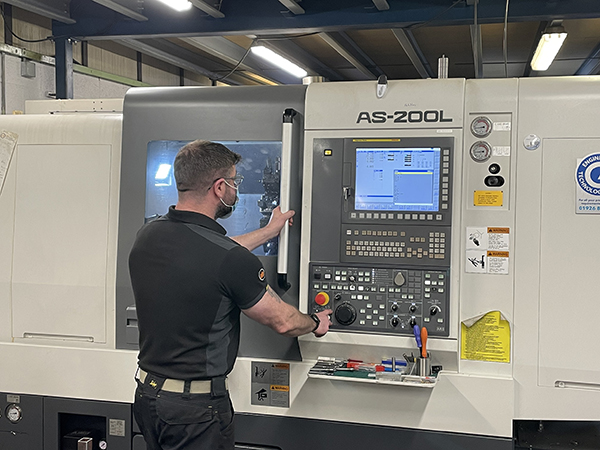
Upon the formation of HPC Services Ltd in 1997, the company started with a single sliding-head turning centre. Since that point almost 25 years ago, the Ilkeston-based company has invested heavily in sliding-head turning technology for small part turning. However, for almost everything outside the dimensional realms of sliding-head machines, the subcontractor has put its faith in turning centres from Nakamura-Tome. Supplied and supported by the Engineering Technology Group (ETG), the Nakamura-Tome machines at HPC have provided productivity and flexibility for everything from simple to complex turning, as well as the machining of prismatic parts from bar.

“I think we bought our first Nakamura machine around 2003, and we’ve had them ever since,” recalls Paul Cobb, managing director at HPC Services.

Now with five Nakamura-Tome CNC turning centres on the shop floor, the subcontract manufacturer invested more than £600,000 in three machines between August 2018 and June 2019. The Nakamura WT100 and two WT150II machines followed the July 2017 arrival of a smaller Nakamura AS200 MY turning centre with live tooling and a Y-axis facility.

At that time, Cobb said: “As a subcontractor, you don’t know what is going to come through the door on any day, so these machines are perfect. We mostly use them for making mill/turned parts, on medium-sized production runs from a few hundred components to a few thousand, which is a real sweet spot for us.”

As part of the Hemlock Group of companies, HPC has more than 17 turning centres and 25 employees producing components for the industrial equipment sector. This includes fire-suppression equipment, printing machinery, scientific devices, packaging machinery, camera equipment and braking systems for the rail industry. The company typifies the subcontracting sector with its diverse workload, the variety of industries it supports and the expansive diversity of materials it machines and the services provided. With this thought in mind, the company has added yet another Nakamura-Tome turning centre, a WT150IIF model, which arrived shortly before Christmas.

Confirming why the Nakamura-Tome turning centres are so popular, Cobb says: “A few years ago Nakamura upgraded their older machines with new controls and much more rigid and powerful driven tooling. The machines were really good before, but now they have changed the game – and we simply had to invest in the new technology when it came out.

“As a business, we’ve built up our Nakamura models over the past couple of years, and the latest machine is testament to both the success we’ve had with the Nakamura machines and our investment programme,” he adds.

Before the investment drive in new Nakamura machines, HPC Services previously had the older models of the Nakamura brand.
“The residual value of these machines is unbelievable,” states Cobb. “We recently sold a Nakamura machine 13 years after we first purchased it, and we sold it for 50% of the purchase price. The loss you make each year really isn’t that much. It caused a problem when we sold the machine because we had written it down very low year-on-year so, when it came to selling the machine, we actually made a profit.”

Discussing the difference between the twin-spindle, twin-turret Nakamura-Tome WT100 and Nakamura-Tome WT150IIF, which both have Y-axis capability, Cobb says: “The WT100 is a smaller machine, making the kinematics and movement a little bit quicker.

However, it isn’t quite as versatile as the WT150II machines or the new WT150IIF, which has more power on the tooling stations. The other obvious difference is the bar diameter: we can get 46 mm diameter bar on the WT100 machine, whereas the WT150II machines can accommodate bar up to 65 mm.”

Continues Cobb: “The Nakamura machines have a lot of versatility and the ability to throw many driven tooling stations at the components. So, if you want to make fully milled parts with complete automation, you can. For example, it can be quite difficult to automate a machining centre, but if you can mill a prismatic component out of round bar, you are better off making the parts on a Nakamura machine. We do quite a lot of that type of milling work on the Nakamuras.

“Additionally, you don’t want to be putting your turned components on to milling machines after they have been turned, as it can knock all of your geometric relationships out. So, if you can make components in a single operation on a turning centre with all the complex milling and drilling, the quality of the finished part is far superior. Furthermore, the cost per component comes down as there is less handling of the parts.”

This is exemplified by the set-up of the latest Nakamura machines, which are all equipped with barfeed systems and a part accumulating Rota-Rack system from Hydrafeed. This configuration permits unmanned machining for upwards of 18 hours.

“The machines are also suitable for simple component runs,” says Cobb. “Our Nakamuras are very capable machines that do not take long to set up with the new control system, making them suitable for simple components. To make these machines justifiable on simple parts, we tend to do a minimum batch of 50 to 100 – that is our entry point for balancing productivity rates against set up times.”

Alluding to the flexibility of the Nakamura-Tome, Cobb states: “We have a really good team of people. This includes two or three highly skilled operators and a couple of apprentices, and they are all perfectly capable of setting these Nakamura-Tome machines. This gives our business the ability to switch components every day if we want.”

HPC Services has been delighted with the enhancements to the new models in the Nakamura-Tome range in terms of stability, rigidity and performance, but nowhere is this better emphasised than in the new Smart X CNC control panel. Working on a Windows platform, the FANUC-based control system introduces a multitude of innovations via a user-friendly and intuitive touchscreen interface. Some of the new technologies include a 3D Smart Pro AI system that automatically analyses CAD models to determine geometries, cutting tools and paths, as well as machining sequences. From this, a CNC program can easily be created to slash programming times and set-ups.

The Smart X system also introduces the NT Thermo Navigator, which uses AI-based machine learning to compensate for thermal growth, thus improving machine set-up and run times, along with precision. In addition, the CNC unit incorporates a simulation and overload function, the NT Work Navigator and an Industry 4.0 interface for complete connectivity.

Discussing the new format of the CNC on the Nakamura-Tome machines, Cobb says: “The old control systems were much more complicated. This new format has simplified the whole programming process, because a lot of it is feature orientated. So, if you are pocket machining or anything like that, there are many cycles built into the system and a lot of mathematical help to support you in working out dimensions and corners. As a result, you don’t have to use a CAM system. For everyday prismatic parts, the CNC control on the Nakamura is perfect.”

For further information
www.engtechgroup.com

Hitting the high notes AFTER first cobot investment

A leading bagpipe manufacturer is reporting a dramatic increase in productivity and operational efficiencies from its first collaborative robot (cobot) investment. Mills CNC Automation, the exclusive distributor of Doosan collaborative robots in the UK and Ireland, has supplied McCallum Bagpipes, an innovative and progressive bagpipe manufacturer that happens to also be the largest in the world, with a Doosan cobot.

The M1013 cobot for McCallum Bagpipes, with its 1300 mm reach radius, 10 kg payload capacity and six torque sensors for safety and collision protection, features RG6 OnRobot gripper end-effectors. It was installed at the company’s 6000 sq ft machine shop facility in February 2021 by Glasgow-based Engineering Supply Co (Scotland) Ltd, an independent distributor and supplier of engineering consumables and an agent for Mills CNC Automation.

McCallum Bagpipes acquired the cobot to undertake machine tool tending operations: in essence loading workpieces that require machining into a CNC lathe and, once finished, unloading the parts into containers, and then repeating the cycle.

The company’s managing director Stuart McCallum says: “Since being installed, the cobot has significantly helped us to improve our productivity and operational efficiencies in a relatively short space of time. By integrating the cobot with our Dugard Eagle 200 CNC lathe we are able to operate the machine 24/7, running it unattended and overnight. The results have been remarkable.”

Several performance and productivity gains are clearly evident during the automated machining of a medium batch of practice chanters made from Polypenco (plastic). A chanter is an integral part of a bagpipe that resembles a recorder. It comprises a short, thin tube with finger holes, and is where – and how – the piper creates the melody/tune.

Practice chanters, say a batch of 100, are placed in a plastic (pallet) tray situated adjacent to the lathe and the cobot. Each chanter sits vertically in its own individual circular hole. This configuration means that the tray is effectively acting as a peg board. The cobot is programmed to open the machine door, take a designated chanter (in sequence) from the tray, orientate it, and place into the lathe’s open chuck, which then closes. Subsequently, the cobot moves away from the machine, the lathe door closes and chanter machining commences. Once operations are complete, the door opens and the machined part is removed from the lathe and placed in a container. Part cycle time, including all cobot and machining operations, is short – typically 3 minutes in total.

“We can load up jobs like this late at night during the 02:00 to 12:00 shift,” says McCallum. “A batch of 100 practice chanters can be machined to completion overnight [unattended] in approximately five hours [20 parts machined per hour].”

He adds: “As well as getting five hours unmanned production from the lathe, the cobot investment also means that operators are no longer required to perform repetitive and tedious part loading and unloading tasks and, owing to the short cycle times, be virtually at the machine’s beck and call.”
McCallum Bagpipes, established in 1998 and employing 38 people at its 9000 sq ft facility in Kilmarnock, is on a strong growth trajectory with revenues and profits up, year-on-year, over the past five years. This growth, fuelled by the company’s innovative product development and marketing strategies, has seen McCallum Bagpipes significantly increase international sales and consolidate its market-leading position in the UK and Ireland.

With customers as far afield as Canada, the US, mainland Europe and the Middle East, the demand for McCallum Bagpipes’ instruments – even taking the Covid-19 pandemic into account – is at an all-time high. The company is constantly augmenting and refining its product portfolio, which now includes Breton and uilleann (elbow)/Irish pipes, as well as more traditional Highland and Scottish small pipes.

Although clearly being good news for McCallum Bagpipes, the consistent upsurge in demand has put pressure on the company’s existing manufacturing resources.
Says McCallum: “To ensure quality and cost-competitiveness, very few of our manufacturing processes are outsourced. But despite running a two-shift system, we were still under pressure. We needed to become more efficient and optimise the technology we already had at our disposal.”

As part of McCallum Bagpipes’ continuous improvement programme, the company began exploring automation at the beginning of 2021.

“Things crystallised and fell into place during a conversation with Engineering Supply Co,” says McCallum. “They introduced us to cobots and, being the agents in Scotland for Mills CNC Automation, to Doosan cobots in particular. In addition, I did my homework, talking to people and looking at a number of YouTube videos to understand the strengths, weaknesses and potential of the technology – and how we could apply it to McCallum Bagpipes. In truth, I didn’t need that much convincing.”

The M1013 cobot acquired by McCallum Bagpipes operates 24/7, Monday to Friday. At the Kilmarnock facility, the cobot is integrated with one of the company’s 20 CNC lathes and, after only two days for its installation followed by a further two days to train four members of staff, the cobot was up and running.

Concludes McCallum: “We are delighted with the investment. Not only have we been able to ramp up productivity and get more out of the Dugard lathe, we’ve also been able to significantly free-up the time of our operators. It’s a real win-win situation.

“We estimate a payback period of four years for the cobot,” he continues. “With this type of return on investment, plus the marked improvements it has made to our productivity and efficiency, we’ll be investing in a second cobot in the not-too-distant future.”

For further information
www.millscnc.co.uk
Prodrive 3D prints car parts in the desert

Prodrive has a long history in motorsports, competing and winning its first event, the Qatar International Rally, in 1984. Since then, the company has been unstoppable, winning a multitude of titles across a wide range of motorsport disciplines.

Earlier this year, the company entered the Dakar Rally in partnership with the Kingdom of Bahrain, under the new team, Bahrain Raid Xtreme (BRX). The Dakar Rally takes place over two weeks, with stages covering hundreds of miles across a range of challenging, off-road terrain in Saudi Arabia.

To prepare for the event, the BRX team began development on the Hunter T1, its new two-car factory team driven by nine times World Rally champion Sébastien Loeb, and 25 times Dakar Rally legend Nani Roma. Roma secured fifth place overall in the 2021 race, the first time any team has achieved such a high ranking on its first attempt at the Dakar Rally.

With work only beginning in late 2019, the BRX team suddenly came up against what would be one of the biggest challenges that hit the industry thus far.

“We often put ourselves in tough positions time-wise, but Covid-19 really threw a wrench in our already-tight timeline,” says Paul Doe, chief engineer at Prodrive. “In the UK, there was a lockdown that effectively forced us to close the factory for a while. Development that should have taken about a year was compressed into nine months. Instead of testing in July, we didn’t end up turning a wheel on a car until October 2020.”

With the Dakar Rally scheduled for the first two weeks of January 2021, this put an immense amount of pressure on the whole team. Although BRX includes 40 people to design, engineer, service and operate the Hunter T1 vehicles, the team was stretched thin with an atypically shorter timeline. Additionally, although Prodrive offered in-house manufacturing, fabricating and machining capabilities, the team was competing for resources with other projects.

When Doe decided to add the MakerBot Method X 3D printer, recommended by DSM (a global supplier of carbon-fibre materials), to his team’s toolbox, it became a game changer. The Method X enabled his team to prototype and print much-needed parts quickly and conveniently as well as experiment with different applications, on and off the course. With the unlimited possibilities of additive manufacturing, prototyping and part production became much more streamlined and cost-efficient.

Innovation has always been a core tenet at Prodrive. The company utilises a wide range of technology to ensure it stays ahead of the competition. Adding Method X to its repertoire of cutting-edge technologies afforded Prodrive an added opportunity to save even more time during its shortened production schedule.

“There is a massive list of benefits from using the MakerBot Method X compared with a normal production method, such as speed and responsiveness,” explains Doe. “When it came to designing parts on the car, the first thought often starts with printing a component off the 3D printer to see how it would turn out. The ability to try the part first before committing to the final product allows us to make changes easily and quickly. This rapid iteration also allows us to stay pretty close to our production timeline, while saving a ton of money.”

With two Method X 3D printers, the BRX team was able to engineer some parts at the factory in the UK as well as on site at the rally.

A Method X was loaded on to one of the BRX maintenance trucks that the team had set up in the desert. The printer was used on-site to produce fabricated parts, or to fix a component that would otherwise have needed steel or aluminium fabrication.

“We carried this machine with us in the truck and printed remotely in the middle of nowhere – literally where you can’t see traces of civilization – yet here we are using this kind of machine,” says Doe. “We took advantage of the speed of 3D printing parts in the middle of our test programme”.

The BRX team used Method X to print over 30 parts on the Hunter T1, including a mount for a suspension position sensor and a sculpted nozzle mount for the cockpit’s fire suppression system. Of particular note, the suspension position sensor allowed the engineers to look at the damper performance, vehicle dynamics, wheel alignment, drive shaft and more. The sensor generates data and relays information back to the team for better analysis, which can then be used to improve vehicle performance. The mounting system was printed with MakerBot’s nylon carbon fibre.

Prodrive points out that the entire process to get the suspension mount just right took only 90 minutes, from having the 3D printed mount on the ground sheet in the middle of the desert, to observing it, to making updates and reinforcements to the design in the truck, to launching production on Method X. With the new part in their hands, the technicians were ready to put it on the car and continue collecting data.

“That was new for us,” states Doe. “In the past, we’ve used additive manufacturing, but we didn’t have the capability to do it so spontaneously. In addition, the materials we used on Method X, particularly the nylon carbon fibre, exhibited higher performance than what we had experienced in past years. There are quite a few parts in the car, such as the engine bays and wheel side near the brakes, where the environments reach up to 120°C and where traditional FDM materials start to struggle, forcing us to revert to aluminium which is costly. In this case, we were able to print parts in nylon carbon fibre, which is able to reach very high temperatures. The carbon print heads on Method X really opened up a lot of new applications for us.”

Doe adds: “With the density of the materials being so low in comparison with traditional aluminium or steel fabrications, we were able to make parts that were much lighter than what a typical part would have been. And it allowed us unlimited freedom to effectively test our parts.”

Using the nylon carbon fibre, the BRX team also printed a lightweight sculpted mount for one of the nozzles of the fire suppression system located at the centre of the cockpit. Due to the sheer size of the cars, each vehicle was outfitted with two fire suppression systems.

With an extremely hot turbo engine, 500 litre fuel tank and other highly flammable materials, fire suppression is critical. Typically, the team would have needed to create that nozzle out of traditional heavy metal, like steel or aluminium, which can be time-intensive and costly.

Nylon carbon fibre is a lightweight alternative to metal due to its high strength, heat resistance and stiffness properties.

“We wanted to move away from the typical folded aluminium bracket as much as we could, and instead have a more premium feel in the cockpit,” says Doe. “Method X allowed us to experiment with a new type of nozzle. The sculpted mount was a nice balance of form and function. In fact, it looked 10 times better than what we had in the past, and with no egregious costs.”

With Method X at its disposal, the Prodrive team has begun to explore new and different applications, from car parts to manufacturing aids and tooling. While the company still has physical parts stored and managed on-site, its digital inventory is also growing.

“With the Method X 3D printers nearby and a digital inventory of parts and tools, we’re able to print on-demand and work with more agility and efficiency,” concludes Doe. “We have very ambitious plans to increase the number of vehicles on our roadmap in the coming years. As we continue to scale up, we may need more than a couple of machines in our collection. The cost is relatively low in comparison with other kinds of manufacturing processes, but the investment will pay off in the long-run. We have loads of projects coming, so there will be more opportunities to test the Method machines.”

For further information
www.makerbot.com

Pulling out all the stops

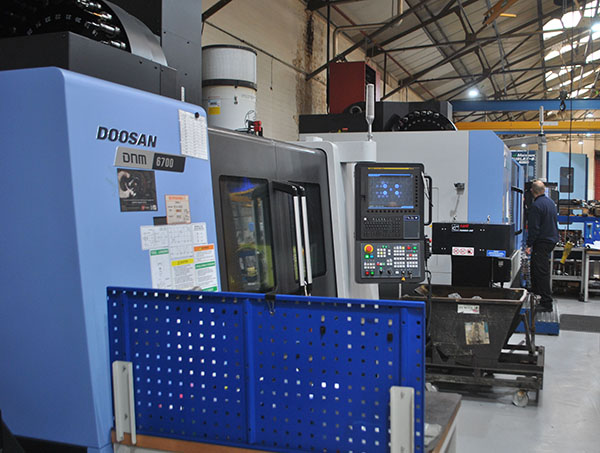
Mills CNC Automation has recently supplied a new Doosan collaborative robot (cobot) to NPI Solutions Ltd, a precision subcontractor based in Irvine, Ayrshire. The M1013 cobot, with its 1.3 m reach radius and 10 kg payload, is integrated with a Doosan DNM 350 5AX five-axis machining centre previously acquired from Mills CNC in 2016. Since installation, the cobot has proved its worth by helping NPI to optimise the spindle uptime on the Doosan machine, minimising operator interventions and improving output.

NPI is a company committed to continuous improvement and best practice. As such, the business regularly monitors, collects and analyses machine-tool performance data; calculating the effectiveness and efficiency (OEE) of the equipment it uses. The objectives are to accurately identify production ‘pinch points’, to remove and/or reduce the issues that cause machine downtime, and make manufacturing processes as productive as possible.

Says NPI’s managing director Kevin Priestley: “We invested in a Doosan five-axis machining centre five years ago to make us more productive, efficient and competitive. The ability to machine precision parts in one set-up, via 3+2 and 4+1 machining, was the appeal…and the goal.”

However, analysis of the machine’s performance over a period of time revealed that it was failing to deliver the expected results.

“It wasn’t the machine’s fault,” explains Priestley. “It was directly related to the type of production work we do, which is characterised by low volumes and small batches, and by short part cycle times.”

Being a high-mix, low-volume component manufacturer meant that the DNM 350 5AX could be idle for long periods each day to allow for frequent job set ups and changeovers.

“Machines don’t make money if they are not making chips,” states Priestley. “To improve our profitability we needed to increase the spindle uptime on our DNM 350 5AX.”

The company subsequently began to explore automation as a means of improving the machine’s utilisation and output.

NPI is no stranger to automation or unmanned operations, having previously invested in high-performance bar feeders to increase the productivity and performance of its CNC turning operations. To increase the productivity of its DNM 350 5AX machine, the company explored a number of automation options before deciding on the cobot investment.

Says Priestley: “There were a number of potential automation solutions available. We looked at automatic workpiece pallet-change systems and industrial robots, but their cost, floor-space requirements and complexity ruled them out.”

NPI required a more economically-viable and ‘simpler’ solution: one offering quick installation to transform the DNM 350 5AX into a flexible, automated manufacturing cell.

“We had investigated cobot technology before,” remembers Priestley. “The versatility of cobots in addition to their safety, their relatively lower investment cost and ease of deployment were attractive propositions. When we found out that Mills CNC, through its newly-created Automation Division, could supply us with not only a Doosan cobot but also project manage and undertake its installation and provide comprehensive training and applications support – we decided to put our plans into action. We visited Mills CNC Automation’s facility in Leamington to meet the application engineering team and discuss our specific requirements in more detail. Ultimately we gave the ‘green light’ to the investment.”

To undertake what are essentially machine-tending operations, NPI worked alongside Mills CNC Automation engineers to select the right cobot for the job. The chosen cobot (based on the dimensions and weight of parts machined on the DNM 350 5AX) was the M1013 model.

Offering a 10 kg maximum payload and 1.3 m reach, the M1013 also features six high-torque sensors that provide ‘best-in-class’ collision protection. The M1013 was supplied with a controller, a teach pendant, an RG6 (OnRobot) gripper and a Schunk work-holding package.

Situated adjacent to the DNM 350 5AX which, as part of the installation was fitted with an automatic door opening/closing facility, the cobot is programmed to pick up blanks positioned on a peg table and load them, in turn, into the machine where they are machined to completion.
Once machining operations are complete, the cobot takes the finished component from the machine and places it back on the peg board in its predetermined position. This cycle then repeats, with no operator intervention, until the completion of all parts.

Parts machined on the DNM 350 5AX are typically made from aluminium. These components vary in size from 15 x 15 x 15 mm at one end of the spectrum, through to 150 x 150 x 20 mm at the other. Cycle times can be as short as 2 minutes, or up to 60 minutes depending on part size, complexity and features.

“The ambition to create a flexible automated manufacturing cell has been realised through the cobot investment,” says Priestley. “During the day, the cell is programmed to machine components (with relatively short cycle times) unattended, allowing operators to work on other machines or perform other tasks. For parts with longer cycle times the cell is programmed to run attended overnight.”

NPI’s new cobot cell has helped it improve productivity, efficiency and competitiveness. The DNM 350 5AX is now running at 85% efficiency as opposed to just 50% efficiency prior to the cobot investment.

NPI is quick to acknowledge the skill and expertise of Mills CNC Automation’s engineers in designing and installing its new flexible automated manufacturing cell.

Says Priestley: “Everything went smoothly, from the design of the system through to its installation, proving out, and on-site and remote training. Mills CNC Automation took the time to understand our requirements. They demonstrated [up front] the productivity gains we could expect to realise from the investment – and they have been proven right. The support they provided throughout the project was first class, and I can’t recommend them highly enough.”

NPI’s automated cobot cell has now been operational for six months. Such have been the productivity and efficiency improvements realised that the company is now actively considering investing in a second cobot.

Concludes Priestley: “Despite the pandemic and subsequent lockdowns, we’ve been unbelievably busy over the past 12 months. To meet demand from customers for our precision machining services, we will be investing in more automation in the near future.”

For further information
www.millscnc.co.uk