
Robotiq introductions boost robot dexterity

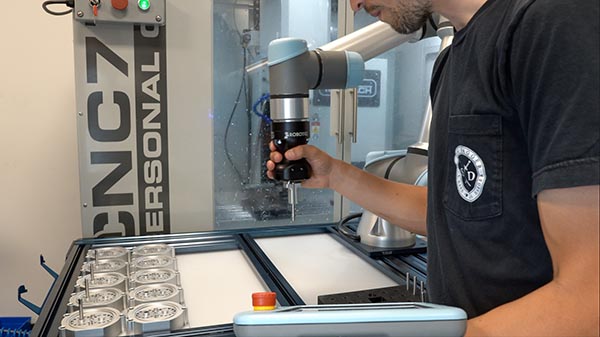
New to the UK from RARUK Automation are two Robotiq innovations designed to make automated, and even lights-out production, easier.

The first, Force Copilot, is an intuitive software development for applications that need force torque feedback, while the other is the Hand-E gripper, which is designed specifically for collaborative robots.
Sensing functions on the Robotiq Force Copilot increase flexibility and reliability in machine-tending, assembly, finishing, and pick and place applications. A suite of set-up tools allows the user to hand-guide the robot on complex trajectories. The software makes it easy to place objects precisely in jigs, trays and chucks, and facilitates assembly applications through alignment, indexing and insertion functions. Finally, the intuitive interface unlocks finishing applications, with adjustable adaptive compliance and constant force for all robot axes.
Robotiq’s Force Copilot is now a standard feature of the FT 300 force torque sensor that can be seamlessly integrated into the second of the additions to the RARUK Automation range: the Robotiq Hand-E gripper. With its compact and ergonomic shape, the Hand-E gripper is said to make collaborative robot hand-guiding safe and easy.
This latest product in RARUK Automation’s line-up of adaptive grippers, is the first UR+ electric gripper to be developed that takes full advantage of the Universal Robot e-Series. High accuracy and 50 mm parallel stroke make the Hand-E gripper suitable for precision assembly tasks, while its sealed design ensures reliability in tough manufacturing conditions. Hand-E gripper comes with a three-fingertip kit, so automation engineers can easily integrate the gripper in their application.
For further information www.rarukautomation.com
Compact clamping smaller than the part

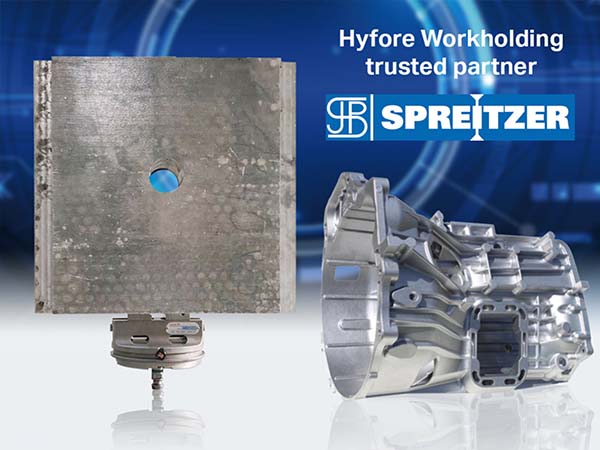
Shown in the photo is the gripping power of a Spreitzer MZR vice compared with the size of the workpiece.

In this instance, the client manufactures prototypes in aluminium and titanium for the aerospace and motorsport sectors. As shown, the result is a typical example of the finished gearbox component.
The client currently utilises roughly 220 vices from Spreitzer, 200 of which are MZR 160-60 PA and the remaining variants are MZU and MZC. Due to the robustness and reliability of Spreitzer vices, the business has successfully and consistently manufactured for three years, performing a three-shift pattern without loss of production or the expense of additional cutting tools.
A further benefit of utilising Spreitzer centric clamping vices is the ability to clamp the workpieces safely without having to pre-stamp, which ultimately saves time and money. Through the use of short cutting tools and less vibration on the workpiece, longer tool life can also be achieved and the machining time per piece can be reduced due to higher metal removal.
Hyfore Workholding is a partner in the UK for Spreitzer products. Spreitzer is known for the development and production of complex system solutions in the field of clamping and measuring since 1983. The company’s areas of expertise extend from modular clamping systems for machining centres to manual quality control and special devices, touching on mechanical clamping systems along the way.
For further information https://hyfore.com/

The gripping solution of tomorrow

The gripping industry is undergoing radical changes. In the past, gripping processes were primarily geared toward boosting productivity and process reliability.

With the advent of smart factories, flexibility is becoming an increasingly important factor. According to Schunk, tomorrow’s grippers will enable flexible operations and even autonomous handling scenarios.
Until recently, industrial gripping has been relatively rigid; the geometry of the parts must be known, as well as the exact pick and place position. A reliable handling process can be provided by predefining traverse paths and specifying target point co-ordinates based on repeatable parts-feeding operations. With the rise of digitalisation, the trend is now moving towards highly automated, fully networked and autonomous manufacturing systems.
Against this backdrop, artificial intelligence (AI) is becoming increasingly important. The first cognitive intelligence applications for grippers in combination with cameras are already possible. This allows for intuitive training by the operator and autonomous handling of gripping tasks by the robot. For these applications, Schunk purposely designs practical, industry-oriented handling processes by limiting the number of component variations. This strategy streamlines the classification and training process.
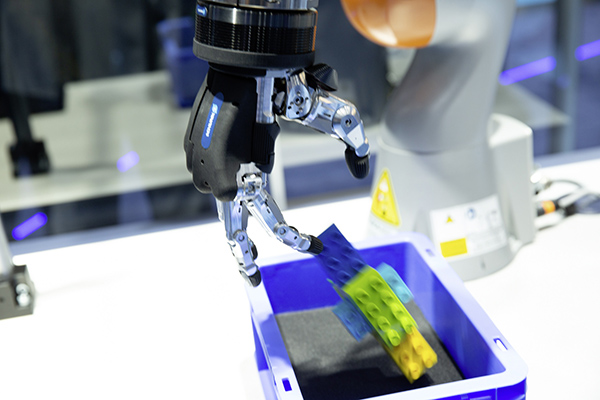
In an initial use case that makes use of machine learning approaches for workpiece and gripping process classification, interlocking building blocks are randomly combined and presented to a lightweight robot in a random arrangement on a work surface. The robot’s task is to pick up and transport the blocks. By interacting with 2D or 3D cameras, the self-learning system rapidly increases gripping reliability after only a few learning cycles. With each grip, the gripper learns how to successfully pick up and transport the component.
For further information www.schunk.com

Leader Chuck offers OMIL gripping systems

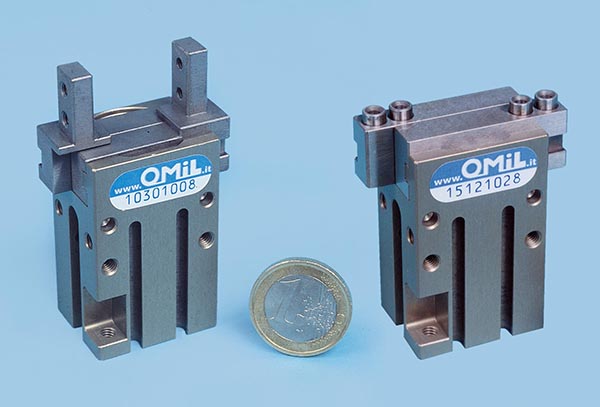
OMIL’s series of gripping systems is now available in the UK from Leader Chuck International.

Within the range there are newly developed and enhanced products that are designed to improve efficiency, productivity and accuracy in a number of sectors, including machine tools, assembly machines, transfer machines, gantry-robots, as well as bespoke machining solutions.
End effectors for industrial robots can grip parts weighing up to 500 kg and up to 1000°C for die casting and forging, while applications for grippers used on automated assembly lines include automotive, domestic appliance, pharmaceutical, electronics, food and beverage, and packaging.
The range of pneumatic grips offered is as diverse as the industrial applications supported, from two-finger parallel to three- or four-finger self-centring, and two-finger radial. As an example of the level of engineering applied to its products, the OMIL GSO range of two-finger parallel grippers is manufactured to facilitate protection class IP67 for use in harsh environments. An oval cylinder is used for higher gripping forces, between
123 N for the smallest unit with 5 mm stroke, and 1640 N for the largest with a stroke of 32 mm.
For applications where larger and heavier workpieces require gripping, OMIL has a number of ranges that provide strokes up to 400 mm and gripping forces of 10,000 N at normal workshop pressure of 6 bar.
With regard to milling machine applications, a range of chucks for round parts and vices for prismatic components are available, while special machinery applications can encompass punching and forming machines, as well as measurement and inspection systems.
“Any company looking at specifying a new automation system or upgrading an existing installation should look at OMIL as a viable alternative to Japanese and German suppliers,” concludes Jones. “Not only do they offer the same performance at considerable cost advantage and complete interchangeability, but the benefit of flexibility allows solutions to be customised in line with each application.”
For further information http://leaderchuck.com/

Röhm expands its executive board

Clamping and gripping specialist Röhm has expanded its corporate executive board, effective from 1 April 2019.

Together with Gerhard Glanz, Dr Till Scharf has taken on the new role of COO/CTO. Dr Scharf is now be responsible for the logistics, development, construction and production business divisions.
After earning an engineering degree from the University of Stuttgart and collaborating on projects at the Fraunhofer Institute for Production Technology, and the Institute for Combustion Engines and Vehicle Technology, Dr Scharf successfully studied for a doctorate at the University of Clausthal. Within the scope of his career Dr Scharf has held a variety of managerial positions with market-leading companies and corporations in the industrial and automotive sectors.
“We are pleased to welcome such an internationally experienced manager as Dr Scharf to our team,” says Glanz. “He has already proven himself to be a highly successfully leader, and we are confident that he will assist us in mastering the current optimisation tasks within our corporate group even faster and more efficiently.”
For further information www.roehm.biz