
Extra-safe wedge clamp for presses

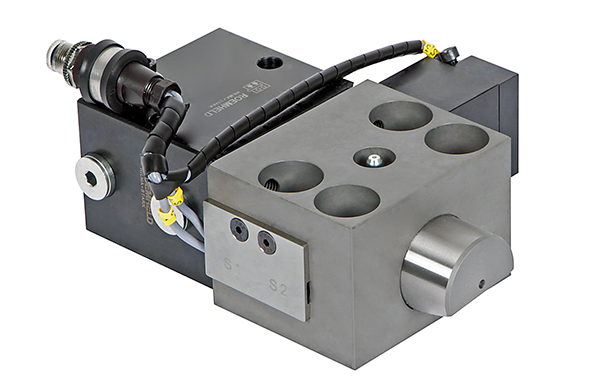
Roemheld’s range of die-clamping solutions for presses and injection-moulding systems has been supplemented with a newly designed series of robust wedge clamping elements.

A hydraulic model has been developed specifically for the fixing of upper dies that meets the highest safety requirements.
An additional locking cylinder holds the wedge clamping bolt in position and prevents any inadvertent retraction. Release of the clamping device is only possible once the locking mechanism has been opened, which ensures that the upper die is retained in position, even in the event of a pressure drop.
The wedge clamping element itself comprises a block cylinder with housing-guided clamping bolt. An angled contact surface creates a frictional connection in conjunction with angled die clamping edges. A position control is integrated as a space-saving measure to monitor the clamping and release position, as well as the status of the locking mechanism. Whenever there is no die available, a notification is issued.
Due to the Roemheld wedge clamps being constructed as a variant system, they can be adjusted in accordance with respective customer requirements. The standard range already includes seven designs with clamping forces of 25 to 630 kN, and cylinder dimensions of between 25 and 125 mm. Clamping strokes of 15 to 36 mm are available here, while the maximum operating pressure is 350 bar.
When elements are to be used for processes with high heat requirements, special designs are available which are temperature-resistant up to 300°C. In addition, there are versions for straight clamping edges, as well as models with clamping forces of up to 1250 kN, and even higher retention forces.
For further information www.roemheld.co.uk
Time-saving indexing head from 1st MTA

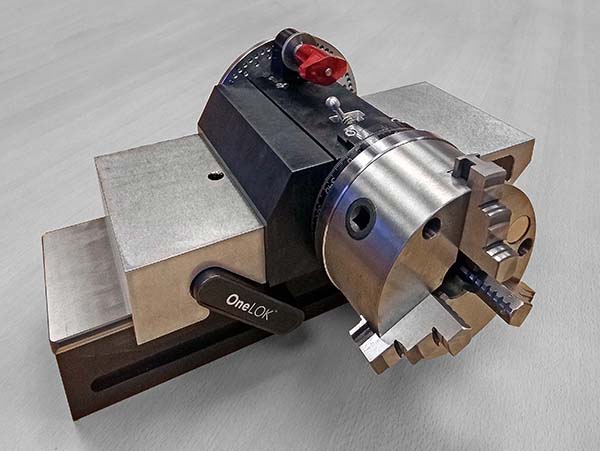
Aimed at production shops where manual mills may still be in operation, but equally suited to use on a CNC vertical machining centre, a manually adjustable indexing head has been introduced by 1st Machine Tool Accessories.

RotaVice can be rapidly set to position a component at multiple rotary angles in the horizontal plane for milling and drilling.
Manufactured in the UK, the unit is designed to be secured in a One-Lok work-holding device manufactured by Chick in the US, for which 1st MTA is the sole agent in the UK and Ireland.
Costly fixtures and the need to change machine set-ups can be avoided, saving money and time. In smaller job shops employing four-axis VMCs equipped with a full or indexing rotary table, where there may be only one or two people able to program the machine, the load can be lightened by having an operator of a lower skill level set up a component manually for three-axis machining.
Everything about RotaVice is said to be fast. First, a One-Lok may be bolted quickly on to a VMC table. Next, positioning the moveable jaw using the integral time-saving ratchet mechanism leaves only a few turns of the handle to clamp the indexing head in a special RotaVice jaw, also made by 1st MTA, which replaces the standard One-Lok jaw. Lastly, the workpiece is secured in moments in a horizontal orientation using an array of work-holding options, which include a three-jaw chuck.
Adjusting the angle is also rapid and accurate, and is effected by turning a circular locating plate to the required angle and inserting a pin into the relevant hole, an array of which are pre-drilled into the plate at the most common angles.
For further information www.1mta.com

Centric-clamping vices upgraded

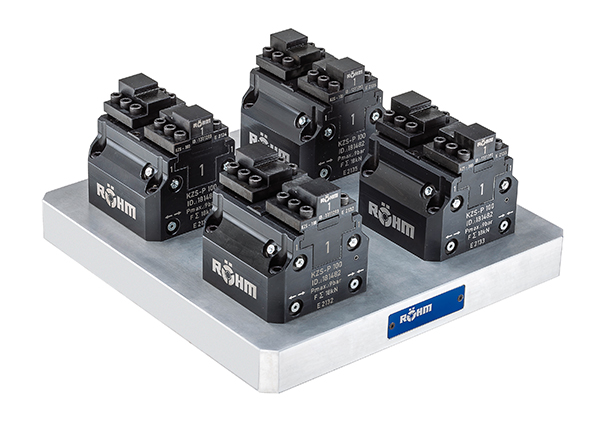
The upgraded KZS centric-clamping vices from Röhm are suitable for, among other things, six-sided machining involving two clamping operations on round or prismatic workpieces. KZS range vices deliver clamping forces of up to 55 kN, an increased clamping range of 20% and a reduced interfering contour for optimal chip flow.

For use in three-axis, four-axis and five-axis machining centres, as well as all the usual zero-point clamping systems, both of the products in the range can be operated either pneumatically or hydraulically. In particular, this fact also means they are suited to scenarios involving robot-assisted workpiece loading. Here, the cost-saving opportunities are large. For example, one or two KZS clamping blocks can replace a large number of manual vices in automated procedures.
KZS vices can be loaded directly into the machine by a robotic arm. This potential means that it is not necessary for an operator to pre-position the workpiece outside the machine with an extra clamping device. Furthermore, a separate manual vice needs not be available for each component. When combined with a zero-point clamping system, such an arrangement makes it possible to shorten cost-intensive set-up times. Röhm can even adapt its centric-clamping vices to other manufacturers’ zero-point clamping systems. The direct benefits for the user are shorter set-up times, better utilisation of machine times and higher productivity levels.
With KZS vices, the precision wedge hook system is said to result in superior part quality and a high level of process reliability. Furthermore, an improved lubrication solution ensures that the clamping forces always remain at their highest level. Consequently, the clamping blocks are also suited to sophisticated milling operations associated with high material removal rates, high cycle numbers and tight machining tolerances.
For further information www.roehm.biz

Expanded range of Microconic systems

MASA’s range of Microconic work-holding systems for the sub-spindle clamping of small workpieces in sliding-head lathes such as those manufactured by Tornos, Citizen and Star, is now extended following product launches at the recent IMTS (Chicago) and AMB (Stuttgart) exhibitions.

Previously, the system was only available for F20 and F25 style collets. However, MASA has extended this line-up to add the F37 (1536E) cartridge for 32 mm diameter capacity machine tools, as well as the F20-201 (136E) system that is specific to Tornos machines. Availability in the UK is via Floyd Automatic Tooling.
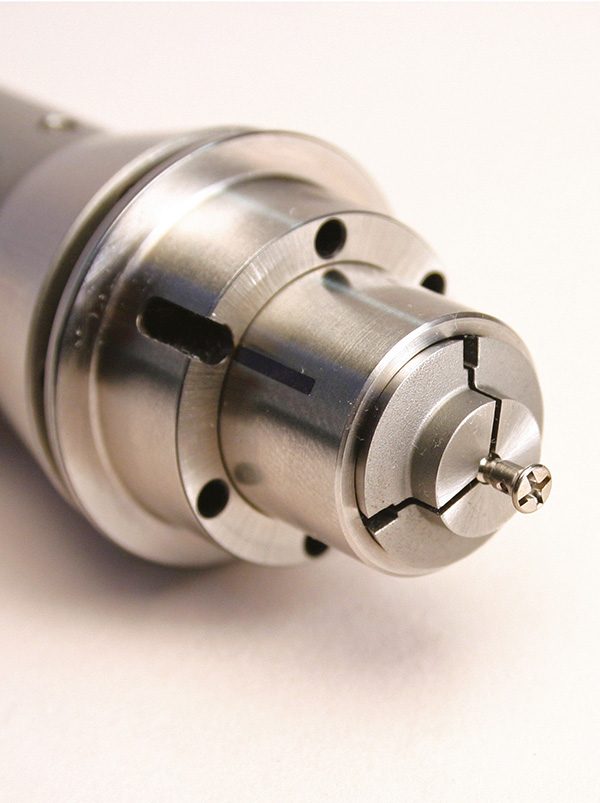
Microconic work-holding systems consist of a cartridge and precision collet. The collet fits inside the cartridge and is adjusted before being fitted directly into the existing collet sleeve. No machine adaptations are required.
Featuring clamping diameters from 0.2 to 10 mm, the collets offer a concentricity level of 3 to 5 µm. The cartridge system incorporates a solid extended nose that is said to be rigid and robust. Of note, the device has the facility for micron-adjustment of the collet closure, ensuring that even the most fragile of components can be clamped. These hardened and ground cartridges can also be used as gauges to verify machine spindle accuracy.
The cartridge/collet combination can accommodate openings beyond 4 mm larger than the clamping diameter (depending on the application). This flexibility gives the production engineer the possibility to machine the part the other way around, which can often improve cycle times.
Microconic collets are available in 0.05 mm increments, from 0.22 up to 10 mm diameter. Each collet has a nominal clamping range from 0.05 to 0.1 mm, depending upon the chosen collet diameter.
For further information www.floydautomatic.co.uk

Quick-change chucks save time

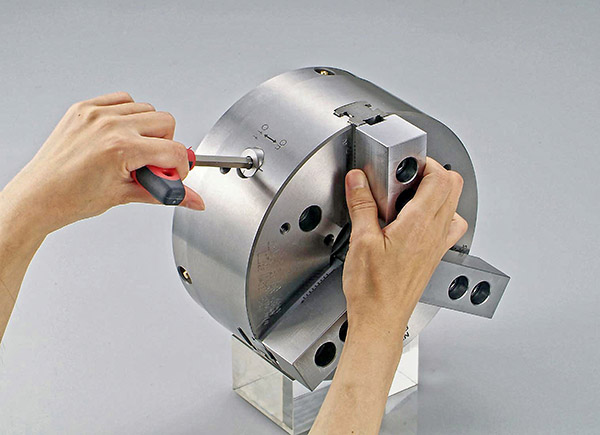
1st Machine Tool Accessories is advising that a quick-change chuck has the ability to eliminate a majority of the time wasted when changing jaws on a conventional chuck, decreasing the delay between the end of op 1 and the beginning of op 2 by as much as 90%.

Instead of wasting 20 minutes, changeover typically takes just two minutes. The company has produced a cost calculation based on the use of a Kitagawa QJR (Quick Jaw Release) chuck, in support of its claims.
The cost comparison generated by 1st MTA, which shows ROI in a very short time, is based on the use of a Kitagawa QJR chuck. Available in four sizes (7, 8, 10 and 12”), QJR chucks use the same jaws as standard chucks in the range.
1st MTA’s hypothetical illustration is based on the use of a QJR10, a 254 mm quick change, three-jaw, large through-hole power chuck with five sets of standard metric quick-change jaws plus soft jaws, which all costs £6124. This chuck interchanges directly with a Kitagawa BB 210 large bore chuck, priced at £2177 with five sets of jaws, with which the comparison is made.
The average time saved when exchanging the QJR chuck instead of the BB chuck is 15 minutes. Based on three set-ups per day and an estimated machining cost of £60 per hour, the daily cost saving for the three changeovers is £45. The difference in purchase price between the two chucks is £3947. At £45 saving per day, the time required to break even is slightly less than 88 days. On this basis, the total saving by the end of the first year is £12,478, after which the annual saving is £16,425.
For further information www.1mta.com