
Robot safety enables mobile machine tending

Be ambitious, dream big,’ proclaims a giant, brightly-coloured graphic that towers encouragingly above the bustling machine shop crammed with CNC machines at ALM Engineering near Newton Aycliffe in County Durham.

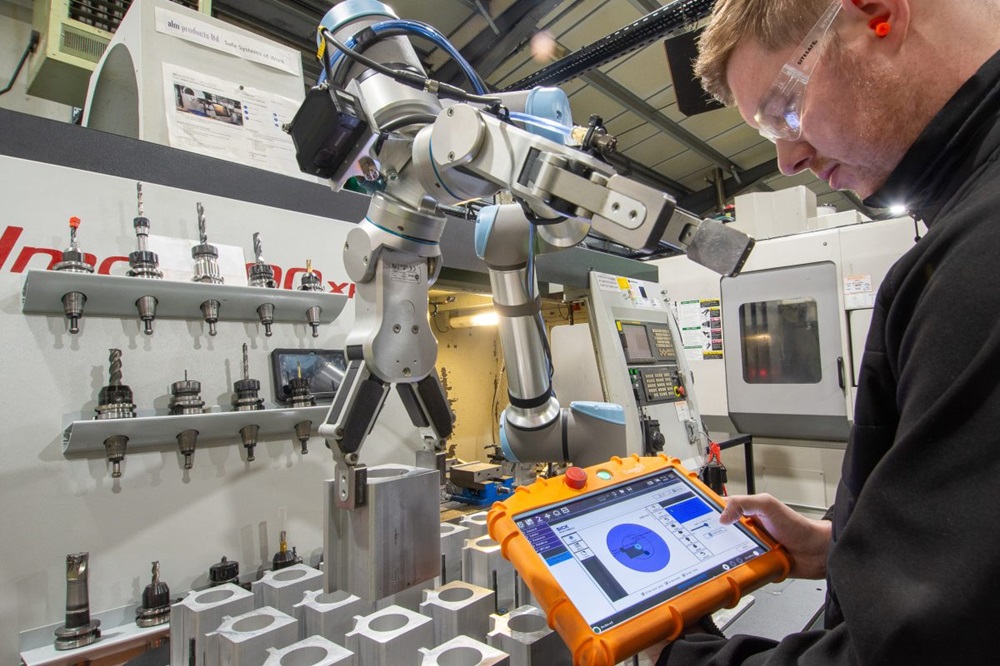
It was this spirit of enterprise and vision that turned necessity into a pioneering robotics innovation. ALM has uprooted machine tending robots, set them on wheels and turned them into freely accessible and adaptable mobile units that it can quickly and easily reposition wherever necessary.

The idea originated from the need for a device that would meet the growing needs of the family-run business. ALM’s development of collaborative robot (cobot) applications, based on technology from Universal Robots, was so successful that the company decided to perfect and market it to external customers, calling it the CoboTend. Now, a partnership with SICK UK enabled effortless safety without sacrificing productivity for the CoboTend, representing a vital step in the product’s continued development.

Two SICK nanoScan3 Pro safety laser scanners sit at opposite corners of the CoboTend’s trolley cabinet. Together, the laser scanners provide 360° coverage around the robot, slowing it to a safe speed when a person enters the outer of two fields and only stopping upon breaching the inner field. This concept means that the cobot can continue to operate safety and dynamically based on the proximity of the person rather than simply stopping if anyone gets too close, ensuring maximum uptime and productivity.

The SICK nanoScan3 Pro safety laser scanner is easy to integrate thanks to the SBot Speed URCap, a safety system that combines safety technology from SICK and Universal Robots.

SBot Speed URCap is simple and fast to set up using smart field definition and field teach-in. 

More information www.sick.co.uk

Automated tool production system launches

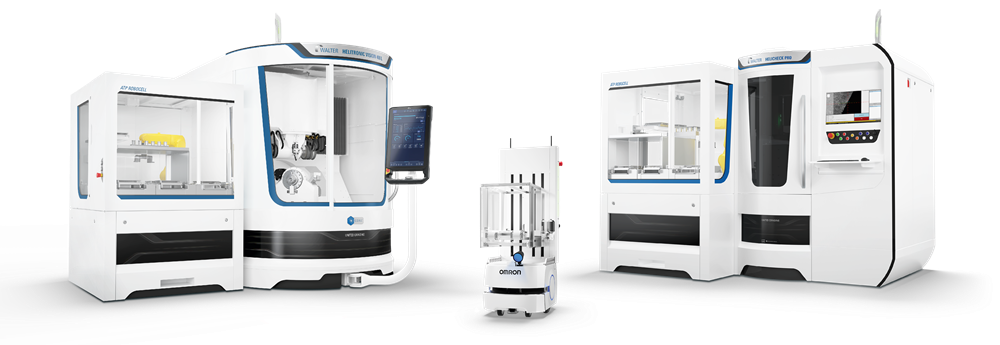
With its new Automated Tool Production (ATP) system, Walter is offering a new automation system for tool handling in the manufacture and inspection of cylindrical cutting tools. The system networks tool production and measuring machines not only from Walter but also upstream and downstream machines from other system partners.

Available from Walter Ewag UK, a manufacturer of CNC grinding, erosion and measuring machines, the new ATP provides a higher degree of automation and thus delivers elevated levels of efficiency. ATP does not require additional floor space and is suitable for integration into existing tool manufacturing systems independent of current automation providers without any need to change system layouts.

System control is based on the Flames OPC-UA data model and comprises at least one robot cell accessible from the front (ATP Robocell) for automatic machine loading/unloading plus at least one autonomous, mobile transport robot (ATP AMR) for transporting workpiece pallets and individual parts between storage and processing stations. The data model also includes a standard communication model between the machines and ATP AMR, as well as a control system for higher-level data and process control.

ATP Robocell offers three access gates and therefore additional buffer spaces for production without waiting time or downtime. A separate removal station for the in-process exchange of individual tools between the measuring and production machine enables automatic correction and, as a result, closed-loop processing.

The ATP Robocell’s multi-range gripper contributes to the system’s flexibility by covering a large workpiece diameter range and providing the ability to exchange collets at the same time.

More information www.walter-machines.com

New robotic systems for machine tools

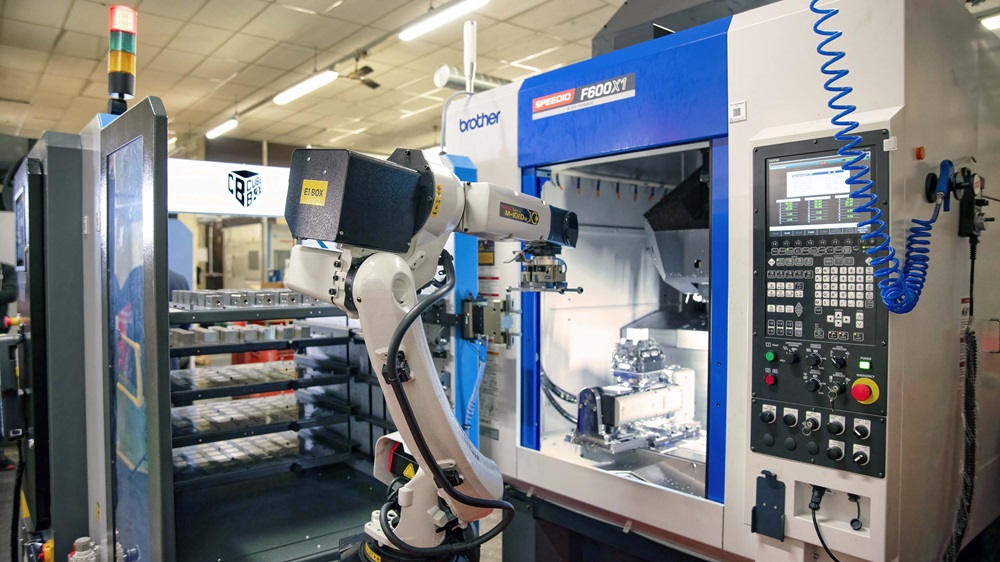
A new range of storage and handling systems for the automatic loading and unloading of machine tools is now available in the UK and Ireland via Whitehouse Machine Tools in partnership with the Turkish manufacturer Tezmaksan. CubeBox robotic cells are suitable for automating virtually any make of CNC lathe or machining centre. Non-stop, rapid loading and unloading of workpieces into and out of up to three machines enhances flexibility and agility, enabling quick adaptation to changing production requirements.

Amortisation is fast as the operator only needs to load billets, castings or forgings into the workpiece magazine and unload finish-machined components. The worker is therefore free to perform added-value tasks elsewhere on the shop floor. Additionally, unattended ghost-shift production is possible, contributing further to profitability.

Cell integration and robot programming are particularly easy, reports Whitehouse. Connecting to any make of machine control system is possible, eliminating the need for customisation or modification. The process does not therefore rely on a skilled integrator, while the high degree of compatibility simplifies and lowers the cost of implementation. Installation and commissioning normally only takes one day, reducing the expense associated with lengthy set-up periods.

The foundation of all CubeBox systems is RoboCAM, an intelligent 2.5-axis CADCAM automation software developed by Tezmaksan. Operators can integrate any compatible industrial six-axis robot into the cell without the need for prior programming knowledge. RoboCAM translates any uploaded 2D product drawing into a robot-friendly language, enabling seamless communication and execution of automated cycles.

CubeBox flexibility allows easy transportation between different machine tools. Such mobility ensures optimal utilisation of the system across various workstations, eliminating the need to perform separate robotic set-ups for each machine.

More information www.wmtcnc.com

UR expands partnership with MathWorks

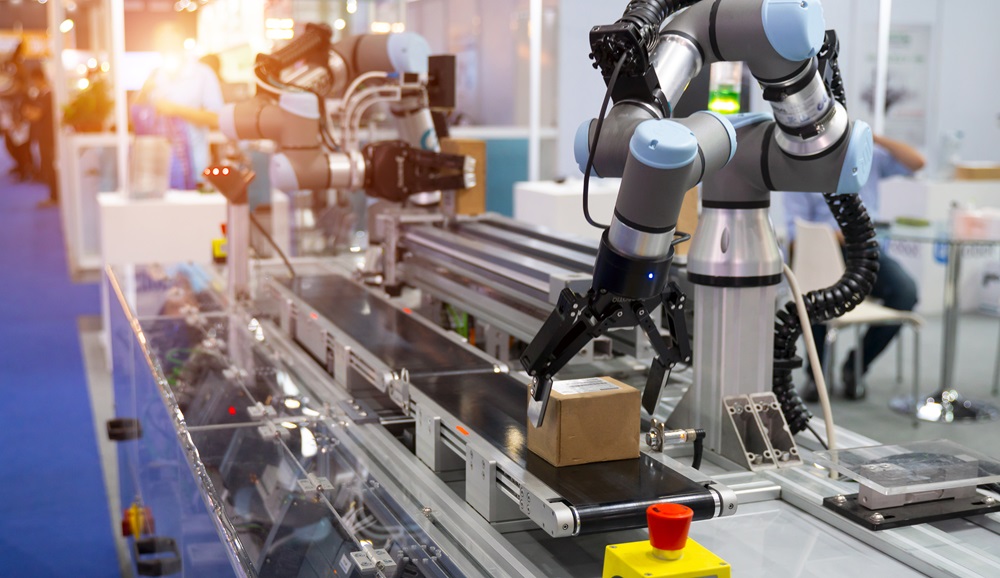
Universal Robots, a Danish collaborative robot (cobot) manufacturer, is further strengthening its partnership with MathWorks, a developer of mathematical computing software, by joining the Mathworks Connections Programme. The programme supports organisations that develop and distribute complementary, commercially available products, training and consulting based on MATLAB and Simulink. Last year, MathWorks became a UR+ partner within the Universal Robots ecosystem, consisting of more than 300+ approved developer companies creating products for the UR platform.


The two companies already work together, co-developing a support package for Robotics System Toolbox that saw its launch in 2023. Engineers can design, simulate, test and deploy their MATLAB-based cobot applications to Universal Robots’ cobots using MATLAB and Robotics System Toolbox from MathWorks.

“In conjunction with MathWorks joining UR+, Universal Robots’ entry into the Connections Programme formalises the organisations’ commitment to helping engineers develop advanced cobot applications,” says Jim Tung, MathWorks fellow. “With Universal Robots’ market leadership and the ability of MATLAB and Simulink to accelerate the pace of innovation, integrators and end users will continue to solve ever-more complex automation workflows.”


Jesper Kildegaard Poulsen, senior director of digital ecosystems at Universal Robots, adds: “We’re delighted to be a part of the Connections Programme and to expand our collaboration with MathWorks. At Universal Robots, we constantly push the boundaries of what we can automate and how easily it can be done. Together with MathWorks, we look forward to continuing our common quest to simplify advanced cobot deployments for robotics engineers.”

More information www.universal-robots.com

Automated airframe drilling becomes reality

An automated drilling solution comprising a FANUC cobot (collaborative robot) is using pre-
qualified tools and process parameters to accelerate aircraft production in response to
booming order books and a record backlog within aerospace manufacturing. The ADUbot
has been developed in conjunction with two partners: aerospace automation specialist
Electroimpact; and Luebbering, a manufacturer of precision fastening and drilling solutions.
By automating the traditionally manual task of drilling thousands of holes in airframes,
ADUbot will help aircraft manufacturers to achieve high levels of rapid drilling autonomy,
releasing human operatives to perform more value-added tasks.

“The record number of orders for aircraft over the next decade means that manufacturers
and suppliers are having to streamline operations and cut cycle times, while at the same
time maintain the highest standards of quality and safety,” says Oliver Selby, head of sales
at FANUC UK.

In a bid to help aircraft manufacturers increase production rates without impacting on
quality, the FANUC/Electroimpact/Lueberring partnership identified drilling as a key
application that would benefit from automation.

“Traditionally, operators rely on a standard aerospace hand tool that uses a concentric
collet locking interface to metallic drill templates or drill jigs that are attached to the wing,”
says Robert Brownbill, senior mechanical engineer at Deeside-based Electroimpact. “These
produce tens of thousands of holes in aircraft every day, yet they are all operated by hand.”

The ADUbot sees a FANUC CRX-25iA cobot take over the manual aspects of this drilling
process. It supports quick programming for the task in hand and equally fast reprogramming
for the next job. Notably, the CRX-25iA is mobile, making it especially suitable for aircraft
assembly operations.
More information www.fanuc.eu