
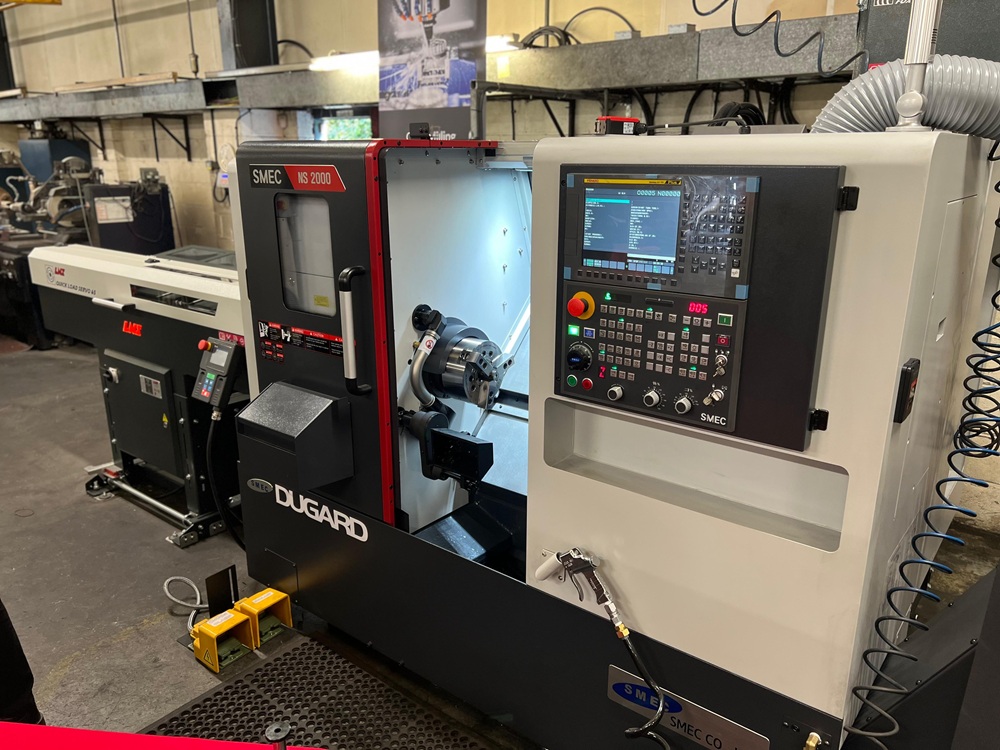
PTG Precision automates production with Dugard SMEC

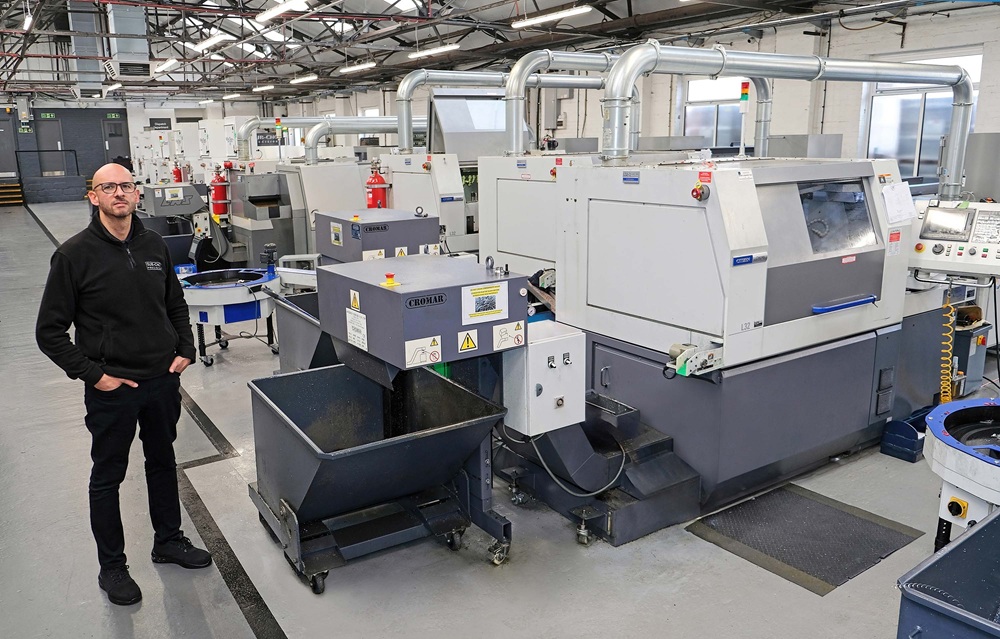
PTG Precision Engineers – an engineering specialist with over 40 years of experience serving the nuclear, aerospace and energy sectors – has taken a significant step towards production automation with the installation of a SMEC NS2000 bar-fed turning centre supplied by Dugard. The investment represents the company’s first foray into automated machining and comes in response to a growing order book and persistent challenges in recruiting skilled machinists.

Over the past 12 months, PTG had experienced a significant upturn in demand, creating operational pressures that existing production capacity struggled to accommodate. When PTG mentioned its interest in a bar-fed lathe to Dugard, the trusted machine tool supplier put together a comprehensive package.

PTG selected the SMEC NS2000A, a bar-fed turning centre that combines accessibility with precision. The NS2000A is equipped with a 6-inch chuck and offers a maximum turning diameter of 310 mm, with a swing over bed of 565 mm.

PTG’s new SMEC NS2000 has been integrated with an LNS bar feeder. The transformation in production has been dramatic. Previously, PTG was processing batches of 25 expanding mandrills at a time on conventional equipment. With the SMEC NS2000 and LNS bar feeder combination, the company now runs batches of 350 off – a 14-fold increase in batch size that has fundamentally changed stock availability and production scheduling.

“The machine requires very little set up,” notes production manager Jim Adkins. “In the morning, we may spend an hour setting the bar feeder, loading it up with bars, putting the programs through again. Then the guys go back and run our other machines. They only return to remove parts from the catcher every half an hour.”

More information www.dugard.com
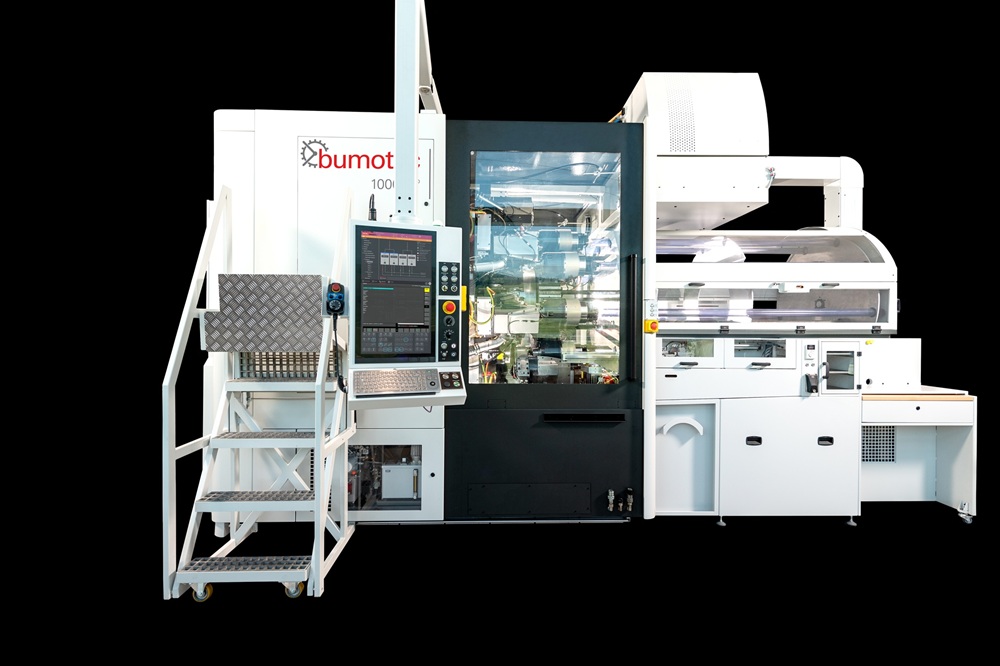
Bumotec 1000/Cneo: Produce more with less energy

The new Bumotec 1000/Cneo horizontal transfer centre was developed based on industry feedback to optimise every step of the machining process. With shorter cycle times, lower energy consumption and easier handling, the machine has 32 motor spindles running at 25,000 rpm and a new touchscreen interface.

“The aim for our new HMI was to make it easier to train new operators on a complex machine with 32 spindles and nine machining stations,” says Cédric Berger, head of the Software Department. “In view of the shortage of skilled labour, companies often employ people who are not trained as precision engineers in machining technology and who previously worked in other professions. For this reason, it’s important for the HMI to be extremely user friendly.”

Up to 40% shorter cycle times are possible, with Bumotec replacing its 8000 rpm motor spindles with 25,000 rpm models. Further supporting short cycle times, a pick-up arm is now in place featuring vices with a shorter stroke. The time for a parting-off sequence is now 7 seconds, a reduction of 30%, while machining time is now 10 seconds – 51% less than the Bumotec s1000/C model.

Another highlight of the Bumotec 1000/Cneo is the monitoring of energy consumption. Thanks to integrated sensors, the Bumotec 1000/Cneo can display relevant values for compressed air and power consumption on its 24-inch screen. And temperature conditions, too.

The new Bumotec 1000/Cneo has been in operation for several months at a company that manufactures watchstrap parts. According to feedback, the increase in productivity is between 40 and 50% compared with the same workpiece machined on the Bumotec s1000/C.

More information www.starrag.com

Two further Citizen CNC lathes bring total to 21

The decision to set up a turned parts subcontracting business at the start of the worst economic crisis in living memory has paid dividends for Yian Stavrou and George Dingley, joint owners of Luton-based Sub-CNC Precision. Supporting their successful evolution from earning a few thousand pounds a month in 2008 to turning over a predicted £3m in the company’s current financial year has been, from the very beginning, continued investment in twin-spindle, multi-axis, bar-fed lathes supplied by Citizen Machinery UK.

Over the years, the ISO 9001-accredited and JOSCAR-registered subcontractor has bought 25 such machines, part exchanging a few to leave 21 on the shop floor as of the end of 2025. Two-thirds are Cincom sliding-head models for producing parts from 0.5 to 38 mm in diameter, while the remainder are Miyano fixed-head turning centres. Many run lights-out from 18:00 to 07:00. 

In 2017, the introduction of Citizen’s proprietary LFV (low-frequency vibration) chip-breaking software in the Cincom control massively assisted unattended machining. The big advantage of the function is that it can be programmed using G codes to switch on and off during a cycle, added to which it also has different modes to adjust the size of the chips. The function is disabled for parts of the cycle where enhanced chip-breaking is not necessary.

As to the fixed-head Miyano lathes, which produce parts from bar ranging from 8 to 65 mm in diameter, or from billet up to 200 mm diameter, they started arriving at the subcontractor’s factory in 2012. The latest to take its place on the shop floor, alongside a new Cincom L20-XLFV, is a Miyano BNE-51MSY.

More information www.citizenmachinery.co.uk

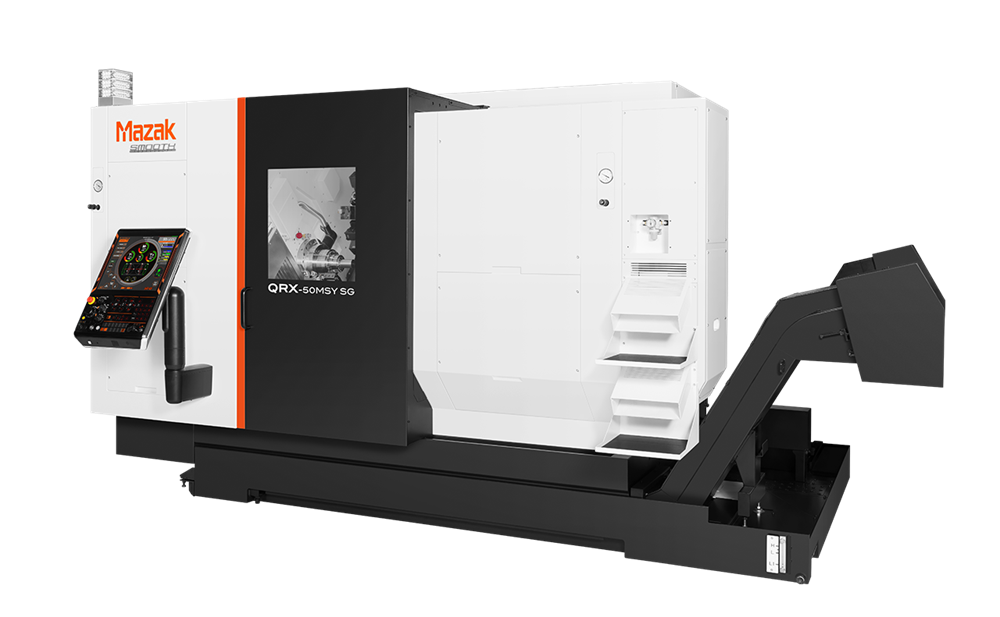
New Mazak QRX-50MSY suits high-volume production

At Mazak Corporation’s recent Discover 2025 event in Florence, Kentucky, the company unveiled its compact QRX-50MSY CNC turning centre, which provides manufacturers with the speed and versatility needed during the high-volume production of small, intricate parts. According to Mazak, the QRX-50MSY’s combination of milling capability, second turning spindle and Y-axis functionality delivers exceptional performance for shops machining small parts such as EV input shafts, mid-shafts, valve fittings and other components exceeding 50 mm in diameter.

The QRX-50MSY is the latest adaptation of Mazak’s HQR Series two-turret/two-spindle CNC turning centre, which has similar milling and Y-axis functions. Mazak’s new machine boasts a 15% smaller footprint with floor dimensions of 3030 x 2200 mm, while maintaining throughput and reduced cycle times. Additionally, the QRX-50MSY’s modular design uses common machine components such as identical left and right spindles, upper and lower turrets, and upper and lower carrier drives. The modular nature of the QRX-50MSY keeps machine cost down to maximise a manufacturer’s return on investment when producing small parts.

Mazak’s slant-bed QRX-50MSY sports a maximum bar diameter capacity of 50 mm with a 152 mm diameter chuck. The main and second spindles use 15 kW motors that provide maximum speeds of 6000 rpm. The 12-station/24-tool position upper and lower turrets feature 5.3 kW rotary tool spindles that also offer speeds up to 6000 rpm.

Its tool holding utilises a BMT 45 interface for fast, precise tool changes. The interface uses static and driven tools and supports a wide range of tool holder types, including radial, axial and angular holders.

The QRX-50MSY comes standard with the Mazatrol SmoothG CNC that includes conversational programming as well as EIA-ISO G-code programming capabilities.

More information www.mazak.com

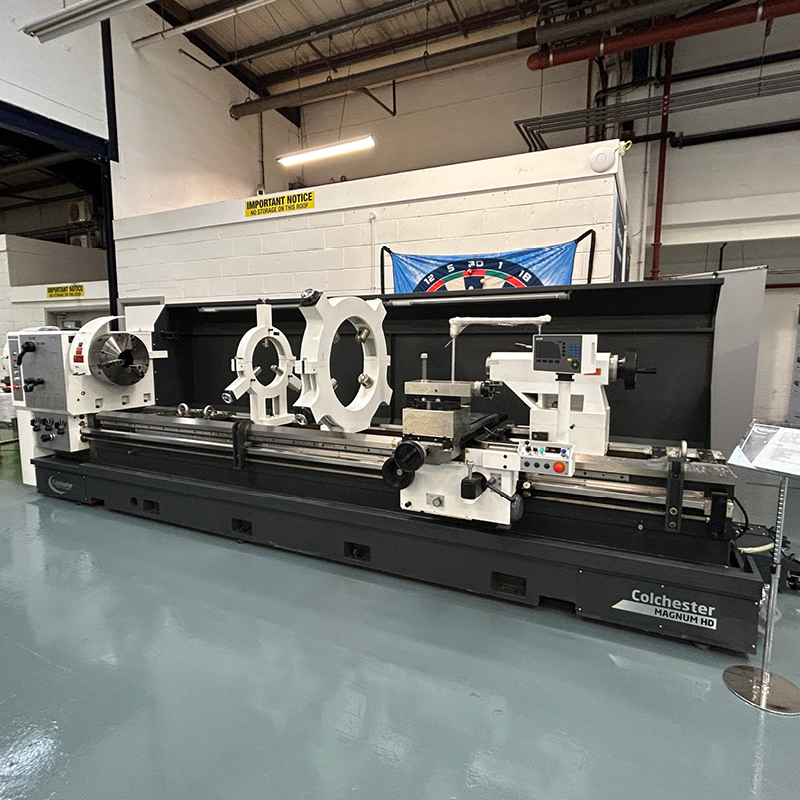
Colchester unveils Magnum heavy-duty manual lathe

The new Colchester Magnum HD is a heavy-duty manual lathe designed for workshops looking to handle large components with complete mechanical reliability. Colchester Machine Tool Solutions says the machine combines attributes that include strength, smooth control and straightforward usability. It is intended for sectors where power and precision must co-exist, such as oil and gas, energy generation, transport, shipbuilding and heavy fabrication.

With a swing-over-bed of 800 or 1000 mm, capacities up to 8 m between centres and spindle bore options up to 380 mm, Colchester says the Magnum HD is capable of tackling components beyond the reach of conventional manual lathes. Its single-piece cast-iron bed provides rigidity and vibration damping, ensuring consistent accuracy under heavy load and extended duty cycles.

Typical headstock configurations offer spindle speed ranges from 4 to 800 rpm across multiple gear ranges, allowing slow, high-torque cutting for roughing and difficult materials, as well as higher speeds for finishing passes. This capability suits a wide mix of work in medium and high-strength steels, stainless steels and other alloys.

The gearbox and headstock are arranged to provide smooth torque transfer at low speeds, helping the machine maintain stability and dimensional control when dealing with large, unbalanced or irregular workpieces. These characteristics make the Magnum HD particularly relevant for repair and maintenance work, heavy turning operations and general-purpose machining, especially where large part envelopes, significant section thickness or tougher materials place high demands on machine stiffness and drive performance.

Notably, the machine’s layout provides clear, unobstructed visibility of the cutting zone, helping operators maintain safe working practices and monitor tool engagement on large components. The controls are positioned for logical reach and intuitive use, reducing unnecessary movement during set up and machining.

More information www.colchester.co.uk