
KASTO Introduces New Control Generation for Sawing Machines

Sawing machine and storage system manufacturer KASTO has introduced a new generation of controls for its sawing machines, combining modern operating principles with practical features to help both experienced and first-time users operate quickly, safely and productively. Initially implemented on the KASTOwin bandsaw series, the new control will undergo subsequent expansion to other models. 

An optimised software architecture provides faster programme loading, quicker response to operator inputs and increased machine availability. At its core is a clearly structured dashboard displaying key information including runtimes, downtimes, current orders and machine status. Operators can rearrange job orders and switch between views, while simultaneously displayed function windows and context-sensitive help reduce clicks and speed operation. 

A ‘Simple Mode’ presents only essential information, guiding novice users safely through the sawing process. User-specific access ensures operators, supervisors and maintenance personnel see information relevant to their roles, while individual settings such as language, measurement units and preferred analytics can simplify training. 

A preloaded material library links material profiles with cutting feeds and speeds, while previously entered data is retrievable to reduce job-entry times. Cutting plans enable the quick creation of multiple jobs with different cut lengths, with each plan assigned to a specific order for better organisation and traceability. 

Used with KASTO’s OptiSaw Light software module, the system automatically assigns orders to available bars, optimising cut sequence and placement to minimise material waste and maximise utilisation. 

A new cycle-stop function allows users to pause and resume jobs from the exact interruption point without re-entering data. Comprehensive diagnostics also identify whether faults are mechanical or electrical, and whether they originate from the machine or material handling system. Analysis functions provide visibility of run time, downtime and saw-band condition. 

More information www.kasto.com 

CAMIO 2026 Launches with Renishaw REVO Five-Axis Integration

LK Metrology has unveiled a major release of its proprietary CAMIO software for programming, analysis and reporting on co-ordinate measuring machines (CMMs). CAMIO 2026 R1 advances multi-sensor metrology with comprehensive support for Renishaw’s REVO five-axis scanning probe system. 

The development enables manufacturers to combine REVO’s synchronised five-axis motion with CAMIO’s advanced inspection capabilities for complex measurement tasks. Users can program and execute REVO inspection routines directly within CAMIO, including advanced strategies such as sweep scanning and head touches. 

CAMIO optimises probe motion and measurement paths to reduce inspection times while maintaining accuracy. Its intuitive interface and offline programming capabilities also allow the creation, verification and optimisation of inspection routines before deployment on the CMM, helping improve productivity and minimise machine downtime. 

“We always strive to give manufacturers the freedom to choose the right metrology hardware for every application, without changing the way they program and inspect parts,” says Jonathan Rich, CAMIO product manager. “Support for the REVO five-axis system is another important step in delivering an open metrology platform that adapts to the user’s manufacturing environment.” 

CAMIO’s plug-and-play interoperability with REVO-equipped CMMs also allows manufacturers to use a single inspection software platform across mixed-brand machines, providing a consistent programming and inspection environment while reducing software lock-in. 

Compatibility with REVO-equipped CMMs is achieved using the industry-standard I++/DME client/server architecture. CAMIO operates as the I++ client, communicating with the UCC controller’s I++ server over a standard TCP/IP network. This standards-based approach avoids proprietary software or hardware modifications, simplifying integration while allowing manufacturers to maximise their existing metrology infrastructure. 

More information www.lkmetrology.com

JWA CNC Precision Overcomes Complexity with Mastercam  

JWA CNC Precision is demonstrating how the right CAM technology can help manufacturers consistently and profitably manage complex components and demanding tolerances. The UK subcontractor produces around 2000 different components each year from a catalogue of 9000, with tolerances routinely reaching 5 µm. 

Working predominantly with non-ferrous materials, including aluminium, stainless steel, plastics and composites, Leicester-based JWA supplies one-off and medium-batch components for aerospace, defence and green energy applications.  

For more than 20 years, JWA has relied on Mastercam software as the foundation of its manufacturing infrastructure. Technical director Tim Shillabeer, who has extensive experience with multiple CAM platforms, says the software’s widespread use provides access to extensive knowledge and support, as well as training resources. 

However, JWA has gone beyond simply ‘using’ Mastercam. The company has developed standardised programming and set-up procedures that enable trained operators to move between jobs and machines with confidence. New employees can become proficient quickly, while annual refresher training helps maintain skills across the workforce. 

“As a long-time user of Mastercam, we’ve ironed out so many little nuances that work really well for us,” says Shillabeer. 

This standardisation has reduced machine downtime, shortened gaps between jobs, and eliminated hours lost through programming and set-up variations. It also enables JWA to respond rapidly to new manufacturing challenges using established libraries, defaults and processes. 

Describing the company as being “quite at the advanced end of the scale” in its use of Mastercam, managing director Pete Wood says the approach has helped JWA maintain demanding quality standards while scaling its operations. It has also supported the company’s achievement of AS9100 certification and created a flexible, skilled workforce capable of handling its diverse production requirements. 

More information www.mastercam.com 

Enztec reduces CNC cycle times 16% with Vericut Force

New Zealand-based orthopaedic surgical instrument manufacturer Enztec has achieved a 16% average reduction in CNC cycle times after implementing Vericut Force, unlocking more than 1800 hours of additional annual machining capacity without investing in additional machines or labour.

Producing high-precision reusable and single-use orthopaedic instruments for global medical-device companies, Enztec operates in a tightly regulated sector where machining accuracy, surface finish and dimensional repeatability directly influence product performance and patient safety. As the company expanded its use of advanced CNC machining, automation and unattended operation, it identified a growing need for greater predictability in machining performance and tool behaviour.

To address this challenge, Enztec integrated Vericut Force into its programming and verification workflow. Unlike traditional CAM systems that rely largely on assumed cutting conditions, the software simulates the real physics of the machining process using actual tool geometry, material properties and machining parameters. It dynamically adjusts feed rates to maintain consistent cutting forces and chip thickness, increasing feed rates where engagement is low and reducing them where loads rise.

The result has been faster, more stable and significantly more predictable machining performance, particularly during lights-out operation.

Jack Greaves, process improvement engineer at Enztec, says support from local reseller AxsysCNC Ltd helped accelerate implementation and optimise machine models for real production conditions.

Over a 12-month period, the improvements translated into more than 1800 hours of additional machining capacity, while also delivering more consistent tool wear and reducing the risk of unexpected failures during unattended machining. Enztec has now established force-based optimisation as a core part of its CNC programming strategy.

More information www.vericut.com

Starrag RCS 8.0 CAM software suite now available

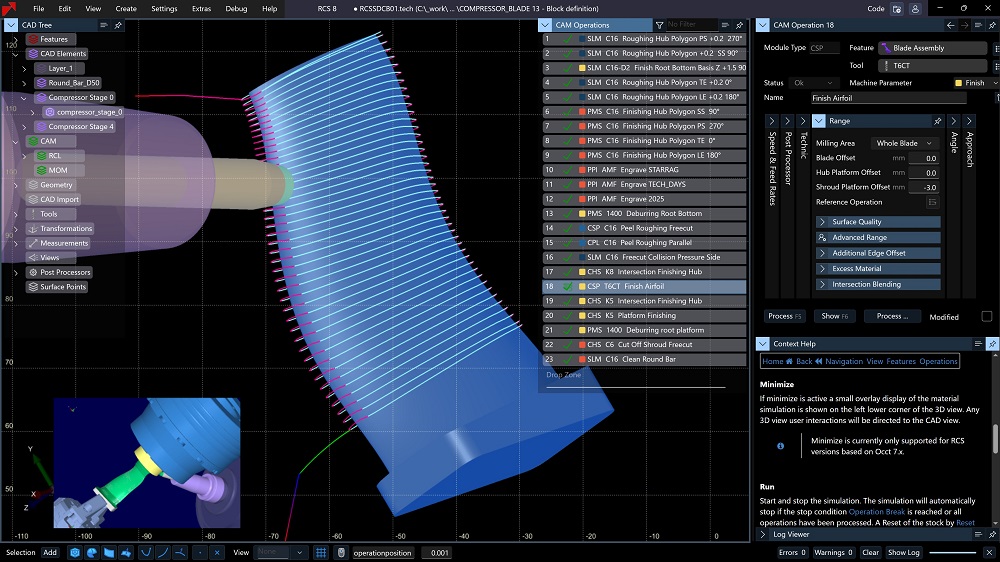
Starrag’s new RCS 8.0 CAM software for the machining of turbine blades now has learning capabilities. Demonstrating over 30 years of software experience, the latest version of the software also integrates pioneering functions such as automated workflows and precise geometrical adaptation to variable unmachined parts – a clear step forward for complex freeform contours.

‘Le mieux est l’ennemi du bien’ – perfect is the enemy of good, noted French philosopher Voltaire over 300 years ago. He warned against destroying things that are already good in the pursuit of perfection. The skilled programmers in Rorschacherberg, Switzerland, have been heeding this warning for more than three decades. Instead of rashly discarding the tried and tested, the Starrag teams developed it further.

Early RCS versions 1 to 6 were mainly used in the five-axis machining of aerospace components. The subsequent 7 series brought advances such as best-fit workpiece alignment, automatic ‘dengeling’, collision avoidance and combined roughing/smoothing strategies, while updates to RCS 7.8 brought numerous optimisations for practical use. Importantly, users who switch to the latest version will not have to go without these tried-and-tested functions and the features that were introduced in version 7.8.

RCS 8.0 is characterised by comprehensive backwards compatibility with projects from RCS 7.x.Existing NC strategies, program structures and milling paths can be transferred over and seamlessly integrated into the new form of AI-supported machining. Users benefit from familiar processes – enhanced by automated workflows, modern geometry algorithms and AI optimisation. Notably, RCS 8.0 brings advances in user guidance, process control and real-time feedback. A modernised user interface, intelligent navigation with integrated error analysis and asynchronous workflows enable continuous work without interruption.

More information www.starrag.com