
PECO on right track with VISI CADCAM

As one of the world’s major manufacturers of model railways, PECO is a forward-looking family business that started trading back in 1946. Initially concentrating the production of trackwork for model railway enthusiasts, the company has grown exponentially. To support its expansion, the Devon-based company relies on VISI CADCAM software from Hexagon at its design and manufacturing facility.

PECO’s toolroom manager Simon Cockerham says: “We use numerous licences of VISI across our processes, from concept through to final press or mould tool creation. In addition, we use VISI to generate laser-cut wooden kits featuring surface textures, and create instructions that guide enthusiasts and users on how to assemble the equipment.”

He continues: “VISI has always been very good for our business as it focuses on what we need to do the job. Some of our previous software packages caused issues due to tight component tolerances and the nature of the machining processes that we have to undertake to achieve the geometries required in our press and mould tools.”

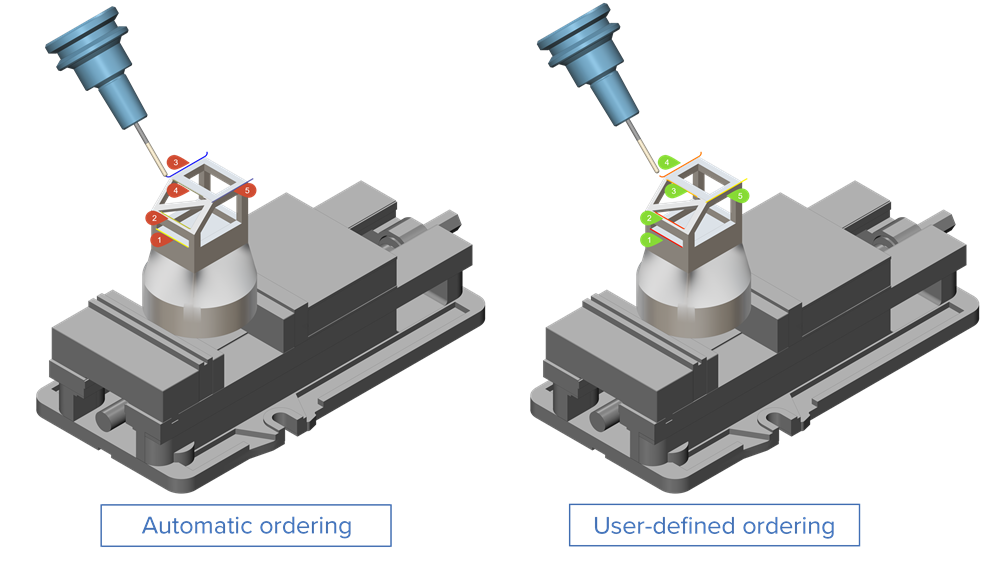
VISI incorporates modules such as: modelling; analysis; mould design; flow; electrode design; die tool design; 2.5, three and five-axis toolpaths; blanks; and reverse. This capability provides PECO with the facility to create solid models, design, analyse, validate and prepare mould tool geometries, and perform pre- and post-production analyses of plastic parts.

With dedicated modules for creating electrodes, designing dedicated progressive die and press tools, comprehensive machining strategies, and even reverse engineering of editable solid models from scanned data – VISI provides a complete package for the company.

“Another key reason why we use VISI is the complexity of our products,” says Cockerham. “We need jobs to be right first time.”More information www.bit.ly/4iX3f8h

Vericut introduces two AI-powered tools

Vericut, a global specialist in manufacturing software, is releasing two AI-powered tools: Vericut Intelligence (VI) and Vericut Assistant (VA). The company says these new resources enhance how users interact with and gain knowledge from Vericut’s suite of software products.

VI is an AI-driven solution that serves as a knowledge hub for all of Vericut’s software offerings, including Vericut, Composites, Vericut Optimizer, and a variety of other modules and features. The resource is accessible to everyone, providing in-depth information on any aspect of Vericut’s software, from basic inquiries like ‘what is Force?’ to more detailed questions about specific functionalities like ‘what is X-Caliper?’

While VI focuses on providing product knowledge, VA assists users with the practical application of Vericut software. VA offers step-by-step guidance on the use of various features, answering how-to questions directly within the software. For example, users can ask, ‘how do I use Auto-Diff?’ and receive precise instructions. As VA evolves, it will also start to interact directly with the software, allowing users to perform tasks like ‘add a tool with these criteria’.

“Our goal with VI and VA is to simplify information access, making it intuitive and easy for users to deepen their understanding of our software,” says Gene Granata, director of product management at Vericut. “The new tools deliver intelligence that’s incredibly useful and relevant, streamlining the user experience and setting a new standard for product knowledge accessibility.”

“The introduction of VI and VA marks the beginning of a long-term strategy to integrate AI into Vericut’s products, with the ultimate goal of maximising productivity while ensuring privacy,” adds Frankie Cates, director of information and security at Vericut.

More information www.vericut.com

New lease of life for large milling machines

The retrofit of Heidenhain TNC 320 controls and drives to three large Elgamill travelling-column bed mills at the Swansea factory of subcontractor Afon Engineering have improved their reliability and performance. It has been an object lesson in how mechanically sound machine tools built in the late 1980s can be given a new lease of life for a fraction of the cost of investing in new equipment.

Engineering director Andrew Beaujean says: “The project has given us more confidence to take on a much broader variety of contracts and is bringing in new business as a result, such as evaporator tube plate machining.”

The refurbished machines at Afon have beds measuring 12, 10 and 8 m respectively in the X axis. The mid-size model, when it was installed in 2009 with an earlier Heidenhain TNC 355 control, was the first CNC machine on site. The other two Elgamills, which arrived five and 11 years later, were fitted with a TNC 155 CNC system. Two smaller, as-yet unmodernised machines from the same manufacturer are also on the shop floor.

The upgrade to the new controls has considerably reduced programming times by up to 50%, making more jobs economical to undertake. A benefit of having identical TNC 320s on three Elgamills is that, from the operator’s perspective, all keys, buttons and switches are in the same place, so swapping between machines is seamless. Moreover, the overall cost of the refurbishments was within budget at approximately £350,000 for all three machines, an order of magnitude less than purchasing three new machining centres of similar capacities.More information www.heidenhain.co.uk

CADCAM for production Optimisation

Open Mind, creator of HyperMill CADCAM, not only presented enhancements to its
software at the recent AMB exhibition in Germany, but also its range of services –
everything from practical training courses to solution concepts for process optimisation.
Visitors to the trade fair could see three workstations demonstrating how HyperMill can
create a connected, digitalised manufacturing environment. Important aspects to this
journey include the Hummingbird MES (Manufacturing Execution System), HyperMill
automation technologies and the virtual machine.
At AMB, Open Mind CADCAM innovation highlights included HyperMill turning
solutions. This innovation is also an example of working with digital twin technology: lathes
with turrets and Siemens control systems where all tools are mapped in detail
in HyperMill Virtual Machining.
 
An agile manufacturing execution system such as Hummingbird MES helps companies
optimise production processes. According to Open Mind, the tool allows the utilisation of
resources in the best possible way, supported by increased productivity. Hummingbird MES
is a flexible solution that offers modules and system components for entry into digitalisation
through production management.
 
“HyperMill is a crucial piece of the puzzle for ensuring future-oriented and connected
manufacturing,” explained Jasmin Huber, director of marketing and communications at
Open Mind Technologies AG. “End-to-end digitalised processes are the key to optimisation
of the entire value chain. We enjoyed showing trade fair visitors how a high degree of
digitalisation has a positive impact on production. At the same time, this can effectively
counteract the shortage of skilled workers, as well as time and cost pressures.”
More information www.openmind-tech.com

Plan, manage and optimise factories in digital reality

Hexagon’s Manufacturing Intelligence division has launched a new digitalisation solution, Digital Factory, to help manufacturers build accurate digital replicas of their plants. It enables manufacturers to optimise floor plans and quickly pivot production lines, and prepare for smarter and more sustainable future factories with open interfaces that enable digital twins of shop-floor assets. Such solutions could save a global manufacturing company millions of pounds a year by avoiding costly mistakes and offering a 50% reduction in travel costs and on-site training. 

Hexagon addresses this issue through its expertise in: reality capture and surveying equipment; software to visualise, explore and simulate scenarios in 3D; and high-productivity cloud-native collaboration workflows. Digitalisation technologies are a proven technology with over two decades of use in civil infrastructure, architecture and public safety. However, their potential has yet to see full realisation in the manufacturing space, where significant disruption now requires manufacturers to rethink their production equipment and use of space.

According to research, 32% of manufacturers believe that outdated or ineffective manual processes and workflows are barriers to productivity and collaboration. Digital Factory is a future-ready alternative to traditional factory planning that enables manufacturerstoramp up productivity and increase efficiency in remodelling, preventing costly mistakes. It also empowers more efficient collaboration between manufacturing and operations teams from anywhere in the world. The core of the solution is improved access to up-to-date data in immersive virtual environments that reflect reality, addressing a major barrier that smart factory initiatives face today. 

Hexagon offers complete workflows to ensure manufacturers achieve the maximum value, from scanning the factory and processing the data into actionable 3D models for various applications, to managing the data in the cloud.

More information www.bit.ly/4eiiB3J