MACH Machine Tools, a supplier of CNC and manual machines and machine shop equipment to UK and Irish component manufacturers, has recently supplied, Hill Helicopters, a vertically-integrated manufacturer of luxury private helicopters, with two new manual machines. The machines, comprising a best-selling MACH VS-1SP (Super Precision) vertical turret-type mill and a MACH L-1340 lathe, were installed at Hill’s modern 5250 sq ft Development Centre in Rugeley, Staffordshire in May and October 2022, respectively.
The investment in both MACH models was made to increase the machining capacity and capabilities of the company’s newly established tool room and, by doing so, help ‘free-up’ its production-led CNC machine tools from having to be available to undertake routine and less complex and critical machining operations.
Although only recently acquired, the two MACH machines have already proved their worth and are an important part of the company’s overall in-house machining resource.
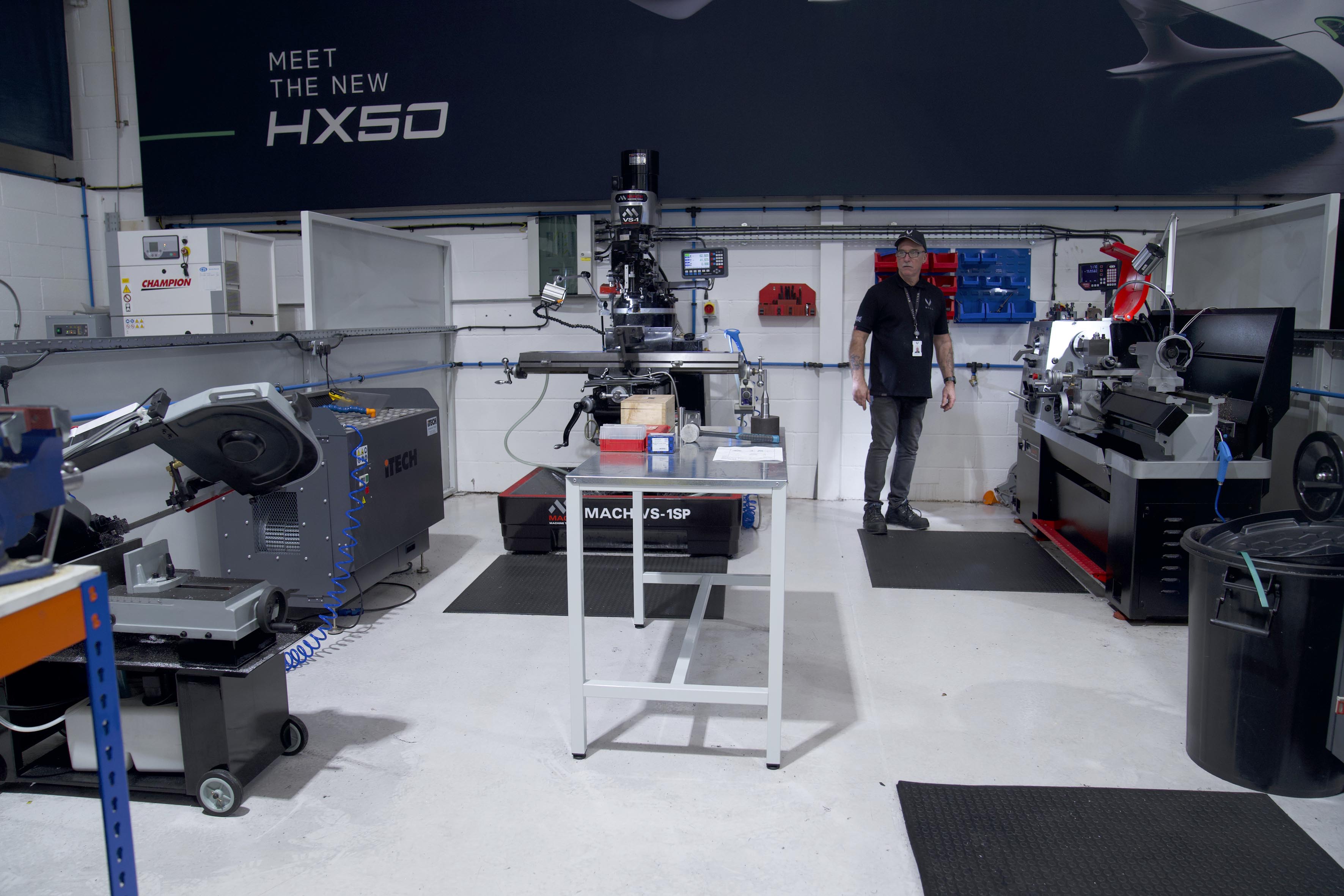
The two MACH machines, along with other manual equipment, are now in-situ within a specially-designated and demarcated tool room positioned within the company’s impressive machine shop facility.
Notably, the tool room plays a crucial ‘supporting’ role in helping the company to achieve its daily production targets which, at present, are focused on designing, developing and machining high-precision prototypes and pre-production parts (and their attendant machining processes) for its HX 50 (private) and HC 50 (commercial) helicopter platforms.
To date, the two MACH machines have earned their spurs machining one-offs and small batch series, as well as machining intricate features, such as shaft thread forms, on specific parts. The machines also manufacture a range of jigs and fixtures which, when completed, are transferred to the production-oriented CNC machines in the machine shop.
Explains Mark Webb, Hill Helicopter’s lead production engineer: “The MACH machines are accurate, fast, flexible and reliable, and are helping us improve our productivity and process efficiencies. Our tool-room facility acts like a ‘business within a business’. It exists to serve and support our wider machine shop needs and takes pressure off our production-oriented CNC machines which, to meet our tight deadlines, are always in high demand.”
The acquisition of the two MACH machines followed a chance meeting earlier in the year between Webb and representatives of MACH Machine Tools at the MACH 2022 exhibition in Birmingham.
“We attended the MACH show at the NEC primarily to look at acquiring a range of ancillary equipment production like wash tanks, welding kit, rumblers and polishers for our machine shop,” says Webb. “During our attendance we came across MACH Machine Tool’s stand and there, in plain view, were a number of manual machines that, I believed, could do an important job for us.”
He adds: “I met Dave Andrew from MACH Machine Tools to discuss our requirements and, after agreeing the scope and scale of the investment and finalising all the details, ordered a manual mill and a manual lathe there and then.”
The MACH VS-1 SP manual mill is built to exacting quality standards that include: hand-scraped hardened and ground dovetail slideways; Turcite B on the ways, slideways and gibs; and hardened and ground table tops and T-slots with nickel-coated lead screws. The machine is equipped with a 3 hp EVS Yaskawa-controlled inverter motor that provides absolute control over the infinitely variable spindle speeds (up to 5000 rpm). Standard features include a two-axis Newall DRO, low-voltage LED lighting, power feed to the X axis, coolant equipment and a stand-on style composite base splash tray. Offering travel of 850 x 305 x 127 mm in the X, Y and Z axis respectively, the MACH VS-1 SP comes with a 1245 x 229 mm worktable that can accommodate workpieces weighing up to 340 kg.
The MACH L-1340 lathe feature a heavy-duty spindle (2.2 kW/2570 rpm) housed in a robust headstock for increased flexibility and improved productivity. Notably, the machine’s headstocks feature British Matrix manufactured clutches, nylon safety pins in the end train and chromium molybdenum gears and shafts. The machine offers 1000mm distance between centres, 171mm height of centres, 180 mm X axis, 1000 mm Z axis and a Newall DP 500 two-axis DRO. Also supplied are three- and four-jaw chucks and quick-change tool posts. The lathe features induction-hardened and ground gears and shafts for long service life. Of particular note, Meehanite cast, anti-vibration and stress-relieved beds offer high accuracy and process reliability featuring Turcite B coating between the bed and carriage, while anti-float backlash eliminators deliver improved accuracy, surface finish and tool life.
With a VS-1 SP already in stock and available for immediate delivery, MACH Machine Tools decided to loan Hill Helicopters an ex-demo L-1340 lathe from its showroom until a new lathe become available.
“We appreciated MACH’s flexible and proactive approach that would enable the mill and lathe to be delivered to us at the same time,” recalls Webb.
Although MACH Machine Tools’ involvement with Hill Helicopters is currently limited to the supply of one manual mill and one manual lathe, this could change, quite dramatically, in the future. The planned move in 2024 to a new 330,000 sq ft manufacturing facility in Stoke, will enable the company to ramp up production to meet its Year 1 and Year 2 targets. This will translate to building and delivering 250 and 500 helicopters, respectively, to customers around the world, presenting opportunities for the relationship between both companies to grow.
Continues Webb: “We will be increasing our headcount quite considerably in the years to come [from 40 to over 400] and, to help address future skills shortage issues and problems recruiting talented staff, we will create an apprentice training school at the new facility. To ensure new recruits learn basic and foundation level engineering and machining skills and competencies, it’s our intention to invest in a number of additional manual machines to train apprentices ‘the Hill way’.”
This is another example of the company controlling the means of production, of its commitment to vertical integration, and of developing and bringing in-house, as many manufacturing technologies and processes as possible.
For further information www.machmt.co.uk