
Industry research from Deloitte shows that manufacturers continue to invest heavily in improving efficiency and resilience, with greater attention on productivity, process stability and making better use of existing capacity. For global cutting tool and machining solutions specialist Sandvik Coromant, this supports its approach of working closely with customers to improve performance directly within production. The company’s ongoing partnership with Merx, a precision subcontract manufacturer based in Söderköping, Sweden, is a case in point.
Fortune Business Insights reports that the global superalloys market is projected to grow significantly from $8.78bn in 2026 to $22.44bn by 2034. As demand increases across sectors that rely on high-performance components, manufacturers require specialist knowledge, stable processes and the confidence to work with these challenging materials, something Merx has been building for decades.
Since Hans Hammargren and his co-founder started Merx in 1989, the company has grown from a small operation into an established high-precision manufacturer, supplying customers across the energy sector and other demanding industries.
Today, Merx employs around 75 people and operates a growing number of CNC machines, producing components where reliability is critical and tolerances are often measured to the thousandth of a millimetre. The company is now preparing for its next phase of growth, with plans to expand its facility by around 1000 m² and add more machines to increase production capacity.
“We’re growing, and we need to keep improving at the same time,” says Hammargren. “That applies to both production and how we work with our partners.”
A key part of Merx’s offering is its ability to machine complex materials that many subcontract manufacturers choose not to work with. One of the most demanding materials is Inconel 718, a heat-resistant superalloy widely used in turbine and energy applications, and where components need to perform reliably under extreme conditions.
The material’s strength and resistance to heat make it suitable for these environments, but the same properties create challenges in machining. Cutting forces are high, heat builds quickly at the cutting edge and tool wear occurs quickly, often reducing tool life to only a few minutes. This places pressure on both process stability and cost, where even small inefficiencies can have a significant impact on overall production.
“It’s a material many companies say no to,” adds Hammargren. “For us, it’s part of what we do, but it requires the right approach.”
Merx has worked with Sandvik Coromant in different ways since its early years, initially through distributors and later through direct collaboration. In recent years, the relationship has developed further, moving from a traditional supplier setup to a more integrated partnership.
Long-term relationships are important in this industry,” remarks Haris Karsic, account manager at Sandvik Coromant. “It’s through ongoing collaboration that you build an understanding of the customer’s production and can make improvements that actually hold up over time.”
This evolved collaboration has been driven by a combination of improved agreements and increased technical involvement. Engineers from Sandvik Coromant now visit the site regularly, working directly with Merx’s production teams to test tools, optimise parameters and identify improvements.
“It’s a very hands-on collaboration,” explains Hammargren. “They’re here in our production environment, working with our people and helping us solve real problems.”
The impact of this partnership is particularly clear in the machining of Inconel 718, where the introduction of Sandvik Coromant’s CoroDrill DE10, an exchangeable-tip drill for high-volume hole making, has led to measurable improvements in performance. Trials carried out in production showed a 48% increase in productivity, alongside a 32% reduction in cycle time per component.
What’s more, the total cost per component was reduced by approximately 51%. This saving was achieved through a combination of longer tool life, improved cutting data and more stable machining conditions.
Tool life doubled during testing, increasing from 20 to 40 components per cutting edge, while engagement time per component decreased from 1 minute 31 seconds to 0.93 minutes. These changes allow more parts to be produced in less time, improving both output and cost efficiency.
“When you look at the total economy, it becomes very clear,” says Hammargren. “It’s not about the price of a single tool, but how much you can produce and how stable the process is.”
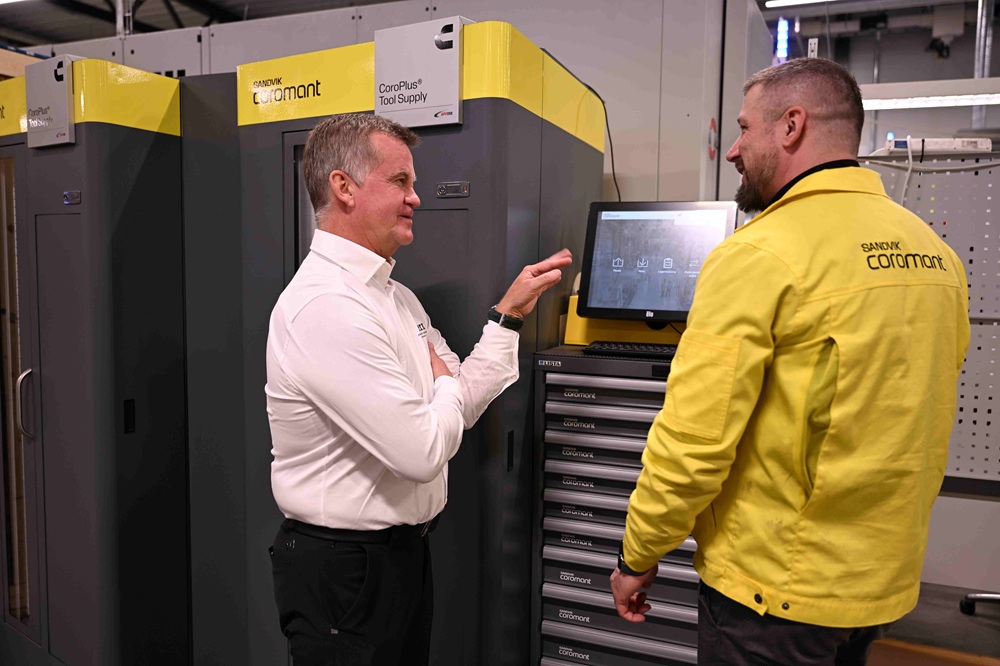
In addition to cutting performance, the collaboration has focused on improving how tools are managed and used within production. One of the changes has been the introduction of Sandvik Coromant’s CoroPlus Tool Supply tool inventory system, which provides controlled access to tools and detailed usage tracking.
The system has improved organisation on the shop floor by allowing operators to access specific tools quickly and efficiently. Unlike previous solutions, where entire drawers were opened, the new system provides access to individual compartments, making it easier to locate the correct tool and reducing unnecessary handling time.
“It’s much clearer and easier to use,” adds Hammargren. “Our operators prefer it, and it saves time in daily work.”
The system also provides more detailed reporting, giving better visibility into tool consumption and usage patterns. This capability allows Merx to monitor costs more closely and make more informed decisions about inventory and process improvements.
The collaboration has also introduced measures that contribute to more efficient use of materials and resources. Through Sandvik Coromant’s buyback programme, used carbide tools are returned and reprocessed, reducing waste and supporting a more circular approach to production.
Reconditioning services are also used to extend tool life, allowing tools to be reused without compromising performance. While the focus remains on efficiency and cost, these steps also help reduce waste and lower the overall environmental impact of machining operations.
“Sandvik Coromant has encouraged the recycling of cemented carbide for several decades,” notes Karsic. “Recovering and reusing materials is a practical way to reduce waste while maintaining performance, and it’s something we continue to develop together with our customers.”
Merx is continuing to expand its operations, with increased production space and additional machines planned over the coming years. As capacity grows, maintaining consistent performance across all processes becomes increasingly important.
The company is therefore continuing to work closely with Sandvik Coromant to evaluate new tooling solutions and refine existing processes step by step. Changes are introduced only when they deliver measurable improvements, ensuring that production remains stable while performance improves.
For Merx, the relationship with Sandvik Coromant is based on ongoing cooperation rather than individual projects. The combination of technical support, on-site collaboration and proven results has helped strengthen production in some of the most demanding applications.
“The technical competence and the support we receive are the most important factors,” states Hammargren. “That’s what helps us move forward.”
As manufacturing requirements continue to evolve, this type of collaboration is becoming increasingly important. For Merx, it provides a practical way to improve performance while supporting long-term growth in a competitive and demanding industry.
With the global superalloys market continuing to grow, manufacturers working with demanding materials like Inconel 718 will face increasing pressure to deliver both precision and efficiency. Success depends not only on the right tools, but also on specialist knowledge, stable processes and the right people behind them, exactly the kind of long-term partnership Merx has built with Sandvik Coromant.
More information www.sandvik.coromant.com