

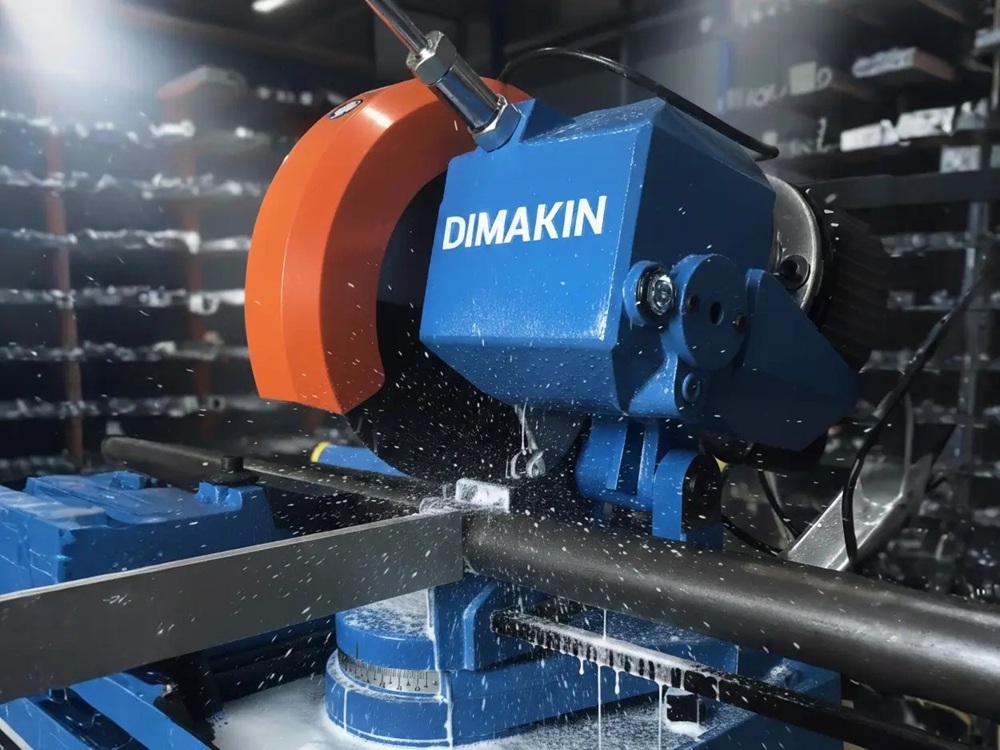
Cold saws are widely used in metalworking because they produce clean, accurate cuts with excellent repeatability. However, many cutting problems attributed to blades or machines can often be traced to a much simpler cause: coolant. Metalworking machinery supplier Dimakin sets out why coolant matters in cold saw cutting quality.
Although described as ‘cold cutting’, the process still generates considerable heat where the blade meets the workpiece. Without effective cooling and lubrication, heat builds up in both the blade and the material, reducing cutting accuracy, accelerating tool wear and affecting surface finish.
Unlike abrasive saws, cold saws use a toothed HSS or TCT blade to shear metal cleanly. Coolant plays a vital role by removing heat from the cutting zone while reducing friction between the blade teeth and the workpiece. The fluid helps maintain stable cutting conditions, particularly during long production runs or when machining difficult materials.
Effective coolant flow also improves surface finish by flushing swarf away from the cut, preventing chips from being recut and reducing burr formation. Lower friction means smoother cutting, less vibration and longer blade life, helping to reduce downtime and operating costs.
Coolant quality is equally important. Poor-quality or incorrectly mixed fluids provide inadequate lubrication and cooling, leading to increased blade wear, residue build-up and inconsistent cutting performance. Using a high-quality soluble cutting fluid at the correct concentration helps maintain reliable cutting conditions while protecting both the machine and the tooling.
Rather than being treated as a simple consumable, coolant should be regarded as an integral part of the cutting process. Correct coolant selection and maintenance deliver measurable improvements in cutting accuracy, surface finish, blade life and overall productivity.
More information www.dimakin.co.uk