Scholarship to support women in engineering

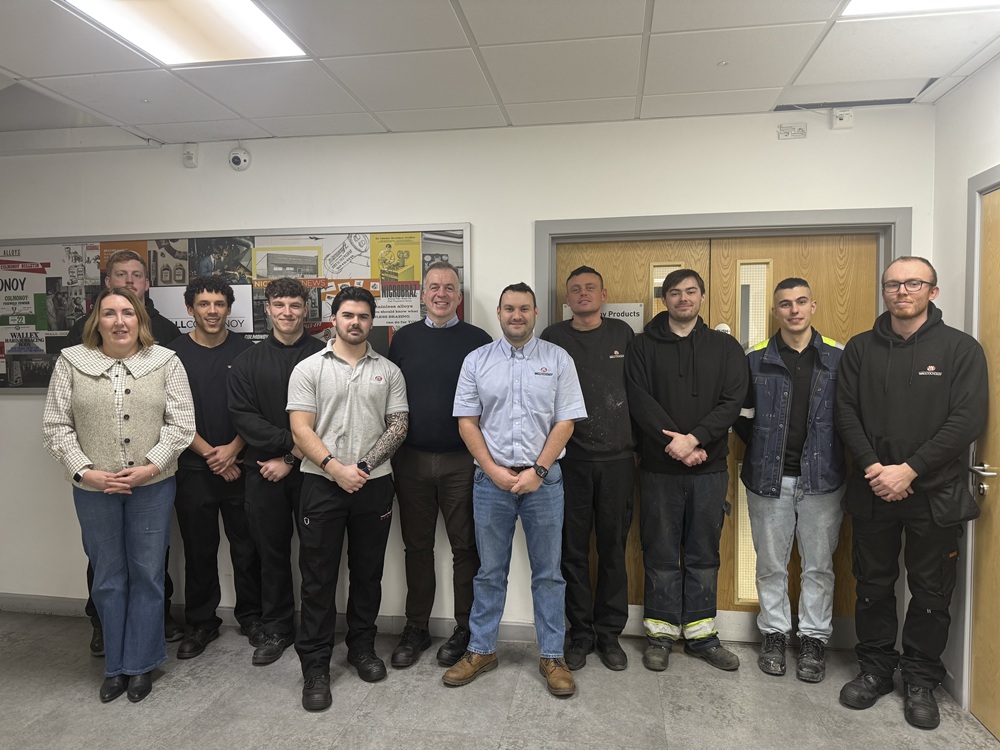
Broadcaster, journalist and author Steph McGovern returned to her Teesside roots recently to launch a major scholarship programme aimed at increasing the number of women entering engineering. The new Steph McGovern Women in Engineering Scholarship will provide support for every first‑year, full‑time female engineering student at Teesside University, thanks to £44,000 of funding from Enginuity, the engineering skills charity. At a special event held in the university’s Digital Life building, the inaugural scholars learnt they would receive support from Steph herself during their studies. 

More information www.enginuity.org

Advanced inventory management on show at Southern

Inventory management specialist Tooling Intelligence demonstrated four control solutions at the Southern Manufacturing 2026 exhibition last week. The company’s stand featured live demonstrations of technologies designed to eliminate inventory waste, reduce downtime and deliver measurable cost savings for manufacturers.

With manufacturers facing mounting pressure to improve operational efficiency while controlling costs, Tooling Intelligence’s offering addresses the growing challenge of inventory control. The company’s comprehensive range of solutions – from weight-based vending to electronic access control – provides manufacturers with real-time visibility, automated replenishment and detailed usage tracking that transforms inventory from a cost centre into a competitive advantage.

Visitors to the stand could see the SmartBin weight-based inventory management solution in action. The system delivers absolute control over fasteners, cutting tools, spare parts and critical components through precision weight-sensing technology. Available in four fixed configurations accommodating between 30 and 64 distinct SKUs, SmartBin eliminates manual counting while providing real-time visibility of stock levels.

The system’s rapid transaction speeds and secure RFID badge access ensure authorised users can quickly access what they need, while automated order generation prevents stock-outs and reduces emergency purchasing. For manufacturers struggling with inventory shrinkage or inaccurate stock records, SmartBin’s continuous monitoring delivers immediate accountability and cost reductions.

Alongside the SmartBin was the SmartDrawer vending solution, which offers high-capacity storage from a compact footprint. SmartDrawer provides an entirely custom configuration of drawers and several locations to meet exact requirements. It dispenses everything from cutting tools and abrasives to calibrated instruments and PPE with individual item control. LED-guided product location and touchscreen operation deliver rapid transactions, while the system’s modular design allows manufacturers to scale capacity as requirements grow. The rapid refill feature enables fast restocking without repackaging, reducing administrative burden and maximising machine uptime.

More information www.toolingintelligence.co.uk

New right-angle heads suitable for automation

A new range of tool-holding heads designed to mill and drill components at right angles to the orientation of a machining centre spindle has been introduced by Swiss manufacturer Pibomulti, whose products are sold into the British and Irish markets exclusively by Gewefa UK. The next-generation CEP-NG heads can likewise be used in the B-axis spindle of a multi-tasking lathe, or in a live VDI turret station of a turn-mill centre.  

Built with high-quality, hardened and ground bevel gears and ABEC 9 angular contact bearings, CEP-NG heads are engineered to deliver reliability, performance, precision and longevity, even when tackling challenging applications in demanding sectors such as automotive, aerospace, medical, defence and energy.

Compared with previous models, the new generation of heads is capable of transmitting higher rotational speeds at a 1:1 ratio, leading to greater productivity due to raised metal removal rate when roughing, or finer surfaces when taking finishing cuts. The CEP-NG 17 model, for instance, which clamps the cutter in an ER25 collet, can reach a maximum speed of 5000 rpm, optionally 6000 rpm, and has a maximum torque of 50 Nm. 

ER8 up to ER50/ISO40 tool clamping is available, the latter being capable of deploying a 36 mm diameter tool and transmitting 210 Nm of torque. A further benefit of the head redesign is that vibration is lower, especially when tool overhang is long, further promoting good surface finish as well as extending tool life. 

Pibomulti CEP-NG heads are also lighter in weight, reducing stress on the machine tool spindle bearings, as well as on the machine structure when the spindle head is accelerating or decelerating in the linear axes. The lightness similarly lessens the load on the magazine arm during automatic tool change and allows quicker exchange.

More information www.gewefa.co.uk

EPS Services explains bandsaw tooth pitch

When choosing a bandsaw blade, tooth pitch is often treated as a secondary consideration. Blade width or overall blade type usually takes priority, with TPI mentioned almost as an afterthought. In reality, tooth pitch plays a major role in how a blade performs in the cut, influencing cutting speed, surface finish, blade life and even machine load. According to EPS Services, problems often blamed on set up or machine condition can frequently be traced back to blade selection.

Tooth pitch refers to the number of teeth per inch of blade, written as TPI. Lower TPI blades feature larger teeth with deeper gaps between them, while higher TPI blades have smaller, closely spaced teeth. These gaps, known as gullets, are responsible for carrying chips away from the cut. If chips cannot clear efficiently, they pack into the gullets, increasing friction and heat and accelerating blade wear. Poor chip clearance is one of the most common causes of premature dulling.

A useful rule of thumb is to ensure at least three teeth are always engaged in the material. This spreads the cutting load and promotes smooth operation. Too few teeth can cause grabbing and chatter, while too many can lead to rubbing rather than cutting, generating heat and reducing efficiency.

Fast dulling, slow cutting, burning and wandering cuts are often linked to incorrect pitch selection, even when machine set up is sound. These symptoms are sometimes misattributed to blade quality.

Variable pitch blades, which alter tooth spacing along the blade, can reduce vibration and improve stability. However, they are not a substitute for selecting the correct pitch range.

Ultimately, tooth pitch affects far more than surface finish. A small change in TPI can significantly improve cutting performance, consistency and blade life.

More information www.eps-services.co.uk

Cutting-edge stainless steel sawing: The real results

Since UK-based KR Saws was founded in 2004, the stainless steel industry has been one of its core focus areas. Backed by the innovation and research of parent companies Kinkelder and Roentgen, KR Saws says it has continually pushed the boundaries of cutting performance and efficiency. The company’s long-standing commitment to this sector is reflected in its position as the only bandsaw blade supplier to be a member of the British Stainless Steel Association.

Roentgen’s R&D team never stops refining its blade technology. After promising test results on stainless steel, the company introduced the Titan ST — a next-generation carbide-tipped bandsaw blade designed for speed, precision and durability. To put the Titan ST to the test, KR Saws partnered with a major stainless steel stockholder that wanted to reduce cutting times and improve productivity.

The stockholder had been using a bi-metal blade, but using Roentgen’s RCS cutting calculator, KR Saws recommended a cutting speed four times faster than the company’s previous set up. In addition, the Titan ST delivered longer blade life, while its pre-honed edge meant no running-in period.

“I’m actually shocked,” said the customer. “The carbide ST blade has been running for a week at the recommended feed and speed, and it’s still cutting perfectly. We’ve had over 100 cuts (16.6 m² blade life) and it’s still going; this blade is a game changer.”

Another recent stainless steel project pushed the limits further — cutting large-diameter 316 and 304 stainless steel. The target was to outperform a competitor’s average blade life of 8.9 m². Following Roentgen’s recommendation, KR Saws introduced the M51 Master, a bi-metal blade built for stainless and alloy steels. Across five blades, the M51 Master achieved an average life of 10.8 m², outperforming the competition by over 21%.

More information www.krsaws.co.uk