
Spanish Automotive Suppliers Generated €40.9bn In 2025

Spain’s automotive supplier industry generated €40.949bn in turnover in 2025, showing resilience, industrial strength, innovation and technological advancement as it responds to the needs of an sector undergoing profound transformation. Exports reached €24.688bn, accounting for more than 60% of total industry turnover. Autoparts From Spain, the platform that brings together leading Spanish manufacturers and exporters of automotive components, says the results are further evidence of the competitiveness of Spanish companies in an increasingly demanding global environment.

More information www.spainautoparts.com

OPTIMISING QUALITY CONTROL SYSTEMS USING ROBOTIC MEASUREMENT CELL WITH MITUTOYO CMM AT ITS HEART

Méca-Précis has implemented a robotic measurement cell to streamline its inspection processes. The solution combines a co-ordinate measuring machine (CMM) from Mitutoyo with robotics solutions from Engineering Data, effectively removing bottlenecks in the parts inspection process.

Some trades are passed down from father to son, along with a passion for excellence. When Bruno Mériaudeau speaks about the sophistication of the components produced in his workshop, the sparkle in his eyes and the enthusiasm in his voice, tinged with pride, say it all. This affable and good-humoured leader has clearly inherited a deep appreciation for precision engineering.

Méca-Précis was founded in 1975 by Bruno’s father, driven by a strong entrepreneurial spirit and a desire to put his expertise in highly technical component manufacturing to work. This expertise was honed during his time working for the military, where he designed and produced one-off parts tailored to highly specialised applications.

Bruno joined the company in 1982, at a time when he was the eighth employee of the family business. Today, he is preparing to pass the torch to his own son, Nicolas, who took over the management of Méca-Précis in 2023. The company now employs 45 people and operates a fleet of 25 machine tools, 18 of which are CNC-controlled. Over the course of nearly half a century, the company, based in Châtillon-sur-Indre, France, has continuously strengthened both its technical expertise and its production capabilities.

Méca-Précis has more than one string to its bow. It now specialises in prototype parts, one-off components, small and medium production runs, and welded mechanical assemblies. As a manufacturer of complex parts for the aerospace and satellite industries, the company has also maintained, for 48 years, the trust of a global leader in carton packaging machinery, for which it produces parts and complete sub-assemblies.

While having the expertise and equipment to manufacture sophisticated components is essential, ensuring these parts meet stringent dimensional requirements is equally critical. To this end, Méca-Précis operates a standard measuring machine on the shop floor, as well as a CMM housed in a thermally controlled environment. However, certain aerospace and space-sector clients require 100% inspection of all dimensions on every single part produced, both before and after surface treatment.


“Dimensional inspection of a single pin takes just one minute, but there can be as many as 300 to check,” explains Nicolas. “At the other end of the spectrum, inspecting a single complex component for a satellite can require up to 80 hours.”


In this context, as production volumes increased and multiple palletised machining centres operated through the night, the CMM was no longer able to keep pace.

“Our two inspectors were overwhelmed,” reveals Bruno. “To maintain a high level of service and manufacturing quality, and to ensure reasonable lead times for our customers, we needed to find a solution to eliminate the bottleneck in the inspection process. We therefore began searching for a way to automate the inspection process.”

As the manufacturer of the CMM used by Méca-Précis was unable to provide a suitable solution, Nicolas turned to Mitutoyo. Mitutoyo proposed the design of a robotic measurement cell integrating the MiSTAR CMM, in collaboration with Engineering Data, a company specialising in fixturing solutions and the automation of machining centres.

Less than a year after the initial meeting between the teams from Mitutoyo, Engineering Data and Méca-Précis – with both quality inspectors closely involved throughout the project – the robotic measurement cell was installed in the workshop. Following phases dedicated to developing part inspection programs, system commissioning, configuration and technical fine-tuning, an additional six months were required before the system became fully operational.

“We’ve effectively removed the bottleneck that was located in the quality control process,” asserts Bruno. “This solution brings us greater flexibility and allows us to significantly increase inspection capacity. If we did not have this robotic measurement cell, we wouldn’t be able to cope with the growing production volumes of series-manufactured parts.”

Adds Nicolas: “We now have a solution that fully meets our needs. Throughout this project, we benefited from the quality of exchanges, responsiveness, attentiveness and geographical proximity of the Engineering Data and Mitutoyo teams.”

As a result, the pressure that had been weighing on Méca-Précis’s two inspectors has been reduced. They can now rely on two measurement solutions to perform all the necessary checks in-house. The robotic cell has reduced their workload by performing automated inspections during the day as well as overnight. Before leaving the workshop, they can load parts into the robotic system, which then carries out the inspections automatically in their absence.

The solution is the result of Engineering Data’s expertise in machine tool loading automation, combined with Mitutoyo’s know-how in dimensional control. Méca-Précis’s robotic measurement cell is installed within an enclosed structure, defined by glass panels that ensure operator safety while providing full visibility of the system’s internal operation.

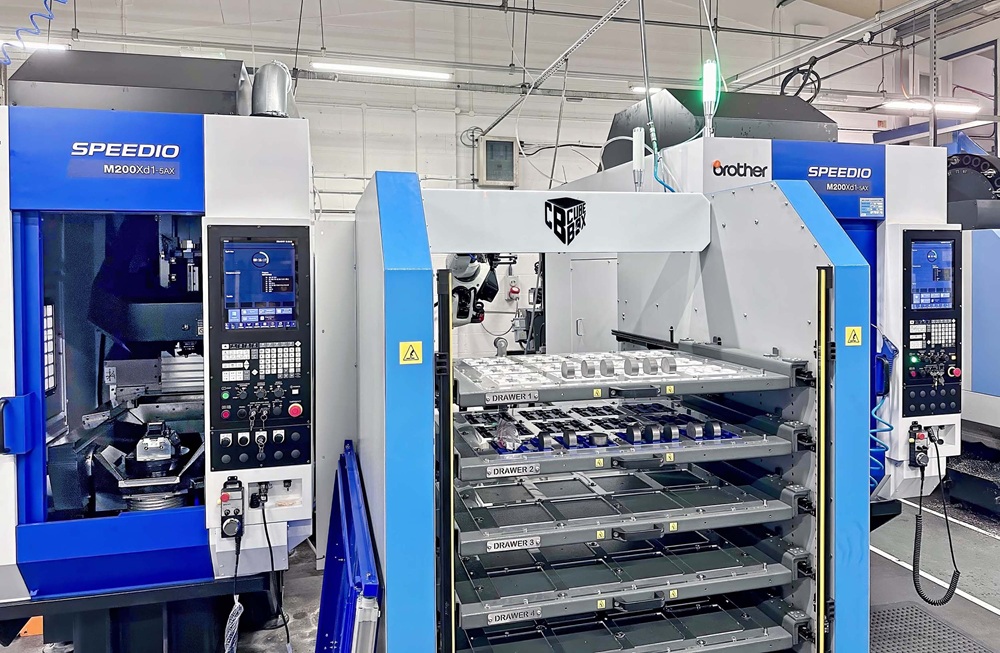
The cell integrates a multi-axis articulated robot responsible for handling operations, a Mitutoyo MiSTAR CMM designed for shop-floor use and an automated storage unit capable of accommodating up to 20 pallets on which the parts to be inspected are secured. A loading station, accessible from outside the cell, allows interaction with the operator without interrupting overall operation.

The process begins with the loading phase. The operator places a pallet carrying a part on to the dedicated loading station. Each pallet is designed to hold the component in a position compatible with robotic handling and measurement operations. Using the cell’s HMI, the operator selects the relevant part type. This information is transmitted to the cell’s control system, which automatically associates the component with the corresponding control program. The robot then picks up the pallet and transfers it to the storage unit. This operation can be repeated until the storage system is fully loaded.

Once the pallets have been loaded, the operator initiates the inspection cycle via the interface, with the cell then operating autonomously. The robot successively retrieves the stored pallets and places them on the surface plate of the CMM, which is equipped with a clamping device ensuring proper positioning and stability during measurement. The CMM executes the inspection program associated with the part, performing the required dimensional measurements. Notably, the duration of this phase depends on the number of features to be checked and the complexity of the component, ranging from a few minutes to several hours.

At the end of the inspection, the robot retrieves the pallet and returns it to the storage cabinet. The cycle then continues automatically until all loaded parts have been inspected. Measurement results are recorded by the system and can be reviewed later by metrology engineers.


The overall operation relies on co-ordination between the control system, the robot and the measuring machine. Pallet handling automation allows the loading operations to be decoupled from the measurement phases, ensuring continuous use of the control equipment while reducing manual handling.

More information www.mitutoyo.eu

Modernising Plant Engineering With Messer Cutting Systems

Greater precision, increased added value and independence: A strategic investment in advanced cutting technology is helping Austrian plant engineering specialist Kremsmüller Industrieanlagenbau strengthen productivity, expand in-house manufacturing capabilities and improve long-term competitiveness.

The family-owned company, which employs around 2300 people, provides engineering, fabrication and installation services for sectors including energy, petrochemicals, pharmaceuticals, food and manufacturing. Seeking to replace an ageing flame cutting system, Kremsmüller selected the OmniMat CNC cutting platform from Messer Cutting Systems to improve precision, increase flexibility and reduce reliance on subcontract machining.

“We wanted more than a replacement machine,” explains Hannes Gattermayer, head of production. “Our objective was to improve cutting accuracy, increase vertical integration and introduce new machining capabilities.”

The new system combines oxy-fuel and plasma cutting, bevel cutting, pipe processing, boiler end machining, and automated marking on a single platform. Integrated OmniWin CADCAM software simplifies programming while supporting efficient production of both one-off components and small batches typical of plant engineering.

Among the new capabilities are in-house machining of boiler ends up to 4200 mm in diameter and processing of pipes up to 6 m long with weld bevels, reducing dependence on external suppliers while improving lead times and quality control.

The installation also incorporates ergonomic features, including a water cutting table with automated water level control, conveyor-based slag removal and plate cleaning, helping to reduce manual handling while improving working conditions.

Completed in mid-2025, the project was delivered through close collaboration between the two companies, with the first production cut completed just three and a half weeks after installation began.

“The new system represents a genuine technological leap for us,” says Gattermayer. “We’ve increased our vertical integration, stabilised our processes, improved working conditions and strengthened our competitiveness for the future.”

More information www.messer-cutting.com

Metalworking Entrepreneur Makes Sparks Fly With Trumpf

At just 18 years old, Peter Götzl founded a one-man metalworking business in Erbendorf, Germany. Two decades later, he leads one of the country’s most advanced contract manufacturers, with a fully automated, digitally connected sheet metal production facility built around Trumpf laser cutting technology.

After qualifying as a master craftsman, Götzl established the business in 2005, initially producing railings and fences. As demand grew, outsourcing laser-cut components created production bottlenecks, prompting him to explore laser cutting technology for himself.

A demonstration of a Trumpf TruLaser Tube 7000 convinced him that laser tube cutting could dramatically increase productivity and precision while opening new business opportunities. The investment required a new production hall and additional staff, but the gamble paid off. Installed in 2014, the machine nearly doubled production speed and transformed the company from a traditional metalworking shop into a modern subcontract manufacturer.

Growth accelerated further as Götzl expanded into high-volume production for industries including automotive, storage systems, furniture and renewable energy. A second TruLaser Tube 7000 followed in 2017, supported by responsive Trumpf service that minimised downtime and reinforced confidence in the partnership.

Inspired by a visit to Trumpf’s Smart Factory in Chicago, Götzl embarked on an ambitious digitalisation programme. Since 2019, he has invested around €25m in an automated production facility, including seven laser tube cutting machines, TruBend press brakes, TruDisk lasers, a 24 kW flat-bed laser, automated storage from Stopa and Oseon production control software.

Around €12m of that investment has been in Trumpf technology. Designed with future growth in mind, the facility provides the capacity, flexibility and automation to serve increasingly demanding manufacturing requirements while positioning the company for the next decade of expansion.More information www.trumpf.com

Fabricator Transitions From CO2 To Fibre Laser With BLM

Helping to position Bell Steel Fabrications, Cricklade, for its next phase of growth is an 8 kW BLM LS7 fibre laser profiling centre, replacing a decade-old CO2 laser cutter. The investment supports the fabricator’s diverse customer base, including its specialist production of bespoke stainless steel exhaust systems for classic cars, which accounts for around 40% of turnover.

Established in 1977, Bell Steel Fabrications has grown into a 21-employee business supplying customers in the UK and overseas. Managing director Matthew Bell first encountered BLM Group at the MACH 2010 exhibition, leading to the purchase of an Elect 80 electric tube bender that has delivered reliable performance and strong aftersales support ever since.

“When the time came to replace our flat-bed laser, BLM was the natural choice,” says Bell. “We assessed three suppliers but felt BLM offered the best combination of quality and value.”

Installed in March 2026, the LS7 delivers reductions in operating costs compared with the previous CO2 machine. Bell estimates annual electricity and gas savings of around £20,000, while benefiting from faster processing, lower maintenance requirements and greater energy efficiency.

The machine processes mild steel, stainless steel and aluminium components for applications ranging from classic vehicle parts and architectural metalwork to structural fabrications and industrial equipment. Features including fly-cut technology, active piercing, automatic focus adjustment and automatic nozzle changing improve productivity, particularly for the company’s high mix of small-batch and prototype work.

Although Bell Steel Fabrications has not yet automated material handling, the LS7 can be integrated with BLM storage and handling systems as production demands grow. The investment provides greater productivity, flexibility and future capacity, strengthening the company’s position as a value-focused engineering partner for subcontract manufacturing.

More information www.blmgroup.com