
Gear production savings on another planet

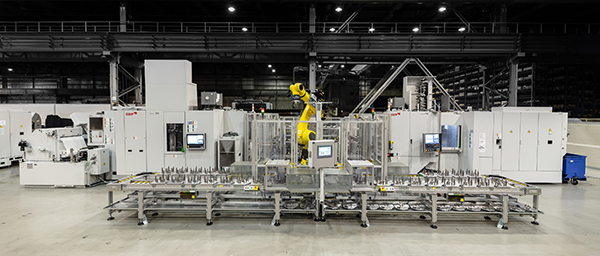
A fully automatic production cell based around two Heckert five-axis horizontal T45 machining centres from Starrag with integrated robot handling is manufacturing process-intensive planetary gear carriers in half the time taken by conventional methods, while also reducing tool expenditure by around 25% and halving traditional equipment costs.

The capabilities of the T45 machining centres combine effectively with robotised pallet, gripper and tool handling, as well as seamless cell control technology, to ensure Germany-based mechanical engineering and automation specialist Voith increases productivity by producing the carriers in the shortest possible lead times and with high levels of precision and process reliability.

Assuming an annual output of 50,000 parts per year, the system is also enabling productivity per unit area to be increased by up to two and a half times thanks to a reduction in the number of machines being used compared with traditional methods.

From a process perspective, once the component is clamped, an optimally co-ordinated sequence of rough and smooth milling, turning and drilling operations are undertaken by machines with 15,000 rpm, 292 Nm spindles, complemented by fast start-up and deceleration rates, and 60-tool magazines. The extremely short process and throughput times for sequentially machining workpieces that may be of variable design are partly due to the robot‘s ability to automatically set up the required grippers and type-specific pallets in the storage area while the machines are cutting. When the operator approves a new series for production, the robot changes all equipment within eight seconds. This innovative production solution halves the previous process time.

Overall throughput time is also reduced because there is no need to change workpieces between machines – thus, for example eliminating the installation of different clamping devices and re-clamping.

For further information
www.starrag.com
Compact VMC packs a punch

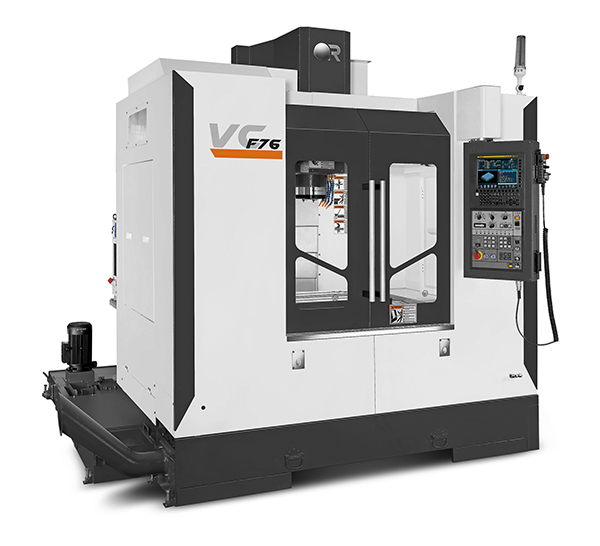
GM CNC has introduced the Victor Vcenter F76 to the UK market for any machine shops seeking a small-footprint three-axis vertical machining centre that is robust, stable, precise and built to last.

Despite its compact footprint, the Victor Vcenter F76 packs a punch with its meehanite casting and A-frame column design. Built upon this foundation is a 15 kW, 8000 rpm BT40 belt-driven spindle that traverses over the 840 x 500 mm table with X, Y and Z-axis travels of 760 by 500 by 510 mm respectively.

The Victor Vcenter F76 can traverse at rapid feed rates of 32 m/min in all three axes. This productivity is complemented by NN-type double roller bearings, 40 mm diameter ball screws and 30/35/45 mm guideways. These technologies help to eliminate backlash and provide bi-directional positional accuracy of 0.010 mm with a repeatability of 0.007 mm.

Affirming this build quality is an overall machine weight of 5260 kg, a FANUC CNC and a barrel-type automatic tool change unit that accommodates up to 24 tools and delivers a tool-change time of 2.4 seconds. As standard, the Victor Vcenter F76 offers fully enclosed splash guarding, screw-type chip remover, air blast, rigid tapping facility, remote MPG, hand tools and toolbox, T nuts for table slots, three-step warning light, and levelling pads.

Some of the options include a spindle upgrade to 10,000 rpm, a 30-tool ATC, an optional 690 mm in the Z axis, rotary tables, coolant and air gun, precision linear scales, oil skimmer, automatic doors, 4th/5th axis interface, auto tool length and part measurement, auto power-off, air conditioning for electrical cabinets, through-tool coolant, and spindle cooling units.

For further information
www.gm-cnc.com

Alpine F1 Team opts for Mikron

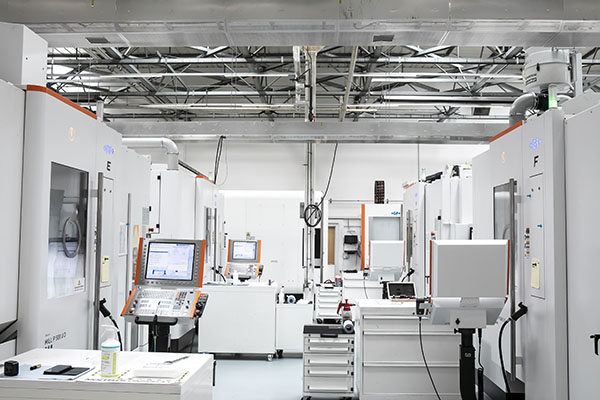
Alpine F1 Team’s recent investment in eight Mikron MILL P 500U five-axis machining centres has had a dramatic and positive impact on the productivity and efficiency of its manufacturing operations. The machines – four with integrated automatic pallet changers and four without – are now operational at the F1 Team’s manufacturing facility in Enstone, Oxfordshire. These eight MILL P 500Us replaced six Mikron HPM 450U five-axis machines that were acquired in 2016. Whilst still performing satisfactorily, the HPM 450U’s days were numbered.

Ian Pearce, Alpine F1 Team’s head of supply chain, says: “The Mikron HPM 450Us are good machines but changing situations and circumstances within our own manufacturing operations dictated that they needed to be replaced as a matter of some urgency.”

The arrival of the new machines has enabled Alpine F1 Team to take advantage of fast rapids (61 m/min) and 1 G acceleration/deceleration rates, as well as gantry-type construction and a trunnion rotary tilting table (with tandem support on its tilt axis).

Front uprights are among the parts now undergoing machining on the MILL P 500Us.
Says Bruce Foster, metallics production manager at Alpine F1 Team: “The uprights are primarily 3+2 machined from solid aluminium, with full simultaneous five-axis machining taking place when and where appropriate and beneficial. Cycle times are about 12 hours per upright, while geometric tolerances across the part are 10 µm or better, along with Ra 0.2 µm surface finish.”
In addition to the front uprights, the MILL P 500U machines produce the cars’ hydraulic manifold from (solid) aerospace-grade aluminium to exacting tolerances. Over 85% of the material is removed during the roughing process, leaving a complex part exhibiting a number of delicate and intricate features.

For further information
www.gfms.com

Metalite moulds automated future

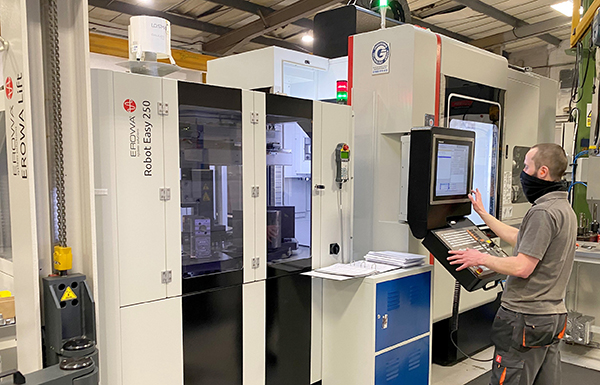
Injection mould tool specialist, Swindon-based Metalite Engineering, has recently added to its plant list with the arrival of a Quaser five-axis UX500C machining centre and a 10-pallet Erowa Robot Easy 250 pallet loading system. Supplied and integrated by the Engineering Technology Group (ETG), the new investment is adding significant capacity to Metalite with its unmanned machining capability.

The UX500 is primarily for medical sector work, although Metalite is also highly regarded for its ability to serve the aerospace, automotive, Formula One, food packaging and horticultural industries. In total, the machine has 60 tools and a 15,000 Maxia spindle with a face and taper dual-contact system. Additionally, the UX500C has rigid knuckle-type axis rotation to provide full machining access around the component. Metalite needs this flexibility and precision as it is making parts that extend from small medical components with 5 µm tolerances, up to large tool steel die parts. For this reason there is a crane on the automation system to load larger billets.

ETG’s Steve Brown says: “The partnership between Quaser and Erowa goes a lot deeper than what is here in the UK. Both companies have a technical partnership and that is rolled through to us at ETG. So, we are the distributor for Quaser machines, and we have great support from REM Systems that supply the Erowa system. When we enter into a package together, we can tailor the solution to meet the needs of the customer.”

The success of this installation has already seen Metalite order a second system that will be applied to a three-axis vertical machining centre, where the robot loading system will incorporate four pallets.

For further information
www.engtechgroup.com

Arcot makes five-axis investment

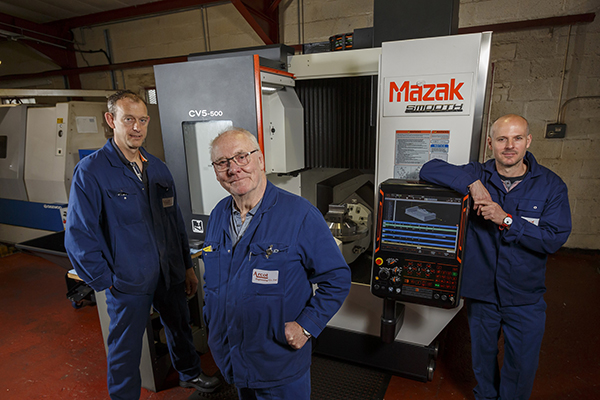
Cramlington-based Arcot Engineering has upgraded its capabilities by investing in a Yamazaki Mazak CV5-500 five-axis machining centre, which Mazak says is suited to engineering companies making their first move into five-axis work.

Kevin Graham, machine shop manager at Arcot Engineering, says: “We have a long history of working with vertical machining centres, but we’ve had ambitions to move into more complex and lucrative five-axis work for some time. The CV5-500 is priced at a very competitive level for subcontract manufacturers like ourselves, but still has the usual Mazak build quality.”

Arcot has developed a strong reputation manufacturing parts for a variety of industries, with particular strength in oil and gas, torque tension tools and hydraulics.

“Our new five-axis capabilities mean we can perform multiple tasks on one machine, which in turn reduces set-up times,” says Steve Mason, machine shop-floor manager. “We’re now doing three, four or five phases of a job in one set up, while also reducing cycle times by a minimum of 30% thanks to the 12,000 rpm main spindle. This machine is going to make us much more competitive.”
The move into more complex five-axis work was aided by Mazak, which provided a full week of off-site training.

“The CV5-500 is programmed using Mazak’s own SmoothX control,” says Mason. “I’ve never run a Mazak before but I’ve found the programming to be really easy and very user-friendly.”

Alan Mucklow, Mazak UK’s managing director – sales and service, adds: “Five-axis is a more complex type of machining, but Arcot Engineering are showing what’s possible when a company has the ambition to try and the will to make it work.”

For further information
www.mazakeu.co.uk