
The best of both manufacturing worlds

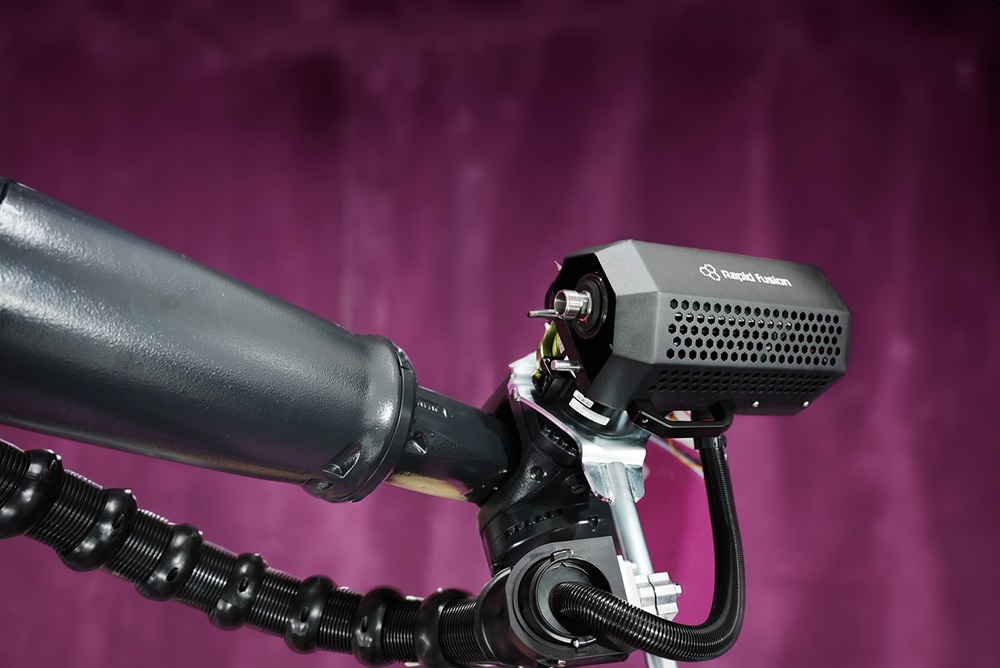
A UK 3D-printing specialist is targeting a £3m opportunity after launching a new CNC milling tool that will offer manufacturers the best of both worlds. Rapid Fusion, which employs eight people at its recently opened Exeter R&D centre, has created a high-performance electro-spindle that will provide the precision milling and post-processing of polymer 3D prints.

Eight months in gestation, the breakthrough technology will be fitted to the company’s future Zeus 3D robotic systems, providing clients with the opportunity to enjoy the speed of additive manufacturing with the precision of subtractive machining – all in a single 6 x 6 m cell. The tool is suitable for use on high-quality moulds across a range of industries.

“This CNC milling tool has the potential to be a real game changer for manufacturers and has been designed in partnership with a number of end users to ensure we deliver exactly what they need,” explains Martin Jewell, R&D director at Rapid Fusion. “3D printing can give unrivalled speed and creates moulds near net shape, within 3 to 4 mm. Certain applications need even greater precision and this is where you can call in a CNC milling tool to remove the excess material. Going forward, we’ll be able to offer this as a single turnkey solution.”

He adds: “The advantages are huge. We know we can deliver repeatable quality and, in a trial project, we reduced the lead time for a mould tool from six to eight weeks to just five days.”

The CNC milling tool comes equipped with a tool changer, allowing users to swap between it and the 3D printing pellet extruder on a robot set-up. It can also handle engineering-grade materials, such as glass- and carbon-filled PEI and PEEK polymers.

More information www.rapidfusion.co.uk

Versatile tool for factory floor unveiled

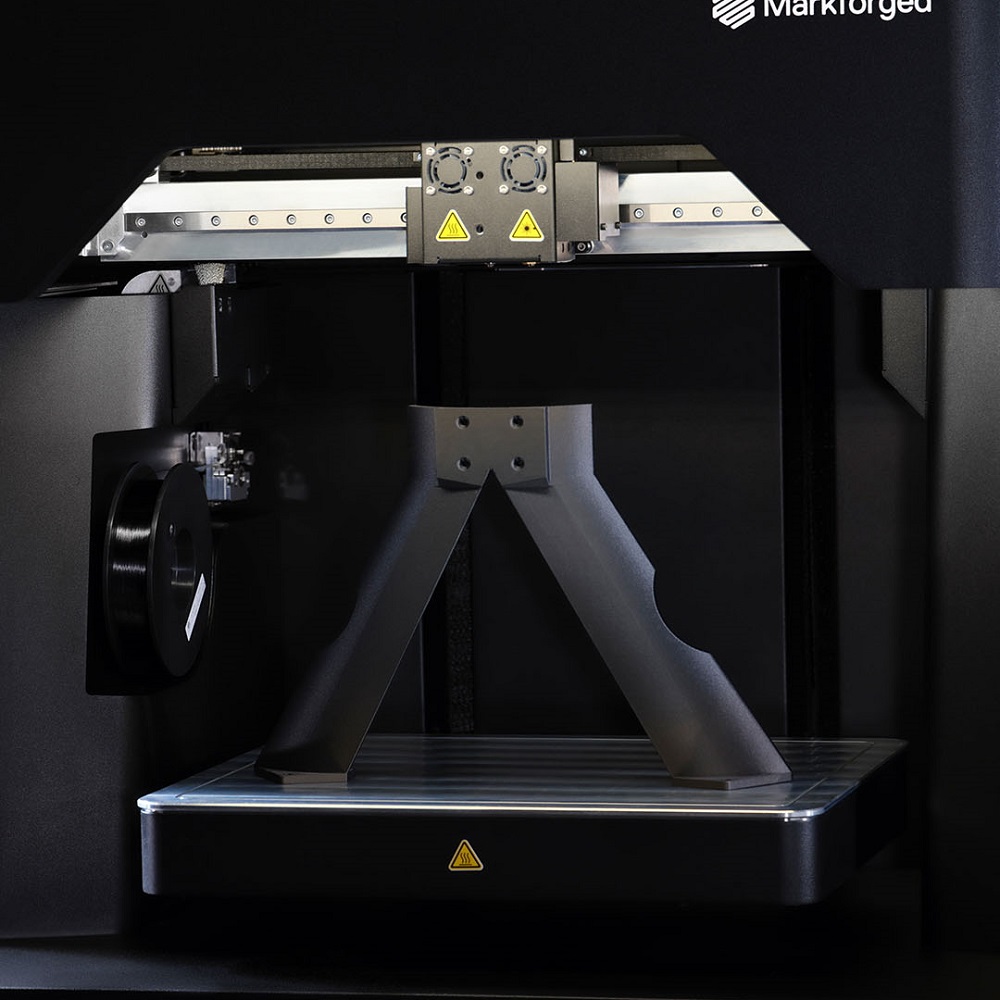
Markforged has unveiled its newest industrial 3D printer, the FX10. The FX10 empowers users to print the right part when and where it is needed, reducing costs and cutting lead times from months to days compared with traditional manufacturing methods.

“We engineered the FX10 to be the best tool for the manufacturing floor,” says Shai Terem, CEO of Markforged. “The FX10 allows manufacturers to slash original part replacement costs in comparison with traditional methods and keep production lines running without worrying about supply chain issues or spare parts inventory. The FX10 can accelerate the digitisation of the manufacturing floor by increasing the adoption of digital inventory to build supply chain resiliency. Our customers now have the potential to save even more capital by reducing physical inventory and boosting production yields while decreasing operating costs.”

Designed with flexibility in mind, it is possible to expand and upgrade the printer’s modular systems with additional capabilities. For example, the FX10 has been designed to incorporate a printhead integrated vision module to capture detailed part images and data to further ensure part quality and optimise printer performance. The fifth-generation Continuous Fiber Reinforcement (CFR) print system delivers high print quality in a heated print chamber, allowing for print speeds that are nearly twice as fast and print sizes that are up to twice as large as previous Markforged industrial series printers. This capability enables the replacement of metal parts with advanced composites.

“The FX10 is another important milestone in our mission to bring industrial production to the point of need,” states Terem.“It enables our customers to address even more industrial applications with clear return on investment. Coupled with our ‘Digital Source’ platform, we are truly starting to bring the vision of distributed manufacturing into reality.”More information www.markforged.com

UltiMaker launches industrial-grade 3D printer

UltiMakerhas released the UltiMaker Factor 4 industrial-grade 3D printer, an end-to-end 3D-printing solution for light industrial applications.

With support for engineering materials, direct-drive dual extrusion, on-board print quality reporting, temperature-controlled build volume, UltiMaker 4 delivers high levelsof predictability and minimal variance. Built upon more than a decade of dedication to openness and accessibility, the machine will support one of the widest material portfolios on the market for a variety of applications, including end use parts, functional prototyping, manufacturing tools, and small batch manufacturing of auxiliary components and spares.

Factor 4 offers a temperature-controlled build volume of 330 x 240 x 300 mm and uniform bed heating, ensuring consistent performance across the entire build plate. Designed for the manufacturing and industrial sectors, it launched with a new high-temperature print core that allows engineers to print up to 340°C, enabling a broader range of high-performance, temperature-resistant, and durable materials. These include the new UltiMaker PPS CF, a high-temperature composite material.

The machine uses the heated bed and actively controlled chamber airflow to manage the build volume temperature up to 70°C, ensuring optimal material-specific processing conditions and consistent part quality wherever the 3D printer is located. It is tested to achieve over 95% print completion success and dimensional accuracy within ±0.2 mm or ±0.2% of the feature nominal length.

The latest print profiles for Factor 4, available on Cura 5.7.1, enable the printing of engineering materials such as PET-CF and nylon with productivity levels similar to tough PLA and PETG, effectively doubling print speed when compared with the UltiMaker S series.

More information www.ultimaker.com/factor-4

UK-manufactured large-format 3D printer

New additive manufacturing technology – designed and manufactured in the UK – was launched at TCT 3Sixty earlier this month.LANDR, which spun out of fast-growing RYSE 3D, is looking to unlock engineering-grade technology and materials for SMEs, disruptors and entrepreneurs with the arrival of LANDR 500.

Featuring a 500x500x500mm build volume, the large-format FDM printer gives users the scope to build larger and more complex parts suited to rapid prototyping and volume production for end-use in the automotive, aerospace, healthcare and consumer sectors.

The machine is the brainchild of Mitchell Barnes, who recognised the need for a cost-effective 3D printer that delivered high power and flexible capability. At £11,398.80 including VAT, LANDR says its nearest competitor is 10 times the cost, three times the weight and twice the size, making it difficult to fit into shop-floor operations.Nearly £200,000 of pre-orders are already in the pipeline and LANDR used the TCT 3Sixty event to give potential customers the opportunity to register their interest.

“I was frustrated with what I was seeing in the marketplace, especially the lack of options that were within financial reach,” says Barnes.“Like most difficult things I encounter in life, there’s no choice but to take them head-on and develop innovative solutions from scratch.

Over the course of the next 12 months, the team has designed, tested and built LANDR 500, a 3D printer that will support a wide range of engineering-grade materials.”

He adds: “We are successfully using 10 printers at our sister business RYSE 3D. With 30,000+ hours of use so far, there’s no better testing ground than a company supplying parts to 18 of the world’s hypercars.”

More information www.landr3d.com

3D-printed body panels for wind tunnel tests

Stewart-Haas Racing partnered with 3D Systems to determine the best-performing aerodynamic shape for the new 2024 NASCAR Ford Mustang Dark Horse through an innovative approach to testing hundreds of different body panel shapes in a highly efficient way.

3D Systems’ SLA machines and 3D Sprint software in combination with the development process used by the two companies, yielded a race car body for the Ford Mustang Dark Horse race car that combines the aesthetics of a 2024 production car with aerodynamic performance for the Ford team’s race cars to win races and a NASCAR Cup series championship.

To submit a new race car body shape, the Ford race teams needed to meet specific aerodynamic coefficient specifications as determined by NASCAR. This is ideally achieved during a full-scale wind tunnel test of the submitted car body, which can be extremely costly and time-consuming. Stewart-Haas Racing found a more efficient solution that allows it to test dozens of different body panel shapes during each test session by partnering with additive manufacturing firm 3D Systems. 

The 3D Systems’ 3D Sprint software is intuitive to use and enables the technician to set up CAD models of parts that require printing. It is then possible to send the resulting files to 3D Systems’ ProX 800for fast, accurate printing of the parts in the desired material. By fastening the 3D-printed parts to the sub-structure of the full-scale car, Stewart-Haas Racing could define the entire car body shape using these 3D-printed tiles.As the car wasundergoing tests in the wind tunnel, additional 3D-printed tiles could be added or removed from the car to test various concepts.

More information www.3dsystems.com