

£60m funding package for Bridgnorth

A Midlands manufacturer and supplier of aluminium flat-rolled products has secured a £60m asset-based lending facility from HSBC UK to help diversify its product range and fuel future growth plans. One of Shropshire’s biggest employers, Bridgnorth Aluminium, produces metal strips for lithography printing. The business will use the funding from HSBC UK to diversify into different markets.

Bridgnorth, which has roots tracing back to 1933, will start to manufacture and supply new aluminium flat-rolled products to the drinks industry, helping to increase annual turnover by 40% over the next five years.

Mark Richards, finance manager at Bridgnorth Aluminium, says: “As a business with big ambitions we need to make strategic investments. Over the past 90 years, we’ve held a well-earned reputation for excellence in the lithography industry, which we want to extend into the drinks and retail markets. It’s an incredibly important and exciting milestone for us and we’re happy to have HSBC UK as a funding partner to help us on our new journey.”

The £60m, fully integrated ABL facility provides Bridgnorth with a significant increase in liquidity, allowing the company to invest in its future growth plans in a controlled and structured way.

Mark Lewis, relationship director at HSBC UK, says: “Bridgnorth has all the hard-working characteristics and heritage you’d expect from a long-established Midlands manufacturer, as well as the ability to look ahead through the lens of innovation. This is a pivotal move in the company’s history and is set to lay the foundations for a new, exciting chapter in Bridgnorth Aluminium’s story.”

For further information
www.bit.ly/3I8l0h2

Servo-feeders aid shift to 4-day week

A UK manufacturer of scaffold board end bands has posted an impressive 12% increase in volumes thanks to a timely investment in ancillary equipment and a switch to a 4-day working week. Chilwell Products, which is now under third-generation family ownership, has invested nearly £100,000 in equipping 11 of its power presses with the latest servo-feed technology from Bruderer UK.

Located at Stanton by Dale, the company was originally looking to continue using air feeds, but was convinced by experts from the high-speed press specialist to trial its MF-2P servo feeders and the results have been astonishing. Volumes have gone from 15.6 million to 17.5 million over the past 12 months and, better still, the firm has managed to achieve this in just four days, making Friday a permanent day off as a thank you (while all staff still maintain full pay).

“We always thought that using servo feeds would mean the material would slip when oily, but these initial concerns were quickly blown away once we put the equipment through a supported trial,” explains Laura Clarke, managing director of Chilwell Products and the granddaughter of company founder Derrick Telford. “Through experience we found set-up times were far quicker and the servo-feeds run the material significantly more efficiently than our incumbent air feeds: less jams, less downtime, and less material rejected and wasted. All making for much more efficient production.”

She adds: “With this in mind, we began to roll-out the feeders across every press in our factory and are now up to 11, with a 12th on order. Working 39 hours per week and overtime at multiple points throughout the year is now a thing of the past.”

For further information
www.bruderer.co.uk

Manufacturing gear wheels in 34 seconds

Minimising production times to ensure competitiveness is one of the most important challenges in the automotive industry, a factor recognised by Henry Ford over a century ago. After decades of optimisation, it is difficult to reduce machining times further while maintaining the same level of quality. Nevertheless, Volkswagen (VW), near the German town of Kassel, has managed to achieve this in its gearbox production facility using Kapp Niles gear grinding machines available in the UK from the Engineering Technology Group (ETG).

The Volkswagen plant in Baunatal is one of the group’s larger German locations with a workforce of about 17,000. Production here focuses mainly on car gearboxes in 10 different series. Half of the manufacturing lines feature gear production centres from Kapp Niles.

Kapp Niles machines also find use in the production of the DL382 dual-clutch gearbox for Audi. A total of 16 gearings are required to shift the seven gears within this type of gearbox – 10 ground and six honed. The production unit runs 24 hours a day, 5 to 6 days per week, depending on demand. VW strives to achieve an EPEI (every part every interval) value of 1 day in the production unit, which means that all components can be produced on each day for the aforementioned gearbox. This type of streamlined production requires seamless processes and a high degree of flexibility.

Technical clerk Christian Hahn is in charge of the production process of the DL382 dual-clutch gearbox: “We have five gearing centres from Kapp Niles in the wheel production unit and two more in the shaft production unit. To achieve an EPEI value of 1 day, we change over the machine in the wheel production unit twice every 24 hours. This way, we can produce 10 different wheels per day.”

The challenge with flexible production is the short cycle times. With an output of 880 gearboxes per day, one machine in wheel production must produce 1760 parts per day. Including all set-up times and failures, this yields a line cycle time of 34 seconds. An average line cycle time is 39 to 40 seconds.

Bernd Kümpel, application technician at Kapp Niles, analyses these figures: “Saving 5 to 6 seconds per cycle does not sound like a lot at first, but together it can be a 15% reduction. If I consider that at least 40% of segments cannot be influenced, I have to reduce the actual process time by 30 to 40%. Seen in this way, 34 seconds is a real challenge.”

A total of seven Kapp Niles machines are deployed which, with their low space requirement, are suited to the highly automated production lines at Volkswagen. The machines include three KX 100 Dynamic, two KX 260 Twin in wheel production and two KX 160 Twin in shaft production.

Hahn and Kümpel agreed from the very beginning that the desired cycle time could only be achieved with a combination of several measures. To minimise the daily set-up effort, Hahn makes sure that the wheels which are to be produced on one machine have bore holes of the same size. Thus, he has to change over the machine, but not the clamping tools. The remaining set-up time is minimised by the intelligent set-up concept of the KX 100 Dynamic. For one machine, he needs just 20 to 25 minutes.

“The semi-automatic set-up makes the KX 100 Dynamic extremely user-friendly,” says Kümpel, describing the process. “All you need is an Allen key for the entire set-up operation. With it, you operate the hydro-expansion clamping chuck of the dresser roll. Everything else is connected without any screws via HSK interfaces.”

An additional visual aid is available in the form of a menu guide and an easy-to-understand cycle on the machine controller. By completing the step-by-step process and the acknowledgement screen, the operator ensures that no work steps are executed incorrectly or forgotten. It thus becomes possible to prevent high-cost failures. The tools are dressed using full profile rolls, allowing all threads of the cylindrical worm to be approached and moulded simultaneously. Thus, with a five-pass full profile roll, the dressing time can be reduced by more than half without compromising on quality.

The integrated measurement system is another important time-saver. Hahn explains the advantage: “After each changeover, quality measurement has to be made outside the machine. We continue to require this, but I can already check the basic, quality-related parameters with the integrated measurement sensor in the machine itself. It saves a lot of time since we can start production before the results of the external measurement are available.”

The integrated measurement system of the Kapp Niles machines thus accelerates the restart process considerably. Furthermore, the external measurement merely checks more teeth and generates the measurement report to monitor the gear.

The search for optimisation potential also includes the actual grinding process. Cubitron II machine tools by 3M show a highly promising approach with geometrically-specific, triangular-shaped cutter heads, compared with conventionally dressable grinding wheels.

“With these, you can step it up a notch, to say it plainly,” states Hahn. “That is, remove more material in one thread, and remove it faster.”

For this purpose, Kapp Niles provided relevant preparatory work with a large number of grinding tests in-house to use the benefits of this machine tool on the DL382 components.

Says Kümpel: “With CII you can remove a considerable amount of material without any thermal damage to the component. This way, we reduce time consumption by a solid 30% compared with other grinders, depending on the component.”

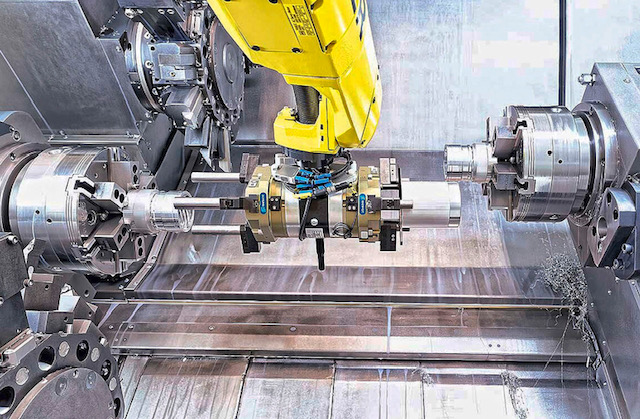
Production is characterised by a belt chaining (or linkage) that goes through the entire production hall. Among the employees, it has gained the nickname ‘the highway’. The available space is limited, hence the compact KX 100 Dynamic machines are the preferred choice. This machine type has two separate rotatable mounted columns, each with vertically movable pick-up axes featuring one workpiece spindle. While a workpiece is being machined, the other pick-up axis places the machined workpiece and loads a non-machined part on to the workpiece spindle. The workpiece is aligned outside the work area. This allows the workpiece spindle, already accelerated to machining speed, to be swivelled in the work area, keeping non-production times to a minimum.

A transfer unit does the loading and unloading from the conveyor belt. Kümpel says: “We usually move with the belt directly below the machine. However, this was not possible here. With the transfer unit, we compensate for height and distance from the belt to the machine. An integrated automation solution would have been significantly more expensive, at about 25% of the price of the machine. A simple transfer unit costs less than 10% of the machine price.”

The time for conversions and commissioning is, in most cases, very limited. But the highly ambitious goals have been achieved.
“Throughout the process, I‘ve been very satisfied with the on-site support and the local service,” says Hahn. “We were convinced by the machine concept and managed to overcome any obstacles together. The cycle time was a critical aspect. But, we did it.”

For further information
www.engtechgroup.com

Report shows apprenticeships remain strong

Investment in apprenticeships has remained resilient in the face of the pandemic according to a new report released last week. In-Comm Training’s third annual ‘Training Barometer’ revealed that 67% of companies had taken on apprentices during the past 12 months, while a staggering 97% kept all their learners on despite the pressures of the pandemic. This confidence extends into the future, with more than two thirds of businesses (70%) committing to taking on an apprentice over the next year (up from 47% in 2021), and 69% giving employees the opportunity to progress learning all the way to an HNC or Degree.

For further information
www.bit.ly/3xAuhgj

Chiron Group buys automation specialist

The Chiron Group has acquired Greidenweis Maschinenbau, a specialist in automation systems for the automotive industry. As a result, the Chiron portfolio that is offered in the UK from the Engineering Technology Group (ETG) will now be available with more automotive assembly and automation systems than ever before.

In addition to its development and assembly of machines and systems for laminating, joining and gluing, Greidenweis has positioned itself competently in process and system integration. One example is the fully automated assembly of components for vehicle interiors using several processing stations. The 60-employee company has many years of experience in integrating various technical solutions into automated assembly systems and production lines.

For further information
www.engtechgroup.com