
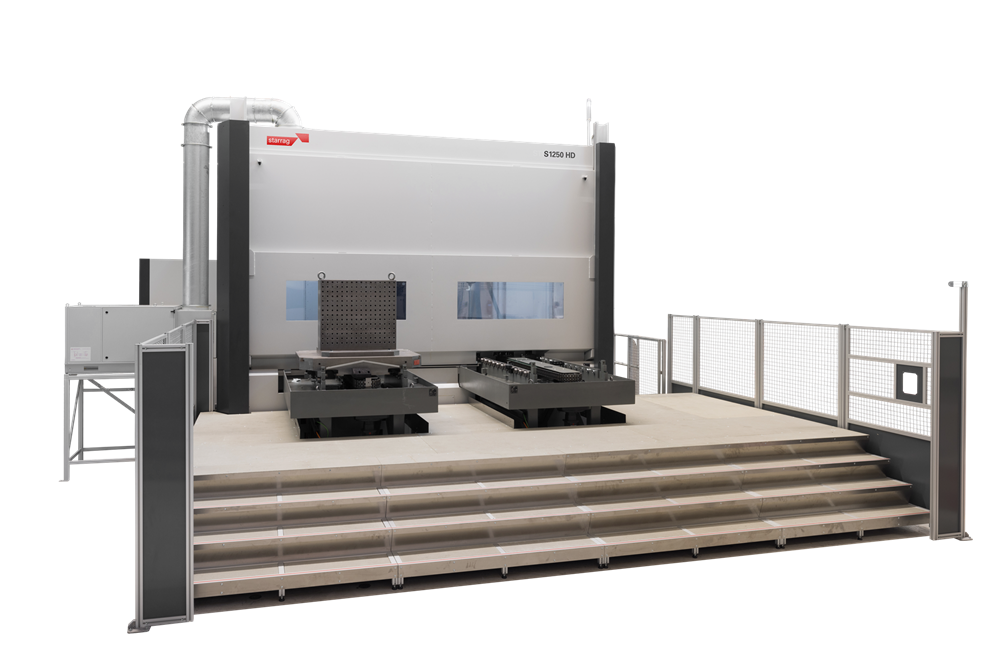
At the EMO 2023 exhibition, Starrag presented a prototype of its hydrostatically guided S1250 HD five-axis machining centre, demonstrating exceptional rigidity and damping that enabled record-breaking cutting parameters in titanium roughing. Initial tests of the current production model have raised the bar further, thanks to a stiffer machine structure, a new high-torque milling head and a geared rotary table.
For years, Starrag’s STC series has set standards for machining titanium structural components. The material’s low thermal conductivity and poor machinability place heavy demands on cutting tools and limit cutting speeds. Effective roughing therefore relies on low speeds and high torque, requiring a machine with exceptional rigidity and damping.
To meet these demands, Starrag developed a hydrostatically guided version of its horizontal STC 1250, subsequently named the S1250 HD. Its friction-free, wear-free linear guidance combines high rigidity with effective vibration damping, making the machine suitable for five-axis heavy-duty machining of titanium structures. Tests with the prototype achieved material removal rates up to three times those of the roller-bearing version, while its damping and dynamic performance also delivered precision and surface quality during finishing.
Airbus recognised the potential after endurance testing the prototype at its Varel site in Germany, ordering five S1250 HD machines with specific modifications to suit its requirements.
The main changes concerned the rotary table and milling head. “Our customers were impressed by the tests conducted two years ago,” says Alexander Fitz, sales director for aerospace and turbine at Starrag AG. “The Starrag S1250 HD promised considerably more efficient cutting of titanium structural components than ever before. To meet the special requirements of titanium cutting specialists, we decided to make some modifications to the series machine.”
The standard STC 1250’s direct-drive rotary table was replaced with a geared version better suited to heavy-duty titanium machining. It delivers 25,000 Nm of torque and 32,000 Nm of clamping torque.
The swivel milling head was also modified to accommodate a more powerful A axis, increasing torque by 50% to 12,000 Nm, with clamping torque of 20,000 Nm. Enlarging the head on one side created the necessary space without compromising workpiece accessibility or the ability to use short tools.
The machine retains Starrag’s 53 kW geared spindle, which delivers 1600 Nm of torque at speeds up to 4500 rpm. A new HSK-B160 tool interface provides a 160 mm contact diameter to improve tool rigidity, particularly when machining at large cutting depths or with tools featuring substantial overhang.
Starrag also strengthened the production machine’s structure beyond the prototype specification.
“Our aim was first and foremost to further increase the possible removal rates and reduce tool wear,” says Rolando Senn, lead designer for hydrostatics.
The machine beds and columns were reinforced, while the contact surfaces of the hydrostatic guides were enlarged to increase rigidity and damping. Starrag also introduced a mechanical solution to make the hydrostatic guide control system more robust and easier to maintain.
Initial tests of the production machine have delivered promising results. During a performance cut witnessed by Airbus’s titanium specialists in Rorschacherberg, Switzerland, the machine roughed titanium using an 80 mm Igel milling cutter at a depth of 68 mm in a full cut, with a feed of 80 mm/min and a spindle speed of 160 rpm. The tool reached its capacity limit while the machine ran smoothly, with spindle power consumption at only 60-70%.
Further tests using Ti6Al4V titanium alloy produced results that Starrag’s milling specialists believe represent a world record for titanium machining. Using a Starrag-developed 40 mm carbide cutter with 18 teeth, the team roughed a titanium block at a cutting speed of 120 m/min, a tooth feed of 0.45 mm, an axial cutting depth of 98 mm and a radial cutting depth of 2 mm. At 955 rpm, the spindle achieved a feed rate of 7735 mm/min and an average undeformed chip thickness of 0.101 mm.
The resulting metal removal rate was 1516 cm³/min, demonstrating the productivity possible when the machine, tooling and cutting technology are optimised as a complete system.
The tests also indicated that the cutting tool, rather than the machine, is currently the limiting factor. Starrag therefore plans further trials with its own tools and products from leading tool manufacturers to explore the potential for additional performance gains.
Looking ahead, the company expects near-net-shape blanks to reduce the amount of roughing required in some applications. Machining complex, deep cavities with tools up to 500 mm long will then become increasingly important. Here, the rigidity provided by the HSK-B160 interface is particularly valuable. Initial tests indicate that vibration-damped tools significantly outperform monolithic alternatives.
“The structure of our HD machine is also ideally suited to this type of machining,” says Markus Ess, director of technology at Starrag’s HPS business unit. “We’ve built an extremely rigid, high-quality titanium machine, with which we can perform excellent roughing and work in complex cavities with very long tools – a future-proof mix.”
Reduced tool wear offers another significant benefit. Titanium machining places heavy demands on cutting edges, making tooling a major operating cost. Improved damping can extend tool life, even at higher cutting speeds, helping offset the additional investment in hydrostatic guidance.
Ess also points to energy savings when measured against output. Although the S1250 HD may consume more power than other machines, shorter machining times can reduce energy use per component and lower the associated carbon footprint. Reduced operating time also cuts the energy consumed by auxiliary systems, including coolant delivery, hydraulics, pneumatics and cooling.
More information www.starrag.com