30 years of all-electric tube benders

Tube bending technology specialist Unison Ltd is celebrating 30 years since it launched the world’s first all-electric tube bending machine. It is an invention that changed the method of tube bending by precision industries around the globe. “It was no great secret that the accuracy of hydraulic tube bending machines could be affected by fluctuating oil temperature,” says joint managing director Alan Pickering.

Called the Unison Breeze, the world’s first all-electric three-axis tube bending machine was launched in 1994, with the company subsequently registering UK and German patents. In the years since, Unison has launched the world’s first all-electric five-stack tube bending machine, followed by the world’s first 76, 115, 150 and 180 mm multi-stack machines, as well as robotised and twin-head tube benders.

More informationwww.unisonltd.com

Growth Guarantee Scheme introduced

Compass Business Finance has been accredited to deliver funding supported by the Growth Guarantee Scheme (GGS), via the British Business Bank, thus creating further access to finance that will help smaller UK businesses invest and grow. Launched as a successor to the Recovery Loan Scheme, an important new development is the addition of asset-based lending and invoice finance to the range of supported facilities. The GGS is a government-backed loan scheme that enables lenders to provide finance where they may not otherwise have done so, or to extend better-than-standard terms on business financing options.

More information www.compassbusinessfinance.co.uk

Better on-site calibration with new capabilities

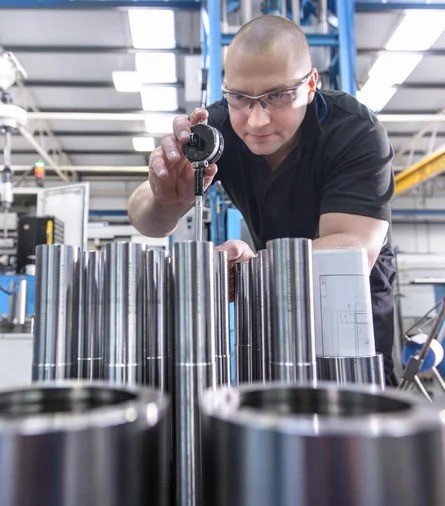
Calibrationhouse, a provider of UKAS-accredited calibration services, is commencing a £500,000 investment in an extensive suite of new capabilities to streamline and enhance equipment calibration for the manufacturing industry. The new services are set to offer a one-stop shop for calibration needs as it is possible to perform the majority of them at customer premises.

In 2023, Calibrationhouse rolled out new calibration capabilities including bore gauges, verniers, micrometers, height gauges, thermal imaging cameras and torque wrenches. The company also introduced inclinometer, protractor and expanded temperature calibration capabilities. This year, the company will offer calibration of force gauges, current transformers, high-pressure gauges, liquid flow, mass, gauge blocks and humidity devices.

A key advantage for manufacturers is the ability of Calibrationhouse to calibrate a wide range of equipment on-site, reducing lead times and equipment downtime.

Calibrationhouse’s engineers can deliver calibration services directly at customer premises, meaning crucial test equipment is unavailable for minutes rather than days. Alternatively, manufacturers can opt to send their equipment to Calibrationhouse’s base in Peterlee for back-to-base calibration completed within five working days from receipt.

Andrew Simpson, manager of Calibrationhouse, said: “We’re providing a comprehensive calibration solution of the highest quality that enables us to calibrate almost all of our customers test equipment, as recognised by our continuous accreditation as an approved vendor for the prestigious UK defence sector [JOSCAR]. Traditionally, manufacturers had to rely on multiple calibration companies who could each only handle a portion of their calibration needs. Our expanded capabilities mean manufacturers can now turn to Calibrationhouse as a one-stop shop.”

More information www.calibrationhouse.com

Renishaw launches RMP24-micro probe

Renishaw says its new RMP24-micro is the world’s smallest wireless probe for machine tools. The RMP24-micro measures just 24 mm in diameter and 31.4 mm in length. Despite its small form factor, the probe delivers measurement repeatability of 0.35 µm 2σ, which according to the company sets a new standard for wireless probes in this size category.

The micro-kinematic mechanism within the probe promotes ultra-low trigger forces, ensuring gentle contact with workpieces during probing. This capability not only minimises the risk of damage, but also reduces part deflection for enhanced measurement accuracy.

Designed for compact machines that manufacture high-value, high-precision components, the RMP24-micro is suited to applications in industries that include medical, dental, watchmaking and micro-mechanics. Tight measurement tolerances are easily achievable with the probe’s repeatability and lobing performance, while its short length and radio communication makes the RMP24-micro useable in confined spaces.

The probe uses Renishaw’s updated radio transmission protocol to communicate with the machine tool controller via the RMI-QE radio interface. With an operating range of up to 5 m, it employs a 2.4 GHz FHSS protocol, compliant with radio regulations worldwide. This FHSS technology has excellent power efficiency and allows the probe to co-exist harmoniously with other radio sources such as Wi-Fi, Bluetooth and microwaves.

Will Fenn, product marketing engineer for Renishaw’s Machine Tool Products Division, expresses his enthusiasm for the RMP24-micro: “Since we first previewed the product at the EMO exhibition in Hanover last year we’ve had an overwhelmingly positive reaction from the market. We’re now delighted to announce the full release of RMP24-micro and eagerly await showcasing it at upcoming exhibitions throughout 2024 and beyond.”

More information www.renishaw.com/rmp24-micro

IDS: Trained quickly, inspected swiftly

Careful quality control is essential to ensure that only flawless indexable inserts leave production and meet high durability and reliability requirements. A flagship project by automation and measurement technology specialists Xactools and IDS Imaging Development Systems demonstrates how AI can help visual inspection make quantum leaps. The companies developed a fully automated handling and inspection system for a global manufacturer of indexable inserts based in Scandinavia.

A total of eight high-resolution industrial cameras and two spider robots handle and inspect the indexable inserts for defects, which monitor and load three rotary table nests and one pin pallet each. DENKnet’s AI forms the heart of the complex image processing system between cameras, robots and a multi-GPU computing rack to help drive zero-defect production.

The indexable insert manufacturer has around 2800 products in its portfolio, divided into almost 100 geometry families. The aim was to automate handling and defect inspection for them all.

The first challenge resulted from the numerous colours, whereby the AI required extreme training to variations and lighting conditions. But in addition to visual appearance, it is also about insert geometry. Categories such as triangle, rectangle, rhombus and square can be found in countless variations. Around 20 to 30 images were needed to teach each geometry family.

The team integrated AI into the production line in just a few months, achieving almost perfectly reliable AI results for checking right from the start.

“Indexable inserts identified as defective are sorted and grouped according to the size and position of the defect,” says Daniel Routschka, sales manager – AI at IDS Imaging Development Systems. “The AI image analysis detects more than 99% of production errors.”

More information https://en.ids-imaging.com