
Winning the tooling race at Tridan

In 2007, Tridan Engineering made a strategic decision to target prestigious aerospace contracts and steer away from commercial, agricultural and power-generation subcontract machining. In the past five years, the Clacton-based company has invested heavily in infrastructure, accreditations and machine tools, which has certainly paid dividends in achieving its goals.

Celebrating its 50th year in business, the subcontractor has spent more than £2.5m in the past two years on new acquisitions, including two Mazak Variaxis i500 machines (as well as an i600 and an i700), a Quick Turn 300 plus a Quick Turn 200MSY. Other recent investments include a six-station Palletech automation system and an additional three machines on order from XYZ.
The investment in high-specification four and five-axis machine tools, and the ever-expanding variety of materials being machined, has prompted a strategic overview of Tridan’s cutting tool strategy. In the two years since deciding to overhaul its tooling strategy, the AS9100-certified company has reduced its cutting tool suppliers from 14 to just two. From the 14 vendors, it is Industrial Tooling Corporation (ITC) that is driving innovation and cost reductions, and standardising cutting tools.
Discussing the logic behind consolidating its cutting tool vendors, Tridan Engineering’s senior production engineer Peter Townsend says: “When it came to cutting tools, our shop floor had no consistency or standardisation, and shop floor staff would order new tools from one of our suppliers as and when they needed them. To consolidate our suppliers, we firstly wanted to eliminate a few of the smaller vendors that couldn’t support our diverse demands. Once we did this, we started 18 months of trials with many of the internationally recognised tooling brands.
“During this process, we were going beyond trialling one vendor against another based on the usual parameters of tool life, performance and cost reductions,” he continues. “We were looking at the complete package: the service and technical support; the rapport between our engineers and the tooling representative; the diversity of the product portfolio; and of course, performance, consistency and cost were always key parameters. In fact, the arrival of a twin-pallet machine and a six-station pallet system means that reliable performance and longevity for lights-out running has become more prevalent than ever.”

During the trial period, ITC was fast emerging as the front runner to win the solid-carbide round tooling business from Tridan. This preference emerged from the relationship between ITC’s technical sales engineer Gary Bambrick and the Tridan engineers and shop-floor machinists. However, with tooling manufactured in Tamworth, it was the rapid turnaround on standard and special tools that also impressed Tridan.
Says Townsend: “We manufacture families of aluminium frame racks for the aerospace industry in batches of 10-off every couple of weeks. With a significant amount of material removal, we applied the ITC 49G9 series of ripper end mills with through-coolant and a trochoidal strategy that was recommended by Gary. This immediately reduced the cycle time from 6 hours to less than 5 hours, a 20% reduction.
“With these racks there are a number of thin walls that needed machining and the tools were pushing against the wall, generating different wall thicknesses and wavy surface finishes,” he adds. “Gary worked closely with us and ITC’s Tamworth headquarters to change tool geometries, edge preparation and corner radii on a 10 mm diameter 3081 series end mill that was used for finishing the thin wall profiles. This not only resolved our technical issue, it demonstrated the expertise and the level of support from ITC.”
With the arrival of the six-station Palletech system, Tridan is achieving upwards of 140 hours of production every week on its latest Mazak machining centre. Manufacturing titanium alloy enclosures for the aerospace sector, the cell has been producing 50 parts per week with a cycle time close
to 3 hours each.
The philosophy of this cell is to maximise machine utilisation and, using ITC’s solid-carbide VariMill end mill tools, Tridan was attaining four days of tool life from each end mill. To extend tool life further, Bambrick suggested a diamond-coated end mill. The result extended tool life from four days to seven, a 40% improvement. With 90% of tools in the cell being supplied by ITC, Bambrick is currently investigating additional opportunities.
Another special application that was causing tremendous difficulty was a nose cone for the defence industry. The titanium cone had a roughing cycle time of 45 minutes that ITC reduced to 25 minutes with a five-fluted ripper, a significant saving on a batch of 100 parts.
Following internal rough machining, the cone requires a series of slots and features, and the limited reach inside the cone caused tool vibration that was impacting upon tool life. The previous end mills were wearing out rapidly through vibration, typically after machining just three parts.
“With the combination of the challenging aluminium alloy material and extended reach requirement, the vibration being created was ruining cutters,” says Townsend. “Added to this, the slots have a 0.03 mm tolerance that we struggled to hit because of the vibration. ITC developed a 2.8 mm diameter extra-long end mill on a 12 mm shank that instantly eradicated the vibration, and improved surface finish and tool life. The new tool ensured we were easily within tolerance, while tool life went from one tool for every three parts, to five tools for the full batch of 100 parts. This gave us consistency, reliability, conformity and it meant we didn’t have to keep changing tools and checking parts. We have a number of ITC tools that have been running for weeks on this family of parts.

“Following the benefits of ITC tools in our production cell and the proven success of the VariMill 4777 series, we trialled the same VariMill roughing tool on a chassis part for the defence sector manufactured from S154 hardened steel (321HB),” he continues. “We were using a high-feed indexable end mill from another supplier and were burning out 2-3 insert edges on each part. Although this sounds like a high burn-out rate, the cycle time was 12 hours per part for each of the 30 components. Gary once again recommended the 4777 series and it slashed the cycle time from 12 hours to 3, and we managed to complete a full batch of 30 parts with just two end mills. This was a 70% cycle time reduction and a 90% tool life extension. We cannot credit Gary and ITC highly enough for the quality of their service and products.”
The tooling strategy at Tridan is continually evolving to suit the ever increasing material diversity and lights-out production requirements. Tridan has selected its two primary vendors based upon indexable and solid-carbide tooling solutions with a number of small vendors still being a necessity for special applications.
Concluding on this point, Townsend says: “ITC has proven that its solid-carbide end mill and drilling lines can outperform everything we have trialled. But most importantly, the support from Gary Bambrick has been exemplary. Gary has not only instigated the introduction of new products, but also new strategies to enhance productivity.”
For further information www.itc-ltd.co.uk

Leaving nothing to chance

Specialist tooling solutions supplier Cogsdill-Nuneaton has recently invested in a new Doosan vertical machining centre from Mills CNC. The machine, a DNM 6700, has been installed at the company’s 27,000 sq ft facility, where it is being used, primarily at this moment in time, to produce precision components for Cogsdill’s range of ZX facing and contouring-head tooling systems. These components include different sized front-mounted cross slides, with slide ranges from 200 to 900 mm, which are machined from nitrided and carbon steel.

The decision to invest in the new Doosan DNM 6700 machine followed an internal review undertaken by Cogsdill into its existing CNC machine tool capabilities and, in particular, whether current milling capabilities were adequate to meet growing demand from customers worldwide for its large-capacity tooling solutions.
Says Lee Donaldson, executive director, Cogsdill UK: “We invest regularly in advanced CNC machine tool technologies, and the audit and review highlighted a potential improvement opportunity within our existing CNC milling capabilities.”
With global demand for its larger tooling solutions on the increase it became clear to management and production staff at Cogsdill that investment in a new, reliable and large-capacity vertical machining centre was required.
“To ensure we acquired a vertical machining centre that matched our needs and expectations we did our homework and created a ‘key criteria’ checklist before investigating the market,” says Donaldson.
In addition to the working capacity of the new machine, other requirements included the machine’s cutting performance, its availability and price, as well as the scope and scale of the technical back-up and aftersales support services provided by the machine tool supplier.
“Although we hadn’t invested in a Doosan machine tool previously, we knew that Doosan machine tools have a good reputation in the market, and that Mills CNC, the exclusive distributor of Doosan machines in the UK and Ireland, is a successful company with a significant market presence,” says Donaldson.

Cogsdill also had direct experience of working in collaboration with both Doosan and Mills CNC as a technical partner; supplying advanced tooling solutions to both. A recent example involved Cogsdill working in partnership with Doosan and Mills CNC to deliver a turnkey process for auto-loading facing heads, boring tools and splining tools, into a Doosan horizontal boring machine (a DBC 130) for a US-based oil and gas customer.
Following extensive research into the market, Cogsdill ultimately decided on investing in a new DNM 6700 vertical machining centre.
The DNM 6700 is a large-capacity vertical machining centre equipped with a work table measuring 1500 x 670 mm and axis travels of 1300 x 670 x 625 mm in X, Y and Z. A high-torque (118 Nm) direct-drive spindle (18.7 kW/12,000 rpm) also features.
Says Donaldson: “The working envelope of the machine was of critical importance, and the DNM 6700 large-capacity working envelope enables us to machine larger components [as well as smaller components] in a single set-up. This means faster production and reduced part cycle times.
“Similarly, the cutting performance of the machine was important,” he adds. “The DNM 6700’s direct-drive spindle technology gives us ability to achieve high volumetric removal rates when required, as well as fine finishes. It is a very versatile machine.”
To increase the machine’s flexibility further still, Cogsdill, as part of its investment in the DNM 6700, also ordered a 4th/5th axis unit to be supplied with the machining centre.
In terms of availability, Mills CNC has at least 70 new Doosan machines, at any given time, in stock at its technology campus in Leamington. A significant proportion of these machines comprises its best-selling DNM vertical machining centres.
“The quick availability of the new machine was important,” says Donaldson. “We attended MACH 2018 where we visited Mills CNC’s stand and supplied them with a ‘letter of intent’ to purchase a DNM 6700. Just a few weeks after the event, once we had acquired external grant-based funding, the machine was delivered, installed and commissioned.
“I have to say that we were presently surprised with the machine’s price,” he continues. “There is a lot of technology and functionality packed into the DNM 6700 and, while price isn’t everything, it clearly is an important factor when making any capital investment.”

SONY DSC

With regard to support, all Doosan machines supplied by Mills CNC are backed by the company’s aftersales service and support.
“Mills CNC’s reputation in the market for its aftersales support is second to none, and we have direct experience of this having worked in partnership with Mills delivering a number of turnkey and process improvement projects for customers,” says Donaldson. “Just knowing that you have Mills’ technical, applications and service back-up at your disposal inspires confidence.”
Since being installed at Cogsdill’s facility in Nuneaton, the DNM 6700 has been used to machine front-mounted cross slides housed in the company’s ZX facing and contouring head tooling systems. These cross slides are rough machined from solid on the machine prior to stress relieving, and are then semi-finished, heat treated and ground before final finishing operations take place.
On average, machining times for roughing, semi-finishing and finishing are 60 minutes, 90 minutes and 30 minutes respectively.
For further information www.millscnc.co.uk

Doubling-up on die-sink machines

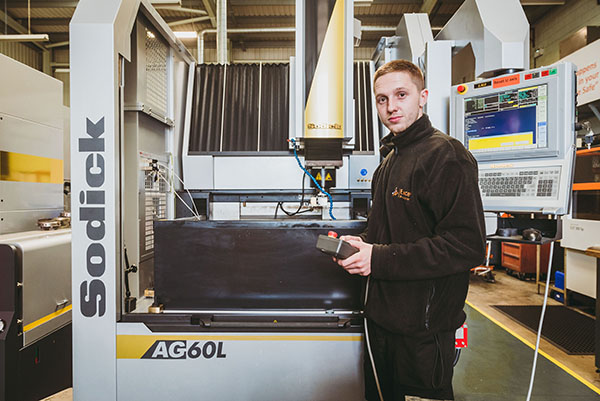
Following a recent move to a facility more than twice the size of its previous premises, RST Engineering has invested in another Sodick AG60L die-sink EDM to help keep pace with a growing order book. Installed in February 2018 by Sodi-Tech EDM, the machine joins an existing AG60L that has performed impressively since 2012. The two machines are now working side-by-side producing a host of complex parts such as titanium internal gears and splines for the motorsport industry.

Established by Robert and Maureen Taylor in 1986, and now run by their sons Sean, Jason and Paul Taylor, RST Engineering has proven itself to be a progressive and ambitious precision engineering business based in Leighton Buzzard.
The recent move to 7100 sq ft premises has allowed the company to grow and improve its services with investment in machinery, staff, training and inspection equipment. Today, RST has 15 employees and is currently in the process of taking on two apprentices. The company specialises in EDM (wire and die sink) and milling (including five-axis machining) to help it produce complex parts for sectors such as motorsport, which is presently proving particularly strong.
“We’ve had Sodick wire EDMs in the business since 1998, after which we standardised on Sodick machines,” explains company director Jason Taylor. “However, we’ve only had Sodick die-sink machines since 2012, when we bought our first AG60L. The machine has proven so reliable in terms of performance and quality that, when we needed more capacity, there was only ever going to be one choice. We didn’t even look elsewhere.”
The new die-sink machine, another Sodick AG60L, now helps RST manufacture a myriad of complex motorsport parts from challenging materials, such as titanium, as well as tungsten carbide components for other industries.
“There are some peaks and troughs with motorsport, but generally the work is fairly continuous,” says Taylor. “We spark a lot of internal gears and splines for Formula One and other racing disciplines. It’s all low-batch, high-precision work. Tolerances of 10 µm on form are normal when it comes to internal splines and gears, but the Sodick machines hold that very consistently.”

A 24-tooth motorsport spline might take around 4½ hours in cycle time and RST prefers to produce many of its long-running jobs unmanned overnight. With this thought in mind, the sole upgrade requested by RST for its new AG60L was the option of a 12-station tool changer, rather than the standard six-station version.
“Due to the inherent challenges associated with machining titanium we tend to burn through a larger number of electrodes,” says Taylor. “As a result, we needed a tool changer with greater capacity for when we run lights-out. In fact, we also opted to upgrade the tool changer on our existing AG60L, which was retrofitted by Sodi-Tech EDM.”
According to Taylor, programming is a stand-out feature of the Sodick machines, a function that offers a high degree of flexibility.
“The control is so easy to use,” he says. “There’s the ability to do conversational programming, which is very comprehensive, or you can write an entire program yourself from scratch – and even bounce between the two methods. Three of us are trained to program the Sodick machines.”
RST also has four Sodick wire EDMs equipped with linear drive technology, two AQ325L models, an AG600L and an AQ750L with 500 mm capacity in the Z axis.
Linear motor technology, which is based on electronic drives, offers several advantages, including improvement in accuracy, repeatability, speed and acceleration. Since linear motors are a direct electronic drive (no mechanical parts), they eliminate problems with backlash and wear.
Data transmission to linear motors is instantaneous with the use of Sodick’s proprietary motion controller technology, while overshoot and undershoot do not occur thanks to absolute glass scales attached directly to the axes. These high-resolution scales measure the location of the drive at all times, so the exact position is always known. Moreover, because the magnetic drive eliminates unnecessary mechanical movement, rigid linear motors also produce zero vibration and zero backlash.
The precision and stability achieved with a no-contact drive makes linear motors a good option, even for applications that do not need their speed but require their accuracy. Importantly, Sodick offers a 10-year positioning accuracy guarantee, which helps companies such as RST provide quality parts to customers on a repeatable and reliable basis.

“Our biggest selling points are quality, delivery and flexibility,” says Taylor. “We work closely with our customers on complex components made from difficult-to-machine materials; always looking to find the best manufacturing solutions to produce the finished part to the required accuracy and within budget.”
RST clearly prides itself on quality, providing a professional service, loyalty and flexibility towards customers with whom it has built strong relationships over the past 30 years. The company currently holds AS9100D & BS EN ISO 9001:2015 quality certifications, while all of RST’s inspection equipment is externally calibrated and operates in a temperature-controlled environment.
A final word is reserved for the professionalism of the support team at Sodi-Tech EDM, which has become an important business partner for RST.
“Both of our Sodick AG60L die-sink machines are utilised all of the time with a fast turnover of work,” says Taylor. “Like the wire EDMs, they have become an integral part of our business. If we ever need to ask something of Sodi-Tech EDM they are always very responsive – they have highly knowledgeable people. This is very reassuring, not just for our motorsport customers, but those in other sectors we serve, such as metrology, satellite, aerospace, scientific and medical.”
For further information www.sodi-techedm.co.uk

Reaping the rewards with latest cutting tools

Vetech Product Design & Development Ltd is a subcontract manufacturer that was conceived by engineers with an expertise in the garden equipment sector. When the Buxton-based company opened its doors for business in 1994, the founders applied their industry knowledge to win business from the globally recognised Bosch brand. Since its inception, the company has always invested in the latest technology to drive its business forward, and central to this strategy is support from its cutting tool partner Industrial Tooling Corporation (ITC).

More than just another subcontract manufacturer, Vetech offers design and consultancy services to a customer base that now incorporates high-profile names in the military, electronic sensor, motorsport and plastic moulding sectors, as well as the ever-expanding network of garden equipment manufacturers. Upwards of 60% of business at Vetech is aluminium mould tools for the garden and leisure industry; and it is here that cutting tool specialist ITC has made all the difference.
Over 10 years ago, Vetech realised that its CNC machine tools could not achieve the high spindle speeds required for machining mould tool ribs with small diameter cutting tools. Vetech visited the TCT trade show and found the solution on the ITC stand in the guise of high-speed spindles. Delivering immediate success, Vetech then approached ITC regarding its line of standard and special cutting tools.
Commenting upon the founding of the relationship that spans over a decade, Vetech senior design engineer Andy Smith says: “We found a solution for running our tools at high speed through ITC. At that time, we were also witnessing problems with our previous cutting tool vendor. The issues included limited stock and tool range availability, excessive lead times on special tools and poor technical support. ITC came to see us and we trialled some solid carbide tools. The tools were successful and 10 years later, ITC supplies over 90% of our cutting tools.”

Many of the aluminium mould tools manufactured at Vetech are for rapid prototyping projects, making turaround times critical. With the availability of high spindle speeds of 60,000 rpm, Vetech could apply ITC’s 1 mm diameter solid-carbide end mills to mould tool ribs that were previously processed using EDM.
Referring to this, Smith recalls: “We process a lot of mould tools that often incorporate cross-rib designs. On one of our early tools for a lawnmower motor end frame, we had to spend 3 hours programming two different electrode designs that would then require an additional 4-5 hours of machining. After this, the erosion time would be upwards of 8 hours and finally there would be an additional 3-4 hours of hand finishing. With ITC tools and the high-speed machining, we immediately eliminated this 16-20 hour process and replaced it by CAM programming the mould tool and machining it in 4-5 hours with impeccible surface finishes. This cut our complex mould tool production times by 75%. Essentially, we were producing a challenging mould every two weeks; ITC reduced our mould tool production costs by over 25% almost overnight.“
Since this early success, Vetech has invested in Hurco VMX42M and a VMX30Ti machining centres. These VMCs offer a spindle speed of 12,000 rpm and both the EDM process and speed increaser have since become virtually redundant.
During this early point of the relationship, Vetech was using both the 2112 and 2001 series end mills to increase tool life by over 30% and reduce cycle times by an average of 35%.
“The 2001 series has been an exceptional performer,“ says Smith. “We use the 16 and 20 mm diameter tools with a 2 mm radius and the smaller 6, 8 and 12 mm tool with a 1 mm radius. The tools are extremely rigid and offer high material removal rates with outstanding surface finishes. Furthermore, the tools are particularly long, so we can pull them further out of the holder for different applications.“
Despite primarily machining aluminium, the ITC 2112 series is a steel geometry end mill.
“The 2112 series has performed extremely well down the years and we‘ve now replaced it with the new 2172 ball-nose cutter,“ says Smith. “Our new 2172 has a 0.5° angle above the ball and this gives added rigidity. More pertinent to us is the clearance that this 0.5° angle provides. The clearance angle naturally creates a draft angle that is essential on mould tools. Draft angles eliminate friction and ensure the mould tool performs at an optimal level. With regard to rigidity, we can run a 2 mm diameter 2172 series at machining depths of 35 mm. This limit was previously 20 mm with other tools and we are looking at pushing this depth to 42 mm; more than double what was previously possible. When it comes to mould tools, the tool reach is a key aspect, so the 2172 series is creating benefits in both machining depth and the creation of a draft angle.“

Over the past couple of years, Vetech has redesigned and developed the Hayabusa 1300cc motorcycle engine to generate huge power and reliability benefits to small vehicles such as the Mini and Fiat 500. ITC has also been integral in reducing cycle times with the engine development programme.
“We machine motorsport components such as oil hoses and pipe fittings that require undercut machining,” explains Smith. “For this, ITC has tweaked its 2001 series for us, grinding a radius on the flute for undercut machining. This is supported by an undercut feature in our HyperMill CAM software. We can now reduce the time for machining an undercut from 10 minutes to just one minute. This dedicated 16 mm diameter tool with a 2 mm radius allows us to use the side of the tool for machining undercuts. The flexibility also enables us to conduct rough and finish machining with one tool, completing the job in fewer set-ups.”
ITC has recently invested heavily in new grinding centres for the production of ‘micro’ cutting tools, and this investment has seen the company add new product lines and extend existing ranges. Vetech has already proven to be a beneficiary of this ITC investment.
“We use a complete range of ITC tools, but the addition of micro end mills and the extension of existing lines are ideal for our mould tool engraving. We are using the extended 2112 series tool in diameters from 0.4 to 1 mm with a flute length of 8 mm to engrave at high speed. As
well as having high-quality tools for intricate engraving applications, we can also use these small diameter tools in conjunction with our high-speed spindle to reduce machining times on mould tools.
“With the arrival of a complete line of micro tools, we can undertake very high-speed machining for long periods of unmanned machining,” he adds. “Our small mould tools require 4-6 hours of machining, while larger tools can run for over 24 hours and sometimes upwards of 50 hours. Intricate mould tools require micro tools, and by applying the 2112 series of micro tools, we can now run unmanned for long periods with exceptional surface finishes and achieve cycle time reductions beyond 30%. However, the most critical aspect of unmanned machining is tool life and consistent performance. The ITC range certainly operates with reliability, efficiency, cost effectiveness and performance.”
For further information www.itc-ltd.co.uk

Fanuc adds spark for subcontract specialist

Located on the outskirts of Glasgow near Hamilton, The Spark Erosion Centre is a subcontract manufacturer that, as the name suggests specialises in EDM machining. To be a dedicated specialist generally requires two things: staff expertise and the latest technology. Luckily for the Scottish company, it has both in abundance and is recognised as Fanuc UK’s largest customer of EDM machine tool technology.

The company has been in business for over 30 years and has employed Fanuc machine tools almost from day one. Commenting upon this relationship, Bill Bright, managing director at The Spark Erosion Centre, says: “We bought our first Fanuc machine back in 1984 and have stuck with them ever since. This is because we find the machines to be very accurate and reliable products that we push to the limit on a daily basis.
“By pushing the limits, I am referring to the type and quantity of work that comes through the door,” he continues. “We are stretching what the machines should and shouldn’t be able to do, such as increased tapers. We have learnt tricks down the years and how to best exploit the capabilities of the Fanuc machines, and this gives us a major competitive edge.”
Not just a one-trick-pony, The Spark Erosion Centre is a precision machining company that undertakes tool making, injection moulding, and tool and jig design and manufacture, as well as spark and wire erosion for the offshore, automotive, aerospace, electronics, academic and tool-making industries. This diversity is a critical factor for success considering the industrial landscape in Scotland “The oil and gas industry is a key sector in Scotland but there is still a lot of automotive and tool-making work going on,” says Bright. “A lot of the local work is overspill from the offshore work in Aberdeen, and in recent years most engineering companies felt the impact of the oil and gas downturn. Some went under, while others had to fight for whatever they could.

Fortunately for us, we operate in a variety of sectors and have niche areas of expertise that ensure a stable business.”
An example of this expertise can be noted on an oil and gas industry cylinder that was turned by a customer of The Spark Erosion Centre. The turned cylinder is intended to be an offshore collet and the customer approached The Spark Erosion Centre to split the cylinder via wire EDM processes to create a collet assembly.
Commenting on this component, Bright recalls: “We received the first component and it wasn’t stress relieved, and this is where wire erosion is a benefit as it has no forces involved in the process. We wire-cut the first part and it sprang quite badly. On future components, we recommended stress relieving the parts and the customer asked us to handle the entire process.”
It is expertise and capability of this nature that has made the ISO:9001 company such as success.
“We utilise the core stitch function to machine from the centre of the part to the outside,” explains Bright. “However, we do not machine all the way through the part – we leave a ‘tag’ like on an Airfix model. This keeps the cylinder in an assembled condition and allows the customer to simply break-off the parts during final assembly.”
Referring to the Fanuc relationship, Bright says: “We have a range of machines now and we tend to trade-in as we get new models, but we still have machines up to 10 years old that perform extremely well. The reliability is there and we have been working with Fanuc machines for so long that we can now undertake a lot of our own maintenance and repairs, although the support from Fanuc is always there if we need it.”
A major advocate of Fanuc technology, the company has once again invested in the machines with the recent arrival of a RoboCut C600 iB wire erosion machine.
“This machine is right on the sweet spot for us; we have both smaller and larger machines and, as a new machine, this gives us the X and Y-axis capability we wanted,” says Bright.
“It has an extra 100 mm in the Z axis, which takes the Z axis to 400 mm, and this gives us a niche. There is certainly work that comes to us that cannot be done by anyone else in the area and this is credit to the generous Z-axis capability on the Fanuc.”

Sitting alongside a previous generation Fanuc RoboCut C600 A-series machine, the new C600 B-series has a multitude of new features that are not integrated into previous generation models.
“The new touch-screen CNC control unit is a new feature that is very easy to work with as touch screens have become a familiar part of everyday life,” says Bright. “Added to this, the control unit is far more capable than previous generations.”
Fanuc has made significant strides down the route of machine efficiency, power consumption rates, automation and precision in recent years, and mentioning this, Bright concludes: “Our customers are very demanding and they want parts back as soon as possible, so energy efficiency isn’t the top of our consideration list. However, when it comes to precision, we have done a lot of intricate R&D work and the machines have been spot-on. Additionally, automation is a core factor, so our machines have to be auto-wire fed. This is something we now take for granted because in the modern competitive market, we have to maximise the running time of our machines.”
For further information www.fanuc.eu