
The power of a positive partnership

GF Machining Solutions has supplied Renault F1 Team with two bespoke five-axis machining centres for the accurate and safe machining of epoxy resin patterns, carbon fibre reinforced plastic (CFRP) parts and Rohacell foam core components.

To cope with the different demands of machining composite materials, both machines were significantly modified and supplied with integrated, high-efficiency extraction systems, as well as fully enclosed and sealed working areas. The machine modifications were implemented seamlessly as part of the long-standing technical partnership agreement that exists between the two companies.
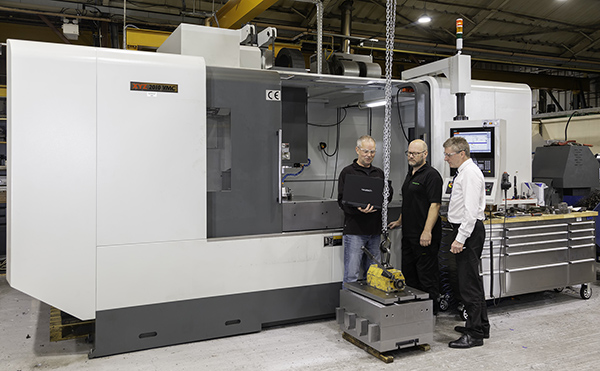
The two Mikron HPM 1350U machines have been installed at Renault F1 Team’s manufacturing facility in Enstone, Oxfordshire, within the team’s expanding Composites Department. Both machines were acquired, initially, to machine high-precision patterns (made from epoxy resin tooling board), which are used to make moulds for CFRP body parts.
However, owing to the machines’ versatility and performance attributes, the HPM 1350Us are also being used (now) to machine carbon inserts, and Rohacell foam (used as a structural filler to strengthen CFRP parts), as well as a range of jigs and fixtures.
The decision to invest in the two Mikron HPM 1350U machines was made as a direct result of accuracy issues being experienced in Renault F1 Team’s Composites Department, and the inability of existing equipment to meet increasingly stringent part precision requirements.
Explains Renault F1 Team’s composites manager Keith Dunsby: “We are committed to continuous improvement and striving for excellence. So, when it became apparent to us in 2016 that two of our machines were not able to meet the accuracy and repeatability requirements demanded by our design engineers, we acted quickly to rectify the situation.

“Since being installed, the machines have been working around the clock – including at weekends – and haven’t missed a beat. From struggling to hit 0.5 mm positional accuracies previously, we are now, since investing in the HPM 1350U machines, achieving 0.1 mm accuracies or better.”
The working envelope of the HPM 1350U machines (1350 x 1150 x 700 mm) enables Renault F1 Team to machine a majority (up to 60%) of these parts. For larger components, like the car chassis itself or a rear crash structure, Renault F1 Team relies on big gantry-type machines with a 4 x 3 m working area.
Renault F1 Team has a long-established technical partnership agreement with GF Machining Solutions. The partnership has been instrumental in Renault F1 Team investing, over recent years, in a number of AgieCharmilles wire and die-sink EDM machines, and Mikron five-axis machining centres. To address the accuracy issues being experienced in the Composites Department it was therefore natural that Renault F1 Team first approached GF Machining Solutions.
Explains Richard Ferguson, Renault F1 Team’s composites supervisor: “This was, to all intents and purposes, a different requirement in that previously, the Mikron machines acquired for the machine shop were for machining metal components. We explained the issues and our requirements to GF Machining Solutions and they recommended the HPM 1350U machines for their size, power, versatility and performance, but with a number of significant modifications to make them more suitable for machining composite parts.”
These modifications included the integration of a high-efficiency extraction system
on the table of the machines.
“Machining carbon fibre composites and Rohacell foam essentially creates a significant amount of dust,” says Ferguson. “This dust needs to be removed quickly and safely from the interior of the machine and the wider machining area and environment. Positioning the extraction units on the tables delivered an effective and optimal solution.”
The modifications to the HPM 1350U machines also included the removal of the swarf conveyors, enclosing the Y-axes and providing additional guarding to prevent dust ingress and escape. A final modification on both machines was the inclusion and integration of the more advanced Renishaw RMP600 – a compact workpiece probing system featuring radio signal transmission which, working in conjunction with Renault F1 Team’s MSP software, ensures improved process reliability, faster and more accurate set-ups, and reduced scrap.
Says Dunsby: “The customisation of the HPM 1350 machines demonstrates the power of the positive partnership, and the way in which specific needs can be quickly addressed and solved through collaboration, and by thinking outside the box.”

Carlos Sainz Jr (ESP) Renault Sport F1 Team RS18.
Japanese Grand Prix, Friday 5th October 2018. Suzuka, Japan.

The HPM 1350U machines’ arrival has enabled the Composites Department to improve its own productivity, as well as having a direct and positive impact on Renault F1 Team’s performance. The team finished fourth in the 2018 season’s Constructors’ Championship – two places higher than in 2017.
“Our HPM 1350U machines are reliable high-performance machines,” concludes Dunsby. “They are equipped with high-torque spindles that enable us to ramp-up feed rates and achieve big depths of cut which, as a result, have helped us improve our productivity levels, reduce part cycle times and meet tight lead times.
“The configuration of the machines also has a positive impact on productivity [and accuracy] as complex and intricate parts can be machined in fewer set-ups using 3+2 and full simultaneous five-axis machining operations,” he continues. “Although initially acquired to machine bodywork patterns, the machines’ versatility and all-round performance has meant that they are being used to machine a wide range and variety of parts, which has clearly resulted in a better ROI than was originally imagined.”
For further information www.gfms.com

True to form

A global industrial high-shear mixing solutions specialist has selected advanced EDM technology from GF Machining Solutions. Silverson Machines, based in Chesham, Buckinghamshire, has recently invested in two new state-of-the-art die-sink EDM machines.

The machines, AgieCharmilles Form P 600 models, were installed in Silverson’s production facility last year and are being used, primarily, to machine complex, high-precision rotor/stator workheads; integral components used in the company’s best-selling high-shear industrial mixers.
For over 60 years Silverson has been at the forefront of industrial mixing technology and innovation, supplying standard products that include laboratory scale mixers and assemblies, pilot scale mixers, batch mixers, in-line mixers, powder/liquid mixing systems and bottom-entry mixers, as well as customised and turnkey system solutions, to a growing global customer base.
Silverson products are used and specified by customers operating in a number of processing and manufacturing industries, such as food processing, pharmaceuticals, cosmetics, lube oils and petrochemicals. Customers in over 150 countries are currently on the books at Silverson and, to service and support this base, the firm operates a network of associated companies, distributors and agents in more than 50 countries.
The company’s mixing systems and solutions help customers reduce process times by as much as 90% in some instances. In addition to delivering a distinct speed advantage, Silverson’s mixing systems are said to be inherently versatile and cost-effective, with one mixing machine being able to perform a range of different operations like blending, emulsifying, disintegrating, reducing particle sizes and gelling. Such versatility is achieved by the incorporation of interchangeable workheads.

Silverson workheads are precision machined units that are manufactured in different sizes and have different designs and configurations depending on their function and end use application. Workheads are made from 316L stainless steel but, for special purpose applications, titanium and exotic alloys such as Hastelloy can also be used. The workheads feature a number of integral components, such as rotor blades, and circular stators and screens with different-shaped holes, apertures, slots or perforations.
EDM spark erosion technology is deployed by the company to machine its stators and screens.
The two new Form P 600 machines have replaced two older RoboForm die-sink EDM machines purchased from GF Machining Solutions some years ago. Silverson’s latest machines provide the company with improved productivity and performance, and are equipped with sophisticated digital generators and feature a number of on-board smart technologies that help Silverson achieve higher part accuracies, improved surface finishes, reduced cycle times, reduced electrode wear and greater process reliability.
Says Alan Pepper, head of manufacturing at Silverson Machines: “We regularly invest in new advanced machine tool technologies as a route to improving our performance and competitiveness. EDM is a mainstream manufacturing technology for us, and has been for some time. However, to meet the growing global demand for our industrial mixers and optimise the machining of sophisticated next-generation workheads, it became evident that we needed to strengthen, and make further investment in our spark erosion capacity and capabilities.”
Silverson has a long-established relationship with GF Machining Solutions and, in addition to investing in AgieCharmilles EDM die-sinking machines, has also purchased two Mikron vertical machining centres from the company in the past.
Says Pepper: “Having talked to GF Machining Solutions about our immediate and future requirements, we were introduced to the new Form P die-sink machines.
We were particularly interested the performance of the new machines’ ISPG generators and IQ technology, supplied
as standard on the machines.”
The Intelligent Speed Power Generators (ISPG) in the Form P 600 machines are said to deliver improved surface quality, material removal and accuracy. As a result of using this technology, electrode wear is reduced during roughing and finishing operations, irrespective of whether copper or graphite electrodes are used.
The Innovative Quality (IQ) technology from GF Machining Solutions has been designed to reduce, and in some cases completely eliminate, electrode wear when using graphite or copper electrodes. This technology helps manufacturers improve their productivity by reducing job set-up times and facilitates improved machine utilisation. In addition, IQ lowers costs by reducing the number of electrodes required.

“Since being installed, the Form P 600 machines have been working around the clock,” states Pepper.
“We are particularly pleased with the low electrode wear and are impressed by the speed of the machines and their ability to produce repeatable, high-quality burr-free slots and perforations.”
In the recent past, prior to investing in spark erosion machines from GF Machining Solutions, Silverson manufactured its workhead components using a combination of turning and welding technologies. Screens, which were bought-in, were made from fine metal mesh and welded to the turned machined stator. This process created a number of issues. The weld lines were not aesthetically pleasing and created potential weak spots and contamination areas in
the workhead.
The use of spark erosion machine tools in conjunction with copper and graphite electrodes has enabled Silverson to simplify and optimise its manufacturing processes, and achieve improved accuracies, reduced cycle times and costs.
For further information www.gfms.com

Schunk has fingerprint in automotive industry

With its additively manufactured gripper fingers, Schunk has opened a new chapter of online sales in the field of mechanical and plant engineering. Automotive supplier ROS from Coburg uses the Schunk eGRIP 3D design tool for diverse robot handling in assembly systems.

Just a few clicks are sufficient to upload the STEP or STL data, design the finger and trigger the order for the additively manufactured components. What sounds simple in theory is apparently also simple in practice. Christopher Lamprecht, production planner at the manufacturing facility of ROS, comes to this conclusion: “With just a little bit of background information on CAD, the program is very easy to use. It is ultimately a great modular design. You upload the STEP model, align it in the X, Y and Z directions, rotate the part how you want to grip it and then the fingers are automatically adjusted. It really is child’s play.”
Comparable with an online photo service, the operator configures the required gripper fingers by means of a few specifications with regards to material, gripper type, installation position and finger length. Once the basic information has been entered, the tool shows the delivery date and the exact price. Upon changing the material, the price changes automatically, making it very easy to compare the available materials with one another. Using a volume-based price model, Schunk can pass the cost benefits of cumulative production directly on to its customers: the smaller the volume, the more affordable the fingers.
With around 300 employees, ROS GmbH develops and manufactures precise tools and assembly systems at its Coburg and Ummerstadt plants for the production of functional and aesthetic plastic parts. In the field of seat systems, ROS provides a comprehensive portfolio of components for headrests and seat adjustments. Worldwide, in virtually all cars in the premium segment, guide bushings are fitted by ROS to lock the headrests.
ROS is extremely open to technologies like Schunk eGRIP. In two assembly plants for a Bavarian car maker, the company fully used the potential of the 3D design tool for the first time. Within two weeks, the additively manufactured gripper fingers were on Lamprecht’s table – additively manufactured, complete with the contour specified by him. Almost 20 different module variants are produced on the two fully automatic machines. Each achieves an output of several hundred parts per hour, so it is worthwhile if the gripper fingers are designed so universally that no conversion is required.

“By being able to additively manufacture the fingers, we always have the same gripper by which we can cover all variants,” says Lamprecht. “I don’t have to change any mountings and have neither maintenance nor retrofitting work. This is a huge advantage.
“All in all, the online tool has saved a great deal of work in device construction,” he continues. “From developing the idea, to the first tests, milling operations and co-ordination, two days would certainly have been needed. However, with eGRIP, the effort was half an hour maximum. When the fingers were delivered, they worked straight away. You mount the jaws, teach in your point, close them and that’s it.”
The effect of the world’s first online shop for individually designed gripper fingers is impressive. According to Schunk’s estimates, it enables the design time for gripper fingers to be reduced by up to 97%, while the production and delivery time is reduced by up to 88%. In addition, finger price is reduced by up to 50%.
Some eight to 10 different sleeve variants can today be produced for each machine: for this, the guide bushings are separated on one linear unit and delivered suspended. A camera records the rotational position and transfers the values to the robot, which grips and places the sleeve so that it is precisely aligned on the rotary table using a multi-tooth guided Schunk PGN-plus 64 universal gripper. At each station, springs, buttons and caps are then assembled. A second robot, which is also fitted with a Schunk PGN-plus gripper, serves to discharge NIO parts. In this way, secure access must be ensured, regardless of which components were fitted before and which ones were not. The gripper jaws of the two Yaskawa robots used differ accordingly.
So that the material of the gripper fingers can be precisely adjusted for the specific application, there are three materials on offer from Schunk eGRIP. Stainless steel fingers with a material density of 8 g/cm3, a tensile strength of
700 N/mm2, an elasticity modulus of 190 kN/mm2, an elongation at fracture of 34% and a tolerance of ±0.1 mm (coating thickness 30 µm) or ±0.2 mm (coating thickness 50 µm) are primarily suitable for sophisticated applications in machine manufacturing.

Fingers made of aluminum (AlSi10Mg) or polyamide 12 show their strengths primarily in dynamic assembly applications. The latter, with a density of barely 0.9 g/cm3, are extremely lightweight, resistant to chemicals, suitable for use with food products and can additionally be used reliably in connection with cooling lubricants and aggressive media. Schunk also offers top jaws made of FDA-approved polyamide 12 (PA 2201), specially for use in the pharmaceutical and medical sector.
For Lamprecht, the polyamide fingers also offer additional benefits: “While until now conventionally manufactured aluminum fingers had been used, we chose polyamide for the additively produced fingers. This will ensure that the sleeves are handled carefully.”
Looking forward, he sees excellent implementation possibilities for the 3D printed fingers: “When we have to tightly grip difficult parts in the future, we will certainly use eGRIP again.”
For further information www.schunk.com

One machine does work of two at R&D facility

A Japanese-built Brother Speedio M140X2 five-axis mill-turn centre with 22-position magazine for 30-taper tools has been supplied by UK agent Whitehouse Machine Tools to Jointmedica, a Worcestershire company that carries out research and development into the design and manufacture of artificial knees and hips.

For the creation of prosthesis designs for hip and knee replacements, a new manufacturing cell is being established at the company’s centre for manufacturing research in Hallow. The facility opened two years ago under the present management, although Jointmedica was established back in 2008.
Managing director Terry Smith says: “The essence of successful implant performance is supreme quality, not only of the materials used, but also of the design, manufacture and insertion of the prosthetic during orthopaedic surgery. A case in point is one of our projects, the Polymotion Hip Resurfacing concept. It comprises a highly polished femoral head – currently produced by a partner company using a special low-nickel cobalt-chrome alloy attached to the top of the femur – which locates into a plastic acetabular cup inserted into the pelvis.”
Technical director Roger Ashton adds: “Metal-on-metal hip resurfacing and hip replacement technology has all but disappeared globally due to a number of products on the market performing below expectations, and in certain cases causing significant problems in patients. Some designs with which I have been involved continue to perform extremely well, going on to deliver class-leading results in thousands of satisfied patients. This previous product familiarity provides the basis for our ongoing development of hip resurfacings.”
He goes on to explain that currently the remaining hip resurfacing solutions are metal-on-metal, with a number of companies exploring the use of ceramic-on-ceramic articulations in an attempt to retain the advantages of the procedure. Jointmedica is privileged to be working with Derek McMinn and Ronan Treacy, both pioneers of hip resurfacing implant design and global authorities on metal-on-metal hip resurfacing gleaned from over 20 years’ experience with their previous hip resurfacing enterprise, the Birmingham Hip Resurfacing of Smith & Nephew Orthopaedics.
Together with these specialists, Jointmedica is conducting research into the optimal medical grade polymer to replace the cobalt-chrome previously used for the cup. The company believes this approach to hip resurfacing offers significant advantages to surgeons and, more importantly, the patients who may receive these implants at a relatively young age.

Jointmedica identified a type of highly cross-linked polyethylene with a porous coating as offering the ideal characteristics for use in hip resurfacing. Prototypes are undergoing exhaustive tests in the new R&D cell. At its core is the Brother mill-turn centre, equipped with Blum in-process gauging and tool probing, on which simple turned forms and complex freeform implant shapes can be readily attained.
Development products can be secured easily in an expanding collet on the torque table of the Brother M140X2. Turning and milling operations are then combined to achieve the appropriate geometry, surface texture and finish. Every completed implant is inspected on an Aberlink Axiom Too shop-floor CMM to affirm geometrical characteristics and ensure dimensional accuracy.
Function and wear simulators are used alongside the in-house development work to prove the safety and efficacy of the resulting implants. In the case of hip resurfacing and hip replacement designs, these simulators load and articulate the bearing through millions of cycles in a manner that mimics human movement.
To support the venture financially, in October 2017 Jointmedica was awarded a Proof of Concept grant from Worcestershire County Council as part of the European Regional Development Fund. Five months later, the company received further significant funding assistance from Innovate UK, which has a remit to find and drive science and technology that will expand the UK economy.
“When we reviewed the options for the machining element of our manufacturing cell, which involves the complex milling of textured surfaces and single-point turning of bearing surfaces, we originally thought we would need a five-axis machining centre and a CNC lathe,” says Ashton. “The availability of the Brother M140X2 mill, with accurate turning capability using a direct-drive 2,000 rpm torque table, offered us the chance to use just one machine to complete all cutting operations.”
It was felt that a 30-taper tool interface would suffice for machining all materials to be used in the orthopaedic devices, and such machines have the additional advantage of a small footprint. The preference was for a true five-axis machine rather than a three-axis model with a compound CNC table, as the former would ensure the necessary functionality within a compact envelope.
Three options on the market were considered. The Brother machine was selected due to its superior turning capacity as well as its fast axis movements. This motion is carried out in four of the five CNC axes simultaneously during non-cutting times together with the 0.9 second tool change, so idle times are minimal. Cutting feed rate is high at up to 30 m/min, maximising stock removal for high productivity.
Manufacturing engineer Oliver Clayton says: “The capabilities of this milling machine are beyond impressive. During my induction training, I was able to produce sample parts in record time. The cutting performance and level of detail I can achieve with this variant of the Brother line-up exceeds our expectations.

“Importantly, the package supplied by Whitehouse was comprehensive,” he adds. “It consisted of not only the Brother machine and one week of operator instruction at their Kenilworth technical centre, but also professional telephone support and recommendations as to suitable CADCAM software. We chose Alphacam, whose engineers have also been helpful. They defined the process, supplied the post processor for the Brother mill-turn centre and provided training.”
Other facets of the installation, he singles out for praise, are the machine’s speed and accuracy, and its user-friendliness, especially regarding the usability of the Brother high-speed C-00 control system. He describes the control as being convenient for editing the off-line programmed feeds and speeds, and as having a huge memory able to hold multiple program files.
“Once we have proved the Polyethylene Hip Resurfacing design and production process, and obtained class 3 CE marking, we will be marketing a holistic design and manufacturing package to the big multinational prosthetics producers,” concludes Smith.
For further information www.wmtcnc.com

Turning the dream into reality

Everyone has dreams and Thomas Karpasitis is no different, except he turned his dream into reality with the creation of Karpas Engineering in the summer of 2018. Taking a leap of faith, Karpasitis, along with his wife Sophie, invested their savings and committed to making their new venture a success. This bold move is already starting to pay dividends, as customers recognise the all-round capability of the start-up business.

At just 30 years of age, Karpasitis has had a varied career within the CCTV, electromagnetic compatibility testing and 3D printing environments, but making things was always a passion.
“I got to that stage where I was fed up of working for other people and needed a new challenge,” he says. “The result is Karpas Engineering, a business that allows me to use my experience in design, project management and 3D development, and combine it with machining capability and machine assembly services. I knew that to do the job well I had to invest wisely, hence the decision to work with XYZ Machine Tools.”
With no business track record, financing any machine purchase may have posed additional challenges. However, working with XYZ Machine Tools, along with Mike Hankin of Capital Funding Solutions, the right machine and finance package was created, which saw the arrival three months ago of an XYZ 2-OP machining centre and an SMX 2500 ProtoTrak bed mill.
“After detailed discussions with XYZ’s area sales manager, we identified the machines that would be right for the business and began our journey,” says Karpasitis. “The partnership between XYZ and Hankin made the process go smoothly with a deal that was built around our personal credit history and a commitment to back it up with our own equity. The positives of the deal will see the machines being ours within a few years, and they will form the foundations of our machining capability.
My vision is to have several XYZ 2-OPs side-by-side to create a highly flexible machining cell.”

The combination of the XYZ 2-OP with its eight-position tool changer and the XYZ SMX 2500 ProtoTrak bed mill suits the mix of work that Karpas Engineering is targeting. The focus is on one-off prototype/development work, along with small-to-medium sized batch production and, with both machines sharing the ProtoTrak control system, transferring work from one to the other is straightforward when required.
“The compatibility of the ProtoTrak controls on the two machines makes it simple to scale up from prototype one-off work to production quantities,” says Karpasitis. “Programming is also quick and easy, which is what you need in order to maximise machine time and, more crucially, deliver accurate and on-time components to customers – from day one I was programming at the controls. I also have the option of importing programs directly from our CADCAM system when customers have provided drawing data.”
Within the first three months of the XYZ machines arriving, Karpas has gone from having no customers to a growing portfolio of regular business, even winning work that had previously been offshored to China.
“It is great to see that customers are buying into our commitment to them through our investment in machining capability,” states Karpasitis. “We will continue to develop our offering and gradually build up our capacity, including additional employees as the workload demands it.
“What we have achieved so far, we couldn’t have done without the XYZ 2-OP and SMX 2500 machines,” he adds. “They have provided the flexibility and efficiency that a small business needs, while at the same time making the transition to becoming a subcontract machinist straightforward due to their ease of use. If we can compete with China when it comes to machining, we are obviously doing something right.”
The XYZ 2-OP vertical machining centre, while compact in size, measuring just 775 mm wide by 1380 mm deep, provides a machining envelope with axis travels of 355 x 305 x 455 mm in the X, Y and Z axes, with up to 525 mm between the table and spindle nose. The spindle is a 6000 rpm, 2.24 kW BT30 unit, making it suitable for general machining or, as its name implies, second operation work. Components weighing up to 250 kg can be accommodated on the machine’s 457 x 381 mm table. Although designed as a portable machining centre that could be moved anywhere in the workshop to provide back-up to more expensive machinery, it has found a niche for itself as a stand-alone vertical machining centre.

XYZ’s SMX 2500 is the smallest of the ProtoTrak controlled bed mills with axis travels of 762 x 381 x 560 mm in X, Y and Z, with an additional 127 mm of quill travel. The spindle has two speed ranges covering 50 to 3600 rpm, and has an R8 taper as standard or, as in the case of Karpas Engineering, an ISO 30 spindle can be specified. The table measures 1245 x 228 mm and can carry up to 600 kg, making it highly versatile.
For further information www.xyzmachinetools.com