

Material handling solutions from Prosaw

When it comes to sawing, often the slowest part is actually loading and unloading the machine with stock lengths and cut pieces of material. With this thought in mind, Prosaw offers the following as a guide to selecting the optimal material handling solution, focusing on stillage arms, cross transfers and powered conveyors.

The addition of fabrication side stillage arms to an infeed conveyor will hold additional stock lengths to allow easy loading of a machine by its operator. From small sections through to large, heavy solid bars, introducing stillage arms means the machine can run for longer periods, avoiding the waiting time for a crane or forklift truck to load the machine.

A more powerful and automated solution is the cross transfer. This can be either of lift and carry configuration (lift the piece of material and carry it forward to the infeed conveyor) or the lower cost option of a drag system, which drags or pulls the material across nylon slide-ways and on to the conveyor.

The use of powered conveyors will take the hard work out of moving heavy material around the workshop. Conveyors designed and built by Prosaw use either tubular or, for heavier applications, solid rollers with bearing blocks. Heavy-duty chain and sprockets with variable speed motors provide easy positioning of material at the saw.

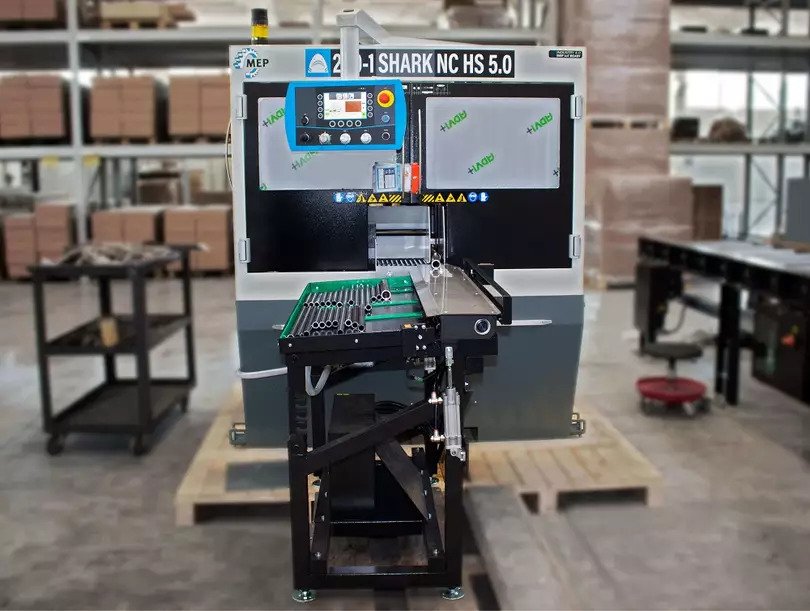
After sawing any material, often the bottleneck is the output side of the machine. One solution is again cross transfers, working in reverse as described previously. Another solution for round materials is a full-length pusher, which acts as a sweeper arm to roll the workpiece clear of the output conveyor. For rectangular and square material, an output table that tips or inclines by means of a pneumatic or hydraulic cylinder works well.
For further information www.prosaw.co.uk

Bison Machinery sets out brand focus

UK-based Bison Machinery is providing an overview of one of its principals, Bianco Srl of Italy, a manufacturer of precision bandsaws since 1982. To date, Bianco has produced more than 150,000 machines, encompassing manual, semi-automatic and fully automatic horizontal bandsaws for general fabrication and engineering workshops.

Bianco’s range starts with the 280M pull-down model; this versatile machine has taken a large market share from traditional circular saws due to being quicker, quieter and better to use, reports Bison Machinery, which adds that the speed and accuracy of cut is exceptional.

The next most common models are the manual – or automatic down-feed – machines. Bison says that the 420 MS is another best-seller and features valve-controlled down-feed adjustment, along with a quick-release vice.

Semi-automatic models feature fully hydraulic cutting with sensitive adjustment of feed pressure and speed. This allows very fast cutting while still not being detrimental to blade life. Hydraulic vice clamping is also standard on these models.

Bison says that fully automatic models provide the ultimate in productivity, allowing the sawing of stock material to size without operator intervention. The automatic range includes powered double mitring models for ultimate flexibility, while loading systems are available for even more productivity.

Particular features of Bianco saws to note are the extremely robust bow – or saw frame – which the company produces as a high-strength aluminium casting and before machining it on CNC machining centres to provide extremely high accuracy. Carbide blade guides ensure the saw blade remains exactly square. The result is fast, accurate cutting of sections and solids.
For further information www.bisonmachinery.co.uk

6ix upgrades to machinery from Selmach

Somerset-based 6ix Process Design, a manufacture of stainless steel tanks, vessels and processing systems for the brewing and dairy industries, has recently acquired several machines from Selmach, including a Bianco 420 MS bandsaw, hydraulic plate rolls, a pillar drill and a tube notcher (linisher).

“Our previous machinery was tired and originates from when I initially set-up the business,” explains managing director Sam Cabell. “Now that we’ve got more investment it’s freed up finances, which meant we could invest in decent equipment to see us through to the next five or 10 years. Selmach came recommended to me by another company that I used to work with.”

He continues: “The plate rolls we had before didn’t have any of the hydraulic support or guidance, so we’ve turned rolling from a four-man operation into a one-man operation, which has saved a lot of hours in the workshop. Same with the bandsaw really; that operation is all automatic now whereas before it was a handheld process, which is a massive plus for us. Furthermore, the new pillar drill has improved how we can put together handrails and guide rails.”

Along with the machine, 6ix also values the aftercare and service available from Selmach.

“If I were to pick up the phone now I know that Selmach will respond, although we haven’t had any issues with the equipment,” says Mr Cabell. “The guys who came down to commission the machine were in and out within a couple of days. A great service. I would recommend machinery from Selmach. In fact, I already have!”
For further information www.selmach.com

Sawing line for continuous aluminium casting

Leichtmetall Aluminium Gießerei of Hanover specialises in the production of continuous cast hard alloy aluminium with ingot lengths of up to 7 m and diameters up to 685 mm. The company will shortly be able to produce ingots measuring up to 1200 mm in diameter. In order to separate the billets after casting into shorter sections between 500 mm and 6000 mm in length, the company sought a strong and precise bandsaw that was up to the task.

The company found what it was looking for in models of the Behringer large bandsaw series, which are suited to large diameters and extreme material weights. In other words, these machines can process heavy continuous castings with weights of up to 3200 kg/m and diameters up to 1300 mm. With a robust material handling system, users position the hard alloys billets centrically and then cut efficiently with the bandsaw. The sawing line is equipped with an effective extraction system for the aluminium dust produced at Leichtmetall Aluminium Gießerei.

Together with the customer, Behringer carried out cutting trials using its HBM1300Z model. Here, various materials were sawn in several passes using different cutting parameters in order to evaluate the effect on chip formation and surface quality. Leichtmetall was more than satisfied with the results.

Today, the company has significantly reduced its previous cutting times with the new sawing line from Behringer, enabling it to establish fast process flows and material throughputs.
For further information www.behringer.net

Large workpieces sawn with precision

Structural steel and tool steel stockholder and processor, JKZ Bučovice, is using KASTObbs automated block bandsaws to cut large, heavy billets and plates of various geometries, grades and dimensions. The company delivers components to domestic customers in the Czech Republic, Slovakia, Poland, Austria, Germany, Slovenia, Hungary, Romania and the Baltic States.

Founded in 2000, employing 125 staff and with an annual turnover of €20m, the company holds approximately 10,000 tonnes of steel in its 15,000 sq m warehouse. The oldest Kasto vertical block bandsaws have been in use for nearly 20 years and are still operating reliably today. More recently, the company invested in two KASTObbs A 3×20 bandsaws for cutting material up to 420 mm high by 7 m long and weighing up to 56 tonnes.

Marek Hermann, sales and production director at JKZ, says: “The new KASTObbs saws are very robust and reliable and provide the high degree of quality and precision that our customers demand, especially those in the toolmaking sector.”

Characteristic of this bandsaw series is a longitudinal cutting method using a vertically oriented blade. The saw head moves on rails having side-mounted, hardened and ground rollers, while the workpiece remains static on the saw table. This configuration results in a small footprint, while the torsion-resistant, welded construction provides smooth running and vibration-free operation, leading to shorter cutting times and longer blade life.

JKZ employees are able to adjust the cutting infeed to optimise productivity, consistent with the required workpiece quality and the cross section of the material in-cut. Band speed is also infinitely variable from the integrated control panel.
For further information www.kasto.com