

High quality with Trimos height gauge

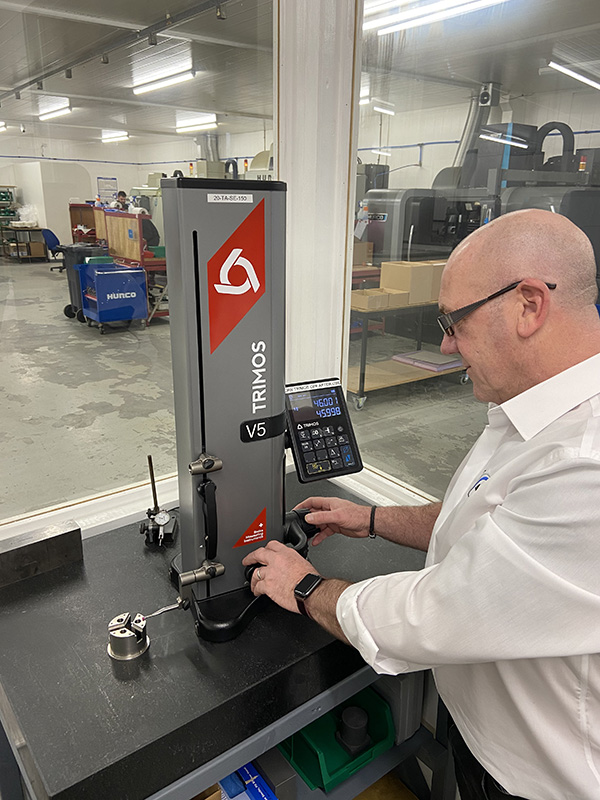
Ashford-based precision turned-parts manufacturer AES Precision Engineering has invested in a Trimos V5 height gauge from Bowers Group to ensure the quality of components it supplies to the medical, defence, aerospace, automotive and electronics industries.

Mark Wilson, director at AES Precision, says: “We have strict quality control procedures and must meet tight tolerances, so accuracy is incredibly important. The Trimos height gauge is a great solution for our general inspection requirements.”
AES typically uses a CMM for the measurement of complex components. However, for basic parts requiring quick and accurate measurements, a simple solution was needed that would be fast and easy to use. The business previously used a basic digital height gauge, but decided it was time to upgrade to a more sophisticated model with a few more features.
The Trimos V5 height gauge can be manually operated or motor driven, and has a clear display and user-friendly functions. Ease of use is a notable feature; so easy that all shop-floor operatives and inspectors at AES use the height gauge on a daily basis.
“We find the height gauge very accurate, and it has a great range of functions to suit our needs,” says Wilson. “Training was very straightforward and everyone here was confidently using the height gauge very quickly.”
Having the option of both manual and motor-driven operation means the height gauge can accommodate multiple users and achieve consistently accurate measurements, regardless of which mode is used. The side probe holders enable measuring with long, robust probes, which guarantee repeatability. AES calibrates the height gauge in-house at recommended intervals to ensure consistency.
For further information www.bowersgroup.co.uk
Reaching for the stars with Hexagon CMM

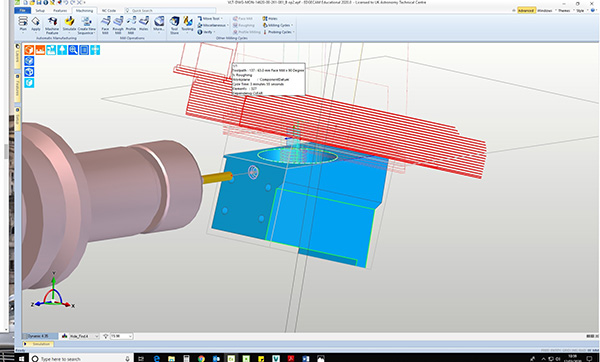
The UK Astronomy Technology Centre is working on two separate instruments that will teach astronomers far more about the universe than is known at present. Some of the parts are manufactured using tool paths created by Edgecam CADCAM software, and then measured to high accuracy using a Hexagon Global CMM.

The instruments will be fitted into the VLT (Very Large Telescope) at the Paranal Observatory in Chile – one of the most productive ground-based telescopes in the world.
One instrument is known as MOONS – Multi-Object Optical Near-infrared Spectrograph – which looks at many astronomical objects simultaneously, while gathering information from them all. The 75 mm square components for the precise calibration system which forms an essential part of the instrument, took a couple of hours to program with Edgecam. With the parts being used for holding optics, calibration was vital to ensure the incoming light source goes to the correct place. This outcome was achieved with the ATC’s Hexagon Global CMM, which checked the bores and positional tolerances of the components in the assembly.
The other instrument is ERIS – Enhanced Resolution Imager and Spectrograph – which will use the VLT’s adaptive optics to remove distortion from the atmosphere as the team hunts for planets outside the solar system.
The mechanisms for ERIS had to be within 10 µm for everything to line up, and the ATC used the CMM to guarantee that accuracy. Each individual mechanism was placed on shims attached to the optical bench. Measurements were taken to determine the centre of the mechanism and to make sure it was square and parallel. Shims were machined to bring the mechanism into the correct position, before the mechanism was rechecked. When the team was completely happy with each one, all components were placed together and a final optical check was performed.
For further information www.hexagonmi.com

Training videos for Baty Fusion software

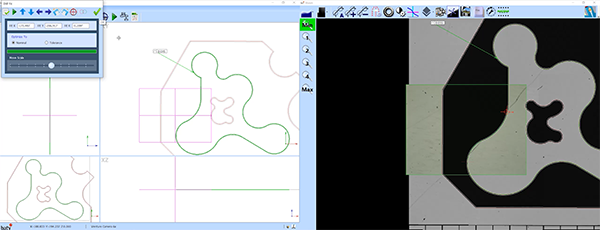
A series of videos has been created by Bowers Group covering new functions included in the latest version of Fusion Software from Baty International. Offering a number of updates, the software now includes a range of technical and feature enhancements, such as lens error mapping, drag and drop positioning, custom reporting options and offline vision/touch-probe programming from CAD.

Geoff Jackson, business and product development director at Baty, says: “The videos explain and demonstrate exactly how the new features make our multi-sensor vision systems more capable and easier to use than ever before.”
Several enhancements have been added to enable users to quickly drive the camera/probe to specific locations and/or features using simple mouse gestures. The new mini-map feature, for example, enables users to see which area of the part is being reviewed in detail, while maintaining a view of the entire component. Furthermore, touch probe moves are now a simple one-handed operation, thanks to a new touchscreen joystick.
DXF CAD files can be overlaid on stitched images of the entire part for profile comparison, while dimensioned drawings of measured parts are easily generated with a combination of standard geometry, as well as profile polylines for a clear visual representation of the scan. In addition, programming and positioning are now easier than ever, and many new dimensioning features are available to enhance reports, making them even easier to produce and tailor to customer needs.
The latest Fusion software can be used on a variety of Baty’s multi-sensor vision systems, including the Vumaster, Venture Touch, Venture Plus and Venture XT.
For further information https://vimeo.com/435689275

Mitutoyo ‘co-ordinating’ precision at ADP

Among the latest users of the recently introduced Mitutoyo Crysta-Apex V series CMM is Newcastle-based ADP Precision Engineering.

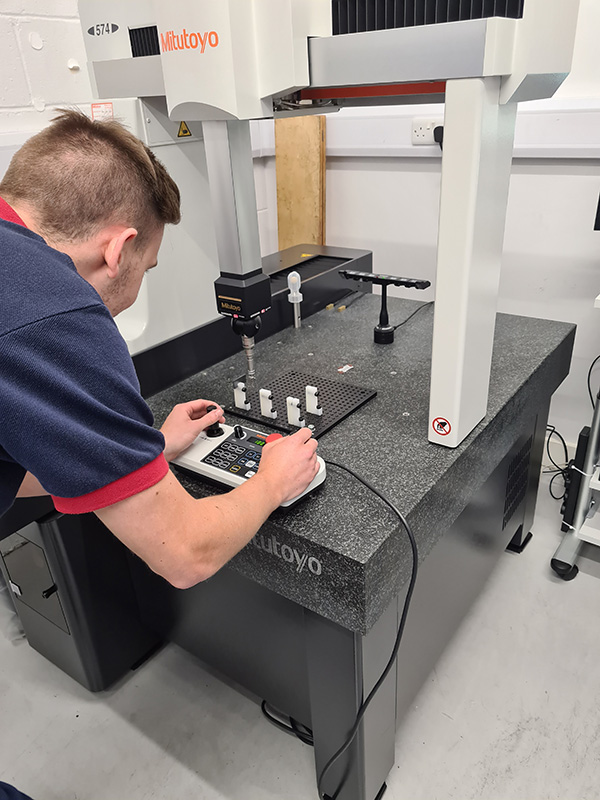
“Given our beliefs in producing premium-quality components and ensuring that we achieve maximum efficiencies in all of our activities, we recently searched for a new CMM,” explains ADP director and co-founder Peter Cornish. “The launch of Mitutoyo’s Crysta-Apex V series proved to be perfect timing, as the new CMM’s high precision and speed specification matched our requirements exactly.
“Our recently installed CMM is now satisfying ADP’s demanding precision needs and helping to guarantee the quality of parts that we produce,” he continues. “In addition, its rapid CNC action is helping to fast-track the throughput of inspection work in our busy quality department. Its speed is also proving very useful when we are faced with challenging lead times.”
ADP quality manager Stephen Cross adds: “The new CMM’s fast CNC performance means that we are now able to load a large batch of components to the machine’s bed, then start a quick, fully automated measuring sequence. On completion, data related to each individual component is then generated and, if required, we can print detailed inspection reports or archive relevant inspection data.
“Given the speed of the Mitutoyo CMM, in addition to inspecting our current levels of production, we are confident that it will also be able to handle any future increases in production.”
Due to the advent of smart factories and the arrival of the IoT, Crysta-Apex V series CNC CMMs are equipped with Mitutoyo’s Smart Measuring System (SMS) technology. SMS allows the online monitoring of a CMM’s operational status and the automated gathering of records related to key parts.
For further information www.mitutoyo.co.uk

Providing precision when ‘heat’ is on

When Alloy Heat Treatment (AHT) was established in 1974 it became the first UK company dedicated to the heat treatment of aluminium alloys. To satisfy increasing demand for its services, the Dudley-based subcontractor has continuously expanded its facilities and invested in the best-available technologies.

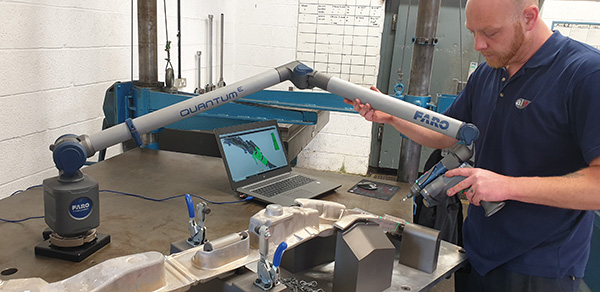
As unwanted distortions can occur in intricate aluminium products due to rapid heat transfer from the quenching process, AHT operates a setting department that removes distortion in the treated condition while products remain ductile. To help further increase AHT’s setting department capabilities and accelerate throughput, a Quantum E ScanArm was recently purchased from
Faro UK.
AHT director Ian Perks says. “The quality of the heat-treated components we deliver to our customers are of paramount importance to us. Owing to the speed and precision that a ScanArm-type device could provide, for many years we’ve felt that such an advanced inspection aid had a part to play in our organisation. Therefore, as our workload grew, we recently committed to placing an order. As we were aware of Faro’s reputation for being the market leader in this technology, we didn’t consider purchasing any other brand of laser scanner.
“After considering several Faro models, we chose the Quantum E ScanArm due to its speed, ease of use and accuracy specification,” continues Perks. “So successful has it been that we now anticipate a much quicker ROI than originally anticipated. In addition to being the perfect choice for measurement and scanning tasks, since using our new ScanArm we’ve found numerous other uses for it across our site.”
For further information www.faro.com