
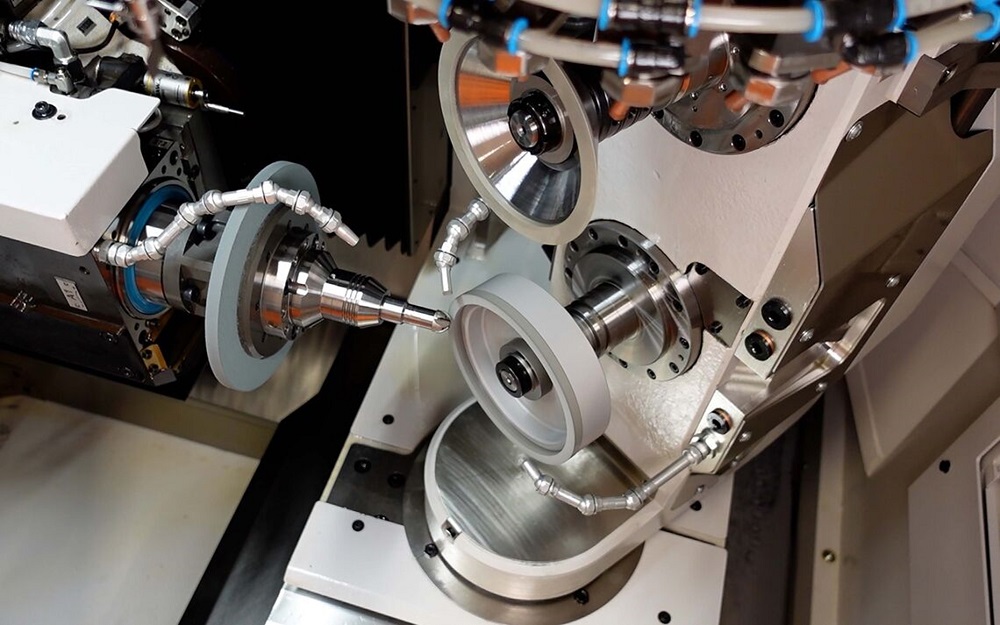
Milling and grinding to micron accuracy

Gerhard Rauch GmbH in Trasdorf, Austria, machines complex mechanical components and assemblies to tight tolerances. For high-precision prismatic machining, the company has standardised on the use of milling centres from German firm Roeders, which are available in the UK and Ireland exclusively from Hurco Europe.

CEO Anton Buresch says: “We produce punching tools to extremely high accuracy. For example, the mass production of aluminium foil yoghurt pot lids requires tools with clearances of 2 µm in some cases. This requires a tolerance of less than ± 1 µm for both the punch and the die.”

In the past, the company required multiple operations to manufacture such tools. Following pre-milling, hardening would result in a certain amount of distortion. Separate milling and grinding would take the tools to their final dimensions. This multi-stage process was necessary because the previous machining centres struggled to process hardened steel.

The solution was to invest in prismatic machining centres from Roeders, which are both rigid and precise enough to machine even extremely hard materials to the required accuracy, including tungsten carbide. Gerhard Rauch GmbH can now clamp and machine to final dimensions by milling and jig grinding on the same platform. This capability results in enormous savings in terms of personnel, throughput time and cost.


Today there are five five-axis Roeders machines on the shop floor in Trasdorf: three RXP 501 DS and two RXP 601 DSH models. All are automated with an RCE 1 pallet storage system which, depending on the pallet type, can hold between eight and 45 workpieces.More information www.hurco.co.uk

Next-generation gear grinders arrive

Kapp Niles says it has reached a new milestone thanks to the introduction of its KNG 350 machine series, with availability in the UK via the Engineering Technology Group (ETG). The previous KX 300 P gear centre was a success with more than 500 machines sold. Kapp Niles’ new KNG 350 series is taking on the mantle thanks to even greater flexibility and productivity.

The KNG 350 is a compact, set-up optimised machine for everything from job shop environments to the large-series production of geared components with diameters of up to 400 mm. Thanks to the integrated ring loader, non-productive times are no more than 5 seconds. The machine can automatically load bore parts and shaft-type workpieces up to 600 mm in length. Loading flexibility extends from manual loading or simple pallet conveyors, up to complex robot solutions.

A functional and ergonomic machine design pairs with a user-friendly interface to support the user during set-up and the optimisation of grinding projects. Process monitoring, part tracing and inline quality assurance are available as an integral component of this Industry 4.0 capable machine.

Regarding energy efficiency, hydraulic functions are reduced to a minimum, while electric drives take the place of pneumatic functions. Moreover, the switch from a base made of cast iron to one of polymer concrete reduces the machine’s overall CO2 equivalent.

The automatic HSK interface allows for a semi-automatic tool change, which Kapp Niles implemented consistently in both the ‘Expert’ machine and other variants in the series. Thanks to selectable dressing methods, it is possible to meet all requirements in a cost-efficient way, from single-item manufacture such as topological dressing to mass production like multi-ribbed dressing.

More information www.engtechgroup.com

Tool manufacturing around the clock

Based in Lower Bavaria, Huber GmbH CNC-Präzisions-Werkzeugschleiferei is a user of sharpening machines from Vollmer, with a VGrind 360S grinding machine the most recent arrival. Huber is using the Vollmer machine and its 24/7 automation capability to boost the production of semi-standard milling tools for the machining industry.

Manufacturing standard and special tools, resharpening circular/bandsaw blades and supporting customers with reliable services – this is how Huber generates a profit of around €2.7m a year.

“Our latest VGrind 360S grinding machine with chain loader enables production around the clock, seven days a week, allowing us to fulfil our high order volume quickly and with high precision,” says Christoph Ziegler, production manager at Huber GmbH. “As such, the Vollmer machine is a perfect match for our guiding principle and self-imposed goal to deliver the best possible quality and precision ‘despite’ the high speed of our processes.”

Alongside automation, the decisive factor for Huber was that the VGrind 360S is suitable for ensuring consistently high-quality machining thanks to the wear-free linear induction motors in the X, Y and Z axes, as well as reducing maintenance costs. With two grinding spindles situated one above the other and the grinding wheel set positioned at the C-axis pivot point, the VGrind 360 tool grinding machine enables efficient multi-level machining. The company can reduce machining times thanks to the shorter travel distances of the linear axes, which is also beneficial in terms of the speed promised by Huber.

As a final point, a plate heat exchanger cools both the machine’s spindles and motors to increase thermal stability and improve both the precision and performance of the grinding process.

More information www.vollmer-group.com

Rapid grinding in the smallest of spaces

In many applications it is uneconomical to use oversize universal cylindrical grinding machines for the external machining of smaller components. With the new WPG 7 CNC external grinder, Emag Weiss demonstrates another way of grinding workpieces with a maximum length of 250 mm. This very small machine requires only a minimal footprint, but at the same time features a whole range of high-tech components for flexibility and productivity.

The WPG 7 fits on two Euro pallets for easy transportation by crane as an easy to set-up machine. It is then possible to start grinding immediately without compromising on quality or process reliability as the WPG 7 has negligible heat build-up thanks to its rigid design. In addition, in-process measurement with Marposs technology, which works independently of the cycle time during the machining process, is available as an option.

The machine uses straight or angled external grinding wheels (with or without profile) featuring a maximum diameter of 500 mm. It is not possible to integrate an internal grinding wheel and there is no B-axis for swivelling the headstock.

Included in the WPG 7 are features such as highly dynamic axes, a powerful and controllable grinding wheel drive, and a work-head with stationary or live centre (MK4/MK5 or W20/W25). The graphical dialogue interface of the control panel is also important for productivity. It is based on a FANUC control system and considerably simplifies the input of technology parameters for certain cycles. The basic version of the control already includes all common grinding cycles.

Last but not least, Emag Weiss offers the WPG 7 CNC solution with automatic or manual loading.

More information www.emag.com

Nissei showcases indexable insert grinder

Nissei Industry from Japan has been developing vertical and horizontal double-disc grinding machines for more than 40 years. Among other things, these machine concepts are for grinding hard materials, one of the company’s core applications in the Asian market. One specific application is the surface grinding of indexable inserts made of carbide, cermet or ceramic. Nissei presented a machine optimised for this purpose, the VP3-400RW, at the recent GrindingHub exhibition in Stuttgart, Germany.

When grinding indexable inserts, the demands on the mechanical and thermal stability of the processing machine are particularly high. The unit from Nissei has the corresponding rigidity, and this with a comparatively compact design. Thickness variations of the ground indexable inserts with capability values of Cp/Cpk of well over 4 are achievable with dimensions of 6.33 ±0.13 mm, for example.

As the main drives for the two 400 mm diameter diamond grinding wheels, the VP3-400RW contains two AC spindle motors delivering 15 kW each. The internal workpiece feeder, which has a 180° swivel function and linear oscillation, features AC servomotors for high dynamics and fast set-up.

The control of the VP3-400RW is by FANUC, allowing various machining modes such as simultaneous grinding of both sides of the workpiece or grinding of the sides one after the other, as well as grinding of only one side. It is possible to store and automatically call-up the respective machining parameters for different types of indexable inserts. Another important feature is the fully automatic dressing device, which can correct the shape on both grinding wheel surfaces simultaneously if necessary.

Nissei presented the VP3-400RW at GrindingHub as a co-operation partner of Nagel.

More information www.nagel.com