
Faro launches CAM2 2019 software

Faro’s latest CAM2 2019 software is specifically designed to enable users of the company’s metrology hardware products, including the recently introduced Faro Prizm colour laser-line probe and 6Probe laser-tracker product families, to realise high levels of measurement performance.

The latest release has evolved from extensive user feedback to the CAM2 2018 version introduced a year ago.
As well as tight integration with Faro metrology products, CAM2 2019 extends the narrative for high-value interactivity and usability. For example, 6Probe users are now able to program button configurations and then interact with the software through the device in real time. Additionally, Faro laser-line probe users can benefit from immediate visual feedback of part quality via live deviation colour scans. Finally, with the built-in universal CAD importer, all major CAD file formats can be directly imported into CAM2, improving workflow by eliminating the need for time-consuming ‘double translations’.
The software features a standard set of instructions, or routines, which automatically guide the user through specific operations, visually and audibly. This capability reduces the technical expertise required to use Faro 3D measurement solutions, shortens workflow and allows users to direct their primary focus on the measurement results themselves. Additionally, pre-set scanning profiles further streamline the end-to-end process by enabling users to select the appropriate scan setting for the specific part type at the click of a button.
CAM2 2018 featured the RPM (repeat part management) control centre, an integrated, web-based dashboard reporting tool for real-time inspection and trend analysis in a user-friendly set of adaptable visual reports. CAM2 2019 evolves this functionality to actionable intelligence by delivering statistics-based graphs and results for trend analysis and predictive alerts. These alerts not only highlight that the measurement target is trending beyond tolerance, but inject advanced intelligence into the process and relay why the situation is occurring.
For further information www.faro.com

Edgecam supports fast 5-axis machining tools

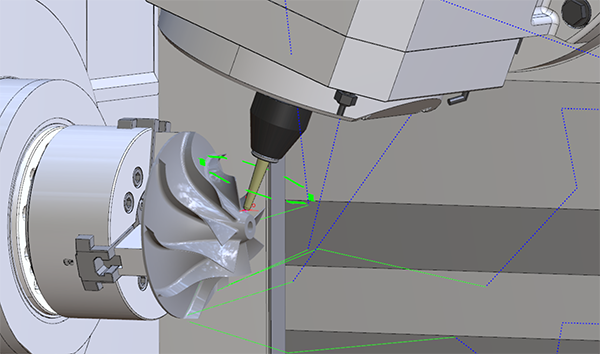
The development of a specific five-axis ‘Tilt’ control strategy, combined with a barrel cutter, is the most significant enhancement in the latest release (2020.0) of Edgecam from Hexagon Manufacturing Intelligence’s Production Software division.

John Buehler, brand manager, says barrel cutters are recognised as one of the fastest tools when performing five-axis machining, and are now fully supported in the Edgecam Toolstore. As well as ‘side tilt by contact point’ capability, the ‘Advanced 5-axis’ cycle also offers further gouge checking in the ‘swarf’ command, along with extra ‘ink’ control in all strategies.
Several newly developed and enhanced features in Edgecam 2020.0 provide increased productivity for both milling and turning users, while the recently introduced Edgecam Inspect module includes 13 upgrades.
Mindful of the need to generate quick tool paths and reduce production costs, Edgecam 2020.0 offers a performance boost when either roughing or profiling a solid model. Essentially, the machining engine will only compute data constrained within the boundary, ignoring the rest of the model. This functionality decreases the cache size, while generating faster tool paths.
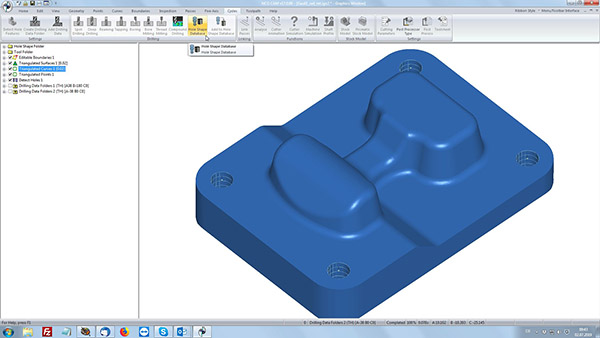
Previously introduced in the ‘Hole’ cycle in the 2018 R1 release, the ‘Deep Hole’ strategy has been enhanced, justifying the creation of its own individual cycle. The original modifiers have been improved, and further control tabs have been added to the cycle, giving greater control over the tool path.
Within the ‘Turning’ environment there is a newly devised machining cycle – ‘Thread Profiling’. Reacting to a high frequency of enhancement requests from customers in this area, Edgecam 2020.0 allows users to machine complex form threads such as VAM and Acme. The cycle provides both roughing and finishing strategies, permitting users to specify their own thread forms.
For further information www.edgecam.com

XYZ to unveil latest ProtoTrak control

The next generation of ProtoTrak control systems from XYZ Machine Tools will exhibited for the first time at the Southern Manufacturing exhibition (5-7 February, Farnborough) on stand J210.

Three ProtoTrak controls have been developed. The KMX is specifically for company’s range of turret mills, while the RMX and RLX supersede the existing ProtoTrak controls on the company’s bed mills and lathes respectively.
Available as either a two- or three-axis CNC, the ProtoTrak KMX is able to create programs without any requirement for G-codes. Furthermore, the AGE (Auto Geometry Engine) facility gives the control the ability to calculate missing print data while programming. At Southern Manufacturing the ProtoTrak KMX will be shown on an XYZ KMX 2000 turret mill.
XYZ’s bed mills benefit from the RMX ProtoTrak with its 15.6” touchscreen, which extends the control’s advantage by further simplifying programming operations. The RMX also introduces additional programming help with the EPA (Enhanced ProtoTrak Assistance) feature, which provides instant access to in-depth on-screen assistance for users at any point. This can take the form of step-by-step instructions to guide users through elements such as cutting parameters, or a series of video tutorials.
XYZ’s ProTurn lathes now feature the RLX ProtoTrak control. As with the RMX system, the RLX also has a large touchscreen for improved user interaction. The makeover to the ProtoTrak controls sees a range of benefits added to both RMX and RLX systems, with gesture technology allowing fly-out windows to be integrated within the interface that can be accessed via a single swipe of the finger. An XYZ RLX 425 ProTurn lathe will highlight the features and benefits of the
RLX control.
For further information www.xyzmachinetools.com

Latest linear motor unveiled by Anca Motion

At IMTS in Chicago last week, Anca Motion launched its LinX M-Series linear motor automation solution for OEMs. The LinX M is housed in a slim body, and is said to be a highly energy-efficient solution for precision CNC applications or high-speed automation systems.

Anca Motion also revealed its Single Cable Motion System that adopts Hiperface DSL protocol technology by using a single cable to simplify machine integration, reduce waste and offer improved diagnostics.
Naveen Nadesan, Anca Motion marketing manager, says: “There is a clear trend for companies to use energy in a more efficient manner. Replacing a pneumatic cylinder with a tubular linear motor reduces energy costs, achieving a relatively short payback period of six to 12 months. The LinX M-Series linear motor therefore provides a unique benefit to OEMs seeking higher performance, accuracy and reliability in their machines.”
At the show, two LinX motors were displayed in a V-structure parallel robot (V-Bot) arrangement showcasing: a high-speed pick and place application; and high-precision contouring around various shapes. The LinX M-Series is fully compatible with standard pneumatics accessories, such as mounting plates, linear guides and couplings.
“Anca Motion offers a wide range of control systems and has more recently been working largely with laser cutting businesses, providing a complete motor solution for its machines,” says Nadesan. “At the stand we had interactive display panels and videos of laser and cylindrical grinding applications to demonstrate the breadth of our technology.”
The LinX M-series V-Bot demo unit will also make an appearance at the MWCS exhibition in Shanghai this week.
For further information www.ancamotion.com

Enhanced CNC simulation with Vericut 8.2

CGTech has announced the latest release of Vericut CNC simulation software, Version 8.2. With input from thousands of users worldwide, the focus of the latest iteration has been to provide features that improve simulation visibility, speed workflow, and streamline each user’s verification process.

Among the major upgrades are those relating to the user interface, force turning and additive manufacturing modules, to list but a few.
A modernised user interface now uses a right-mouse-button ribbon to put favourite Vericut functions just a click away, and provide convenient access to external applications that programmers find useful. The configurable head-up display (HUD) improves simulation monitoring and visibility by showing the NC program, or machining and cutting status information, overlaid on top of Vericut’s graphical views. HUD provides constant access to important details about the machining process, while keeping simulation views as large as possible for optimal viewing. Furthermore, NC program alert symbols and colours highlight errors and warnings found in NC programs, making it faster and easier to identify problem sources.
An additional enhancement relates to ‘Force’ a physics-based NC program optimisation module that CGTech says analyses and improves cutting conditions to achieve ideal chip thicknesses, while managing the cutting forces and spindle power required. Vericut 8.2 introduces ‘Force Turning’ to optimise lathe turning, and mill-turn operations, when combined with Force Milling. According to CGTech, Force Turning makes it easy to create NC programs for the optimal cutting of inside/outside diameters, shoulders, and in corners and tight spaces – without the worry of encountering excessive cutting forces or high spindle power demands.
For further information www.cgtech.com