
VISI gives flexibility for mould parts

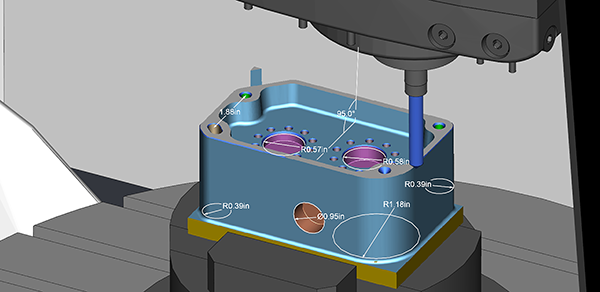
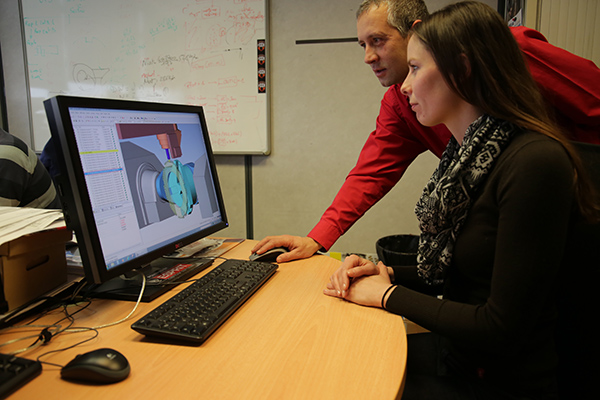
An Italy-based hot runner and injector specialist for the mould and die industry is using a range of VISI CADCAM software solutions to optimise its workflow.

“We use it for feasibility studies before the production phase, and to formulate quotations for customers,” says Sergio Pozzan, founder and owner of Injection Point Srl. “Information is better organised, and errors minimised when moving from design to the machining phase, thanks to VISI’s interface.”
Being an integral part of its processes, VISI Modelling is used for design, VISI Flow to simulate plastic injection flow inside the mould, and VISI Machining to program complex cycles. The company, based in Turin, specialises in the construction of hot runners from 8 mm diameter up to 2300 mm centre-to-centre distances, injectors and filtering systems for thermoplastics.
The VISI Machining CAM module is used to program complex cycles for the company’s two CNC machining centres – a Mikron VCE1250 and a Bridgeport VMC 1000 XP2.
Operating with seven employees from an 800 sq m plant, Injection Point works with partners to extend its market to a large part of Europe, the US, Mexico, India and China. Exports currently comprise around 30% of total revenue.
“Despite the downturn that has hit our sector globally in recent years, with the help of VISI our products are always of the highest quality, meaning customers continue to have full confidence in us and we remain competitive with a good market share.”
For further information www.visicadcam.com

GibbsCAM 13 now available

3D Systems has released GibbsCAM 13, which provides a streamlined user experience, additional milling and turning capabilities, and an enhanced G-code editor that improves communication between software and CNC machining centres. UK availability is via Tech CADCAM.

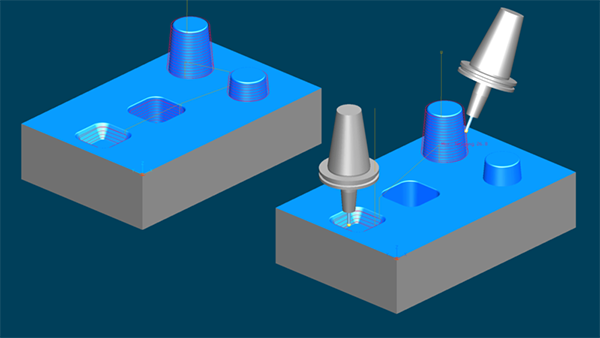
GibbsCAM is said to be the industry’s only software offering elliptical turning, interpolation turning and eccentric turning, thus allowing full functionality for multi-tasking machines. Elliptical turning allows the user to turn parts on any machine that has an accommodating axis, such as four-axis mills, turn-mill and boring machines. Interpolation turning allows the user to cut a turning-style path by orienting a lathe insert towards a centreline, while moving three linear and up to three rotary axes. Turning operations can now be performed on milling and boring machines as well as turning centres with orientable spindles. Eccentric turning facilitates turning operations for shapes not aligned with the centre axis of a part, such as the cutting of lobes on a crankshaft or camshaft, eliminating costly set-ups and fixtures.
‘Autobar Chamfer’ is offered for the first time in the industry in GibbsCAM 13. This function lets the user define automatic chamfering of stock to eliminate burrs, which is especially useful on Swiss-style (sliding-head) lathes. In addition, broaching enables the programming and simulation of linear and rotary broaches from the GibbsCAM interface. A full set of broaching tools are included, or a
user can create custom broaches. Full broaching capabilities are available for milling and turning.
Five-axis deburring enables users to automatically program deburring operations by selecting geometry, surfaces or an entire model.
For further information www.techcadcam.net

CGTech to highlight aerospace applications

CGTech is set to showcase its expanded range of software applications for the aerospace industry in Hall 4, Booth E120, at the Paris Air Show next week (17-21 June).

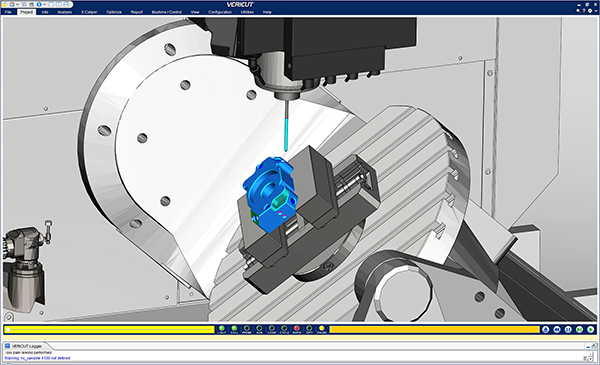
The company says that its Vericut software is used widely in the aerospace and defence sectors to improve the efficiency of various CNC machine-tool types.
Vericut is CNC machine simulation, verification and optimisation software that enables users to eliminate the process of manually proving-out NC programs. The software simulates all types of CNC machining, including multi-axis milling, drilling and trimming of composite parts, waterjet cutting, robotic machining, and turn-mill, additive, and hybrid machining processes. Vericut runs standalone, but can also be integrated with all major CAM systems used in the aerospace industry.
During the show, CGTech will be demonstrating Vericut’s Force optimisation module. Force, which now offers optimisation capabilities for both milling and turning operations, is said to reduce machining times by as much as 30-70%, while also extending the life of cutting tools. A physics-based optimisation methodology, Force determines the maximum reliable feed rate for a given cutting condition based on four key factors: force on the cutter, spindle power, maximum chip thickness, and maximum allowable feed rate.
CGTech’s Force calculates optimum feed rates by analysing tool geometry and parameters, material properties of the stock and cutting tool, detailed cutting-tool geometry, and Vericut cut-by-cut contact conditions. The module interpolates cutting conditions using a proprietary set of coefficients to account for the strength of material, and the effects of friction and temperature. Materials data is generated by actual machining tests and does not rely on extrapolating from FEA results.
For further information www.cgtech.co.uk

Machine awareness with Esprit

Esprit CAM software from DP Technology now provides freeform five-axis solutions essential for factories looking to make the transformation to a more digital manufacturing process.

At the heart of Esprit’s freeform five-axis machining capabilities is the concept of machine awareness. Unlike most CAM software suites, which according to DP focus primarily on the shape of the part and often devote scant attention to the machine itself, Esprit first considers the cutting parameters of the machine tool. Esprit precisely models the machine’s full capabilities, from axis travels and kinematic chains, to tooling and work holding.
This model generates an accurate simulation that works within the machine’s axis travels to avoid collisions. As the simulated part takes shape, the ‘stock automation’ feature accounts for the new space and adjusts the tool path to suit. The result is a complete and accurate picture of the entire cycle, letting users prove out and optimise their programs before making a single chip.
Full support for tool orientation strategies results in efficient, adapted tool paths that are said to maximise cutting engagement and feed rate, while preserving tool life. As users add operations, Esprit automatically calculates links between them to save time and motion. Change the order of operations at will, and Esprit automatically adjusts these links.
Freeform features are easy to create. Users simply define the part areas to machine, and the part areas to avoid. The smart selection, snap and propagation tools in Esprit further simplify this process. From there, programmers can choose an appropriate five-axis freeform machining strategy from several options.
For further information www.espritcam.eu

Tebis Version 4, Release 7 unveiled

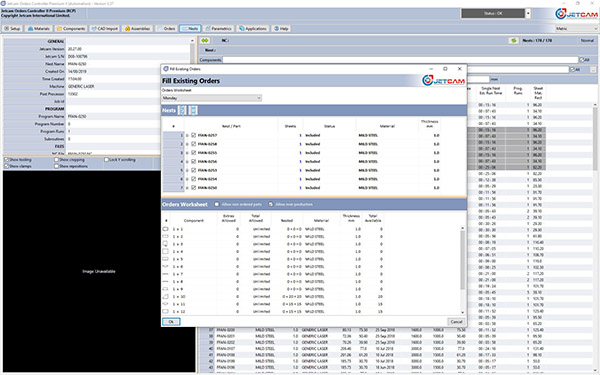
Tebis is unveiling the next release of the current Version 4.0. Release 7 introduces newly developed and improved functions for all those who want to better utilise the potential of their machines and keep their manufacturing processes ahead of others.

Concerning the user interface, customers can now save time with the R7 set-up. There is a new way to transfer user configurations, which includes easier methods to transfer toolbars, work environments and other user settings from a previous release at the click of a button. In addition, the latest updates in importing STEP data are used to specify whether to include covered geometries and axis systems, as well as references in the import. This functionality also adds more efficiency in importing small structures.
With regard to preparing for manufacturing, all sharp edges in a part can be detected using a newly devised function that stores and generates edge surfaces with a structure for optimal preparation of deburring based on NC machine templates. This feature creates the outline surfaces for cutting and restricting dies with a step relief at any cutting angle.
Programmers can now machine edges with ball or tapered cutters using the five-axis deburring function. Practical tool paths can be quickly and easily created for deburring with automatic tilt direction calculation and automatic avoidance of shank and tool-holder collisions.
Another enhancement involves 3D surface machining, which has a sorting strategy that allows users to organise the paths in a more efficient way. The paths can be further sorted from outside to inside in the ‘Axis Parallel’ strategy.
For further information www.tebis.com