

Prima Power and Gasparini in co-op

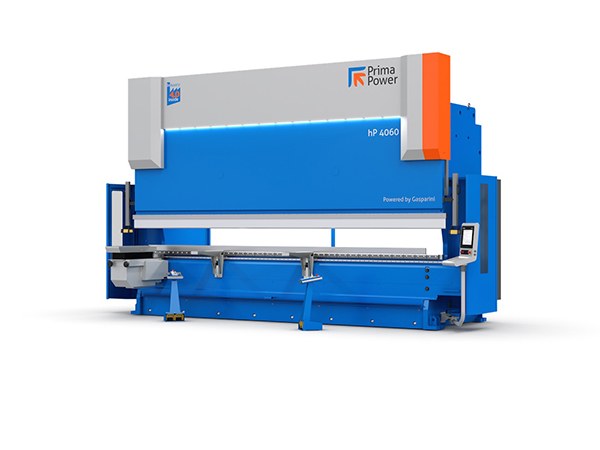
Prima Power has signed an agreement with Gasparini for the distribution of products in the latter’s range with Prima Power branding and colours.

Thanks to the collaboration, Prima Power expands the range of its press brakes, combining the models of the servo-electric eP series, produced in the Prima Power plant at Cologna Veneta, with the new family of hP hydraulic press brakes.
The hP range comprises 10 medium-large format models covering a range from 270 to 650 tonnes. At the base of the agreement there is a real industrial project, valid at a global level, whereby hP press brakes are not only marketed but also assisted by the Prima Power network.
Hydraulic press brakes are suitable for the agricultural and earthmoving sectors, as characterised by high-thickness components. The adaptive crowning and reflex system is also said to make this press brake the most accurate machine in its category. As a result, it is possible to compensate for any deflections of the frame, which are inevitable during the bending process, thanks to sensors and control systems that guarantee the repeatability of the angle, whatever the material and thickness.
The DSP laser safety system protects the operator from the danger of being crushed between the upper and lower tool. What’s more, hP series machines can be connected in tandem, or integrated into automated lines or robotic cells.
Available options include front supports, a bending follower for large sized or very heavy sheet metal, a wireless digital gauge for automatic correction of the bending parameters, a flattening table for increased productivity and simplified operations, and the Laser Check bend angle measurement and correction system.
For further information www.primapower.com
Get familiar with horizontal bending

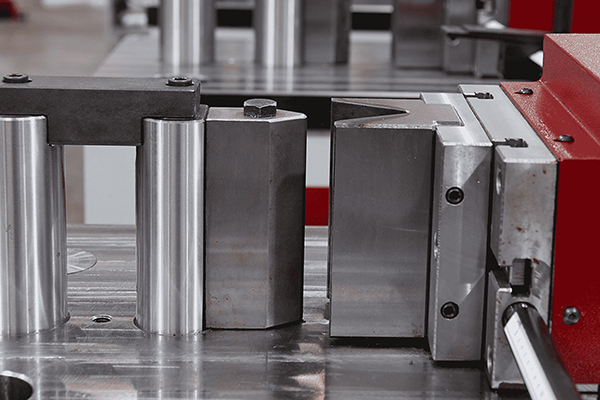
Horizontal bending presses are suitable for many operations, including straightening, punching, shearing and bending.

These machines might not see as much use as a corner notcher or press brake, but for the angle bending of cleats, bracketry and small parts, a horizontal press can handle thicker materials and deliver genuine production line efficiency, reports Selmach Machinery.
The Selmach range is built around two different presses. Firstly there is the Morgan Rushworth HBM range, which is both capable and adaptable with seven different capacities. The range extends from the HBM 10/150, featuring a maximum pressure of 10 tonnes and a tooling height of 150 mm, up to the HMB 100/300, a machine that offers 100 tonnes maximum pressure, a 10 kW motor and, like all the models in the range, a 10 mm/sec working and return speed.
Selmach also offers the SIMASV hydraulic range. These top of the line machines combine power with ease of use, thanks to hydraulic cylinders located below the table, giving a spacious working area that lets users perform enclosed bends without colliding with the machine’s frame. The four models in the SIMASV range offer capacities from 22 to 100 tonnes, with rapid-change tool pins, a large range of specialised tooling and quiet operation.
The company has found over time that the most popular bending presses tend to fall in the 10-40 tonne capacity range.
For further information https://selmach.com/

Get the most from a sheet-metal brake

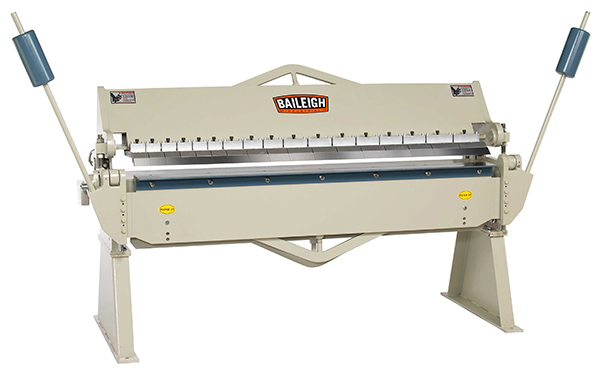
Baileigh Industrial specialises in sheet-metal brakes, the major components of which include clamps to hold the sheet metal, a bending plate where the sheet metal rests, and a lever that lifts the bending plate until the desired angle has been achieved.

Hydraulic sheet metal brakes from Baileigh boast a fully welded top beam, bending leaf and solid steel support rods, which help minimise any deflection when bending at full capacity. So, how do users get the most from such machines?
Like with any project, the best place to start is by measuring not once, but twice. By measuring twice, users can avoid multiple bending attempts. Once all the sheet metal required for the project has been cut to the desired sizes, it is time to make the first bend. Slide the metal into the machine until the measurement marks line up with the clamps on either side. Then, simply lower the clamping lever using the handle on the side of the brake and fix it against the sheet metal.
Once in place, lift the lever on the bending blade so that the metal moves up toward the sheet-metal brake. Using the angle guide on the side of the brake, bend the metal until the angle indicator shows the correct angle. Stay in that position for a few seconds before replacing the lever back to its original starting point.
Now all that is left to do is remove the sheet metal and check the bend matches the required angle. If the bend is not quite right it is always possible to re-insert the metal into the clamps and bend the metal further.
For further information www.baileighindustrial.co.uk

SevenHills unveils tube-bending facility

SevenHills Fabrication, part of the Steetley Corner Group of companies, has expanded its production to include bespoke tube bending through inward investment.

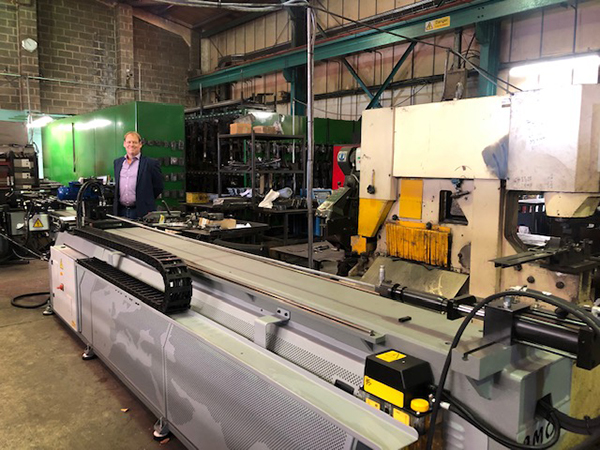
The company has invested £60,000 in an electric tube-bending machine to broaden its offer and complement its established design, consultancy and fabrication services, which include laser cutting and welding.
James Harding-Terry, managing director of Sheffield-based SevenHills, says: “The installation of a tube-bending machine not only adds significantly to our function as a one-stop-shop for fabrication projects, it is an important stage in the company’s transition to Industry 4.0, which is essential for future-proofing the business. It is a highly flexible piece of equipment with a range from 19 to 90 mm external diameter tube, and allows for bending complex tube geometries within seconds of programming.”
The AMOB NDH series electric tube-bending machine comes with a hydraulic mandrel extractor, hydraulic clamp and pressure die, and can be used to fabricate a variety of products, ranging from hand-rails to complex, bespoke geometric shapes.
Demonstrating 31% year-on-year growth with a turnover of £2.5 million, SevenHills will see investment reach £1m over the past two years.
“Increasing investment will see us install more new machinery, including a Bystronic press brake and a Panasonic robot welder before the end of the year,” says Harding-Terry. “This follows the commissioning of a £550,000 laser cutter less than two years ago. Although there is a lot of business uncertainty around at the moment due to Brexit, investment cannot stand still and UK businesses like ours must be ready to compete at the highest level, which means using the best resources.”
For further information www.sevenhillsfabrication.com

LVD adds to electric series

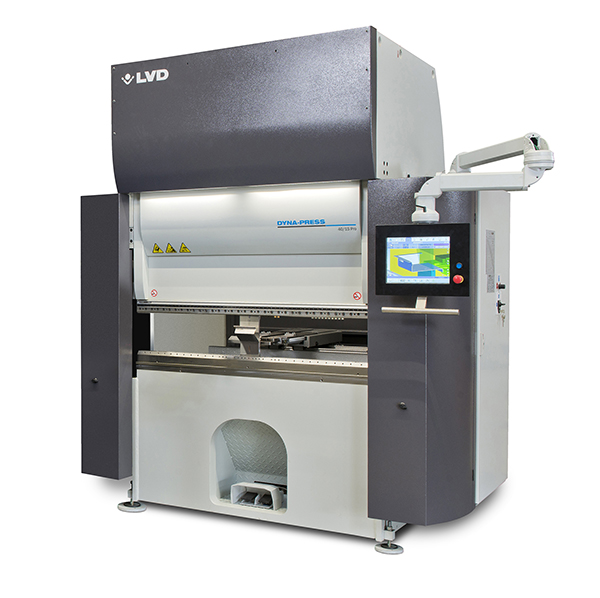
LVD has added the Dyna-Press 40/15 Pro to its Dyna-Press Series of high-speed electric-drive press brakes.

The 40-tonne press brake features a 1500 mm working length and a five-axis backgauge, and can bend at speeds of up to 25 mm/sec to generate more parts per hour at a lower cost per part. Dyna-Press 40/15 Pro can be combined with an industrial robot to create a compact, high-speed bending cell (Dyna-Cell) for automated bending operations.
The Dyna-Press electric ram offers a smooth transition from approach to working speed and minimises power consumption through the use of an optimal power to inertia motor ratio. Of note, the coupling between the ram and the servomotors is made using two heavy-duty ball screws to distribute force and tonnage evenly over the working length. As a result, the press brake provides fast, energy-efficient operation across a
range of bending jobs.
Dyna-Press 40/15 Pro is equipped with a five-axis backgauge which provides consistent and repeatable accuracy. The press brake uses vertical removal type tooling for the simple and quick changeovers, even of heavy tools.
LVD ensures a comfortable and safety-conscious environment for the operator. Like other Dyna-Press models, the newest Dyna-Press can be operated in a seated or standing position. The IRIS Lazer Safe guarding system provides an added measure of security.
Dyna-Press 40/15 Pro is easy to operate with minimal training. The 15” Touch-B touchscreen control features an intuitive graphical display and offers additional functionality by enabling the operator to create and simulate 3D designs at the control. Importantly, the controller is compatible with LVD’s CAM software, CADMAN-B.
Dyna-Press 40/15 Pro features a 400 mm opening height and a 200 mm stroke.
For further information www.lvdgroup.com