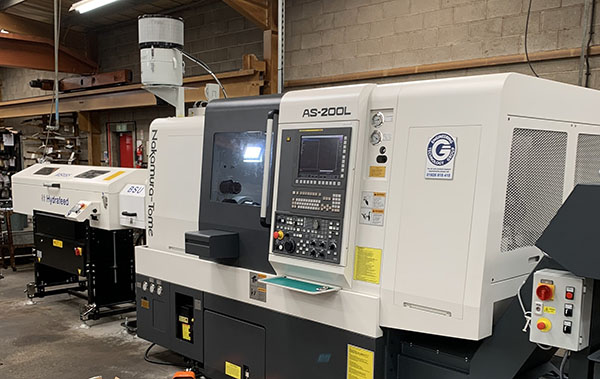
Founded over 100 years ago, Blackburn-based Dobson & Beaumont is a subcontractor with a distinct niche: thread rolling. This established process relies on cold forming to create the threads, while simultaneously providing advantages such as work hardening, strengthened grain flow and overall strength that is some 25% more than that of threads produced by cutting operations. Before rolling its threads, Dobson & Beaumont has to machine some of the most challenging materials known to the industry, which is one of the many reasons the company has just purchased a Nakamura-Tome AS200 twin-spindle turning centre from the Engineering Technology Group (ETG).
Appointed managing director of the family business last year following the unfortunate passing of Phil Dobson, who had served the company with distinction for 50 years, Richard Guest comments on the firm’s position during the pandemic: “Like all subcontract manufacturers, we were impacted by Covid-19. Luckily for us, our niche offering sees our business work across the fastener, pump/flow control, automotive, motorsport, oil and gas, petrochemical, marine, defence, subsea, wind energy, and aerospace markets, which means that we were not too heavily impacted by one particular industry segment.”
The pandemic allowed the company to review its processes and ageing plant list, and instigate a plan for investing in new technology.

“We machine a lot of parts in batches that can vary from 4 or 5-off through to 50, 100 and beyond, and our turning centres were all single-spindle machines,” explains Guest. “This meant that most of our turned parts required secondary operations. We knew we needed a twin-spindle turning centre to reduce secondary operations and, following a comprehensive review of the market, the Nakamura-Tome AS200 twin-spindle turning centre from ETG was the perfect choice.”
The company machines ‘normal’ materials but increasingly processes more challenging metals such as titanium, Inconel, stainless steel and super duplex to tolerances in the region of ±0.0125 mm. Thread rolled parts are often critical components in their respective assemblies.
“We run six Hardinge lathes and have been using Hardinge for over 20 years, so we understand the build quality, rigidity and stability they offer,” says Guest. “Out of the available machines, the Nakamura-Tome from ETG was sensibly priced. In addition, it had the same FANUC programming language as existing machines and was supplied as a long-bed version for our 400-500 mm parts with a bar feed, part catcher, twin spindles for one-hit machining and a reputation for build quality, stability and precision.”

Installed at Dobson & Beaumont in April, the new Nakamura-Tome AS200 twin-spindle turning centre immediately replaced two ageing machines to release shop floor space, free-up machine capacity, cut power consumption, and reduce set-ups and the subsequent labour requirement. In the few months since the machine has been installed, it has reduced the cycle time for a number of parts, including connecting rods from 2 minutes 10 seconds to just under 1 minute. The company has also reduced the cycle time of double-ended bolts from 1 minute 30 seconds to less than 45 seconds. The ease of use of the Nakamura-Tome AS200 and its FANUC CNC control have immediately impacted the 14 staff at Dobson & Beaumont.
The most dramatic saving has arrived on hexagonal head bolts, where the cycle time has fallen from 8 minutes to 1minute 30 seconds.
Says Guest: “We produce a lot of bolts where we have to machine the hexagonal heads, and this is a perfect example of the savings that we can achieve with the Nakamura-Tome machine. The combination of twin-spindle machining, powerful and robust milling capability, and automated production through the bar feed and part catcher has made a significant difference on this component – as it will on future parts. This machine is a step-change in technology for our business and, as we move forward, we will be aiming to transition legacy work from existing machines to the new Nakamura.”
The robust Nakamura-Tome AS200 has a spacious work envelope offering a maximum turning diameter of 340 mm and a turning length of 570 mm with a bar capacity of up to 65 mm diameter. A 15-station tooling turret provides machining flexibility, supported by a 5.5/3.7 kW driven tooling motor that achieves a speed of 6000 rpm. Motors rated at 15 and 11 kW drive the main and sub-spindles. These high-torque units are capable of reaching a maximum speed of 4500 rpm.

Concluding on the acquisition, Guest says: “We are still in the early days of this installation, but, so far, it is clear we’ve bought the right machine for our business. We have drastically cut cycle times on many parts and we’re eliminating secondary operations across the shop floor. ETG has been extremely helpful in getting us up and running, and we’re still enlisting their help on more complicated components. We have one part that currently requires five operations, but ETG’s engineers will help bring that to one-hit machining on the Nakamura. It’s a perfect example of why we have moved to twin-spindle turning with Y-axis milling.”
He adds: “The next step for Dobson & Beaumont is processing more new and legacy work through the Nakamura to reduce the burden on other turning centres, as well as in the milling department. With the bar feed and parts catcher, we also have the opportunity to automate the production of complex work, meaning unmanned and lights-out running. The investment in the new Nakamura, as well as a new thread-rolling machine, has created enthusiasm on the shop floor and who knows – we may be looking at more Nakamura machines from ETG in the future.”
For further information
www.engtechgroup.com