

For any established subcontract business to switch from one CAM system to another can be a daunting prospect. Considering the training and skills invested in staff, the legacy programs and the prospect of having to re-program historical parts – many busy subcontract businesses will often stick to what they know. But for SRD Engineering, the change from a licence to a subscription CAM system did not fit with what the Bicester-based company wanted, so it made the switch to hyperMILL from Open Mind – a move the company is happy it made.
As a subcontract machine shop founded in 1989, SRD Engineering services clients in the motorsport and automotive sectors, as well as aerospace, oil and gas and medical among others. However, when its CAM software provider changed to a subscription-based model, the company started to investigate various alternatives available on the market.
SRD Engineering’s production manager Chris Bryant says: “One of the main reasons we invested in hyperMILL is because of the money. We were paying a subscription for our CAM software, and we wanted to pay a licence fee, so we started looking around and calculated that by make the switch we would save over £20,000 in three years.”
The financial savings should be enough to turn the head of any subcontract business, but particularly when the lower cost alternative can offer better performance. During the initial period of getting familiar with Open Mind’s hyperMILL, SRD Engineering felt the software was comparable to its previous system. However, once the subcontractor started to get more proficient with the software’s features, that perception changed.

“Now that the guys have got used to hyperMILL and gone through a transition period, it’s definitely better,” says Bryant. “Another reason we invested in hyperMILL is that our customers use it, which is really good for us, especially if we want to discuss any particular projects or similarities in the parts that we’re making. It helps us in supporting our customers.”
With regard to productivity gains from hyperMILL, Bryant says: “Since we’ve been using hyperMILL, we have optimised our run cycles and there’s a lot less ‘air cutting’. Additionally, some of our finishing cycles are much faster. We have one job that we were previously running at 45 minutes per part, which is now down to 30 minutes. For this component, we produce around 60 a year, thus giving us a saving of around 15 hours.”
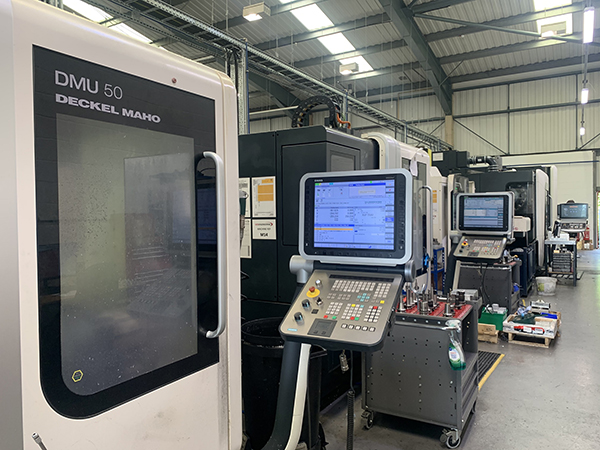
This 30% cycle time saving is magnified throughout the business, especially when considering that SRD has five five-axis machines from DMG Mori and multi-pallet machining centres like the Matsuura HPlus-300. The 80-employee business manufactures over 1000 five-axis parts each month, and the savings on these complex components has been impressive.
“We have one motorsport part that was produced in a batch of over 130 components, and the cycle time was over 3 hours per part. By re-programming this job with hyperMILL, we’ve reduced the cycle time by 45 minutes per component, saving us over 100 hours of machining on just one job. We also have another part that we are producing at present for electrical testing machines. Here, hyperMILL has reduced the cycle time on a batch of 40 components from 10 hours to 5 hours per part – a 50% reduction.”
Since investing in Open Mind’s hyperMILL CAM software last year, SRD Engineering has rapidly ramped up to nine seats of the package, with many of the shop-floor operators programming their components online at the machine.

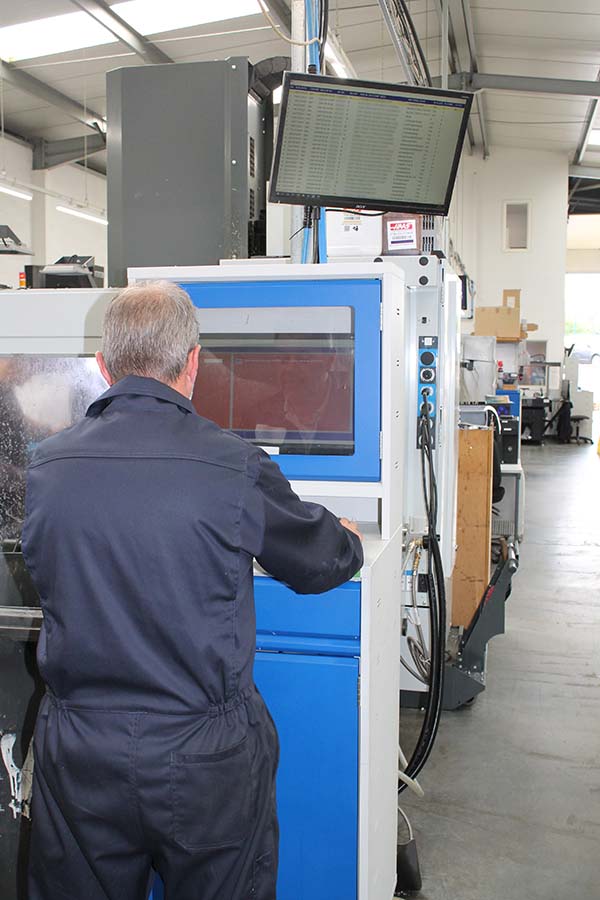
“By programming at the machine, operators take responsibility for following each job from the start to the end of the process,” states Bryant. “With often lengthy cycle times on complex parts, the operators can identify and eradicate any potential issues on the machine. For long-running parts, our team can also program the next job while the machine is running. One feature in hyperMILL that has saved us a lot of time is the pocket milling feature. It can machine straight and inclined pockets with any contour, and with automatic recognition of islands and rest material areas. Open and closed pockets can also be machined easily when using the pocket milling strategy.”
“The support from Open Mind has been incredible,” he adds. “Unfortunately, we made the change during the Covid-19 pandemic, so that didn’t help with things, but the support and online training has been very good. We even had specialist meetings using Microsoft Teams, so if we had any queries the development engineers at Open Mind would look into it and try and make the processes better for our programmers. The Open Mind team are customer-led in their development of the product to stay ahead of the curve. They want to have the best product out there and the best way to do that is by speaking to the customers and developing the product in partnership.”
SRD Engineering has also invested in some three-axis and four-axis machines, and will be running hyperMILL on those machines in the near future too.
“We really want hyperMILL used on as many machines as possible because of the capability it gives us,” concludes Bryant. “We have no regrets from making the switch; we are saving money, the machines are producing parts quicker than ever before and the surface finishes and overall quality have also improved.”
For further information
www.openmind-tech.com