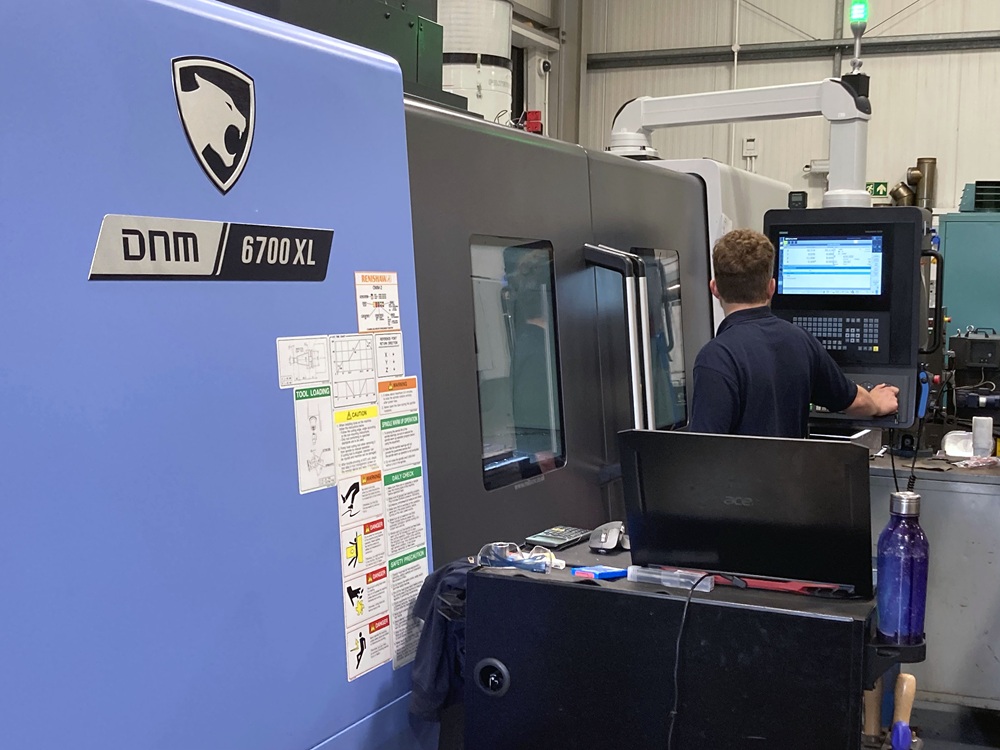
Complete Engineering Services’ recent investment in a DN Solutions DNM 6700XL vertical machining centre from Mills CNC is helping the Carlisle-based precision subcontract specialist meet growing demand for large, complex and high-precision components.
Mills CNC, the exclusive distributor of DN Solutions and Zayer machine tools in the UK and Ireland, supplied the extra-long-bed DNM 6700XL equipped with a Detron fourth-axis rotary table and Siemens 828D control with ShopMill conversational programming software.
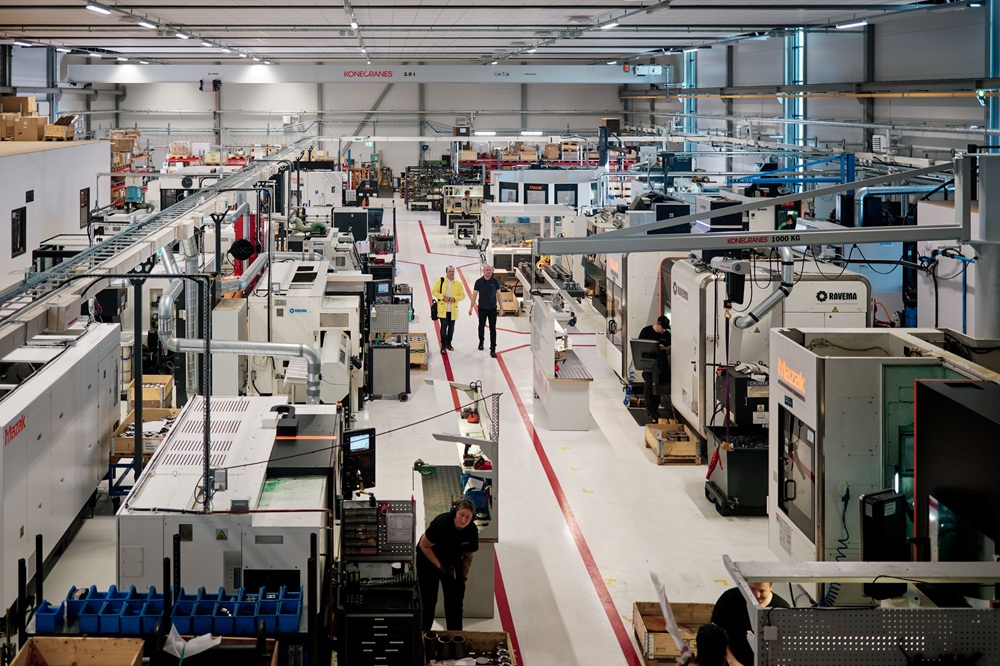
Installed at Complete Engineering Services’ 12,000 sq ft machine shop in June 2026, the machine is already being put through its paces machining components for customers in motorsport, timber processing, power generation, renewables, fluid sealing systems, packaging and rail. These include prototypes and one-offs through to pre-production parts and small-to-medium batches, manufactured from materials including stainless steel, aluminium, mild steel, titanium and exotic alloys. Components are machined to tight geometric tolerances and high surface finishes.
Complete Engineering Services provides customers with three- and four-axis milling and multi-axis turning, complemented by two simultaneous five-axis machining centres and two advanced wire EDM machines. The company also has 3D printing and light fabrication capabilities, in-house inspection and access to secondary services including heat treatment, anodising and plating.
This broad capability supports the company’s aim of providing an integrated design, machining, finishing and assembly service from a single source.
“We provide customers with a one-stop engineering service that, through a range of integrated advanced technologies and the skill and experience of our staff, can deliver high-quality prototypes, pre-production and production parts from concept through to completion,” says managing director Andrew Monkhouse.
Continuous improvement is central to the company’s approach, with regular investment in people, plant, equipment, systems and processes. Its machining capacity is routinely upgraded by replacing older machine tools with newer, more efficient multi-axis and multi-tasking models.
The DNM 6700XL is the second CNC machine tool Complete Engineering Services has acquired from Mills CNC in its 28-year history. The first was a Lynx 2600Y multi-tasking lathe, installed in June 2024.
The Siemens 828D-controlled Lynx 2600Y features an 18.5 kW/3500 rpm high-torque spindle, a servo-driven 12-station BMT-65 turret with 24-position indexing, a ±52.5 mm Y axis and 5000 rpm driven tooling. These capabilities allow turning, milling, drilling and tapping operations to be completed in a single set up.
To increase productivity and overcome floorspace limitations that prevented the installation of a bar feeder, Complete Engineering Services equipped the lathe with a bar puller.
Mounted on the turret, the mechanical gripper automatically draws bar stock forward through the spindle to predetermined lengths, allowing front- and back-end operations to be completed in one setup and enabling unattended running.
“Our Lynx 2600Y is inherently flexible and delivers excellent cutting performance. The machine has been a great addition to our machine shop,” says Monkhouse. “Prior to acquiring the lathe, we were on numerous jobs having to perform first operations on an older lathe and then transfer parts to a machining centre for milling, drilling and tapping. Such labour-intensive processes were inefficient, created production bottlenecks and affected our productivity.”
He adds: “We needed to change things, and with the arrival of the Lynx 2600Y, with its integrated Y axis, C axis and driven tooling, we were able to transform our small-parts processing operations.”
The company’s positive experience with both the Lynx 2600Y and Mills CNC subsequently influenced its decision to turn to Mills again when the need arose to replace an older large-capacity machining centre. In late 2025, Complete Engineering Services decided to replace the 15-year-old machine, which was used to process large, complex components, with a faster and more powerful model.
“The older machine was getting a bit long in the tooth, was more prone to breakdown and the operator dedicated to run it was about to retire,” he recalls. “This set of circumstances provided the ideal opportunity to improve and increase our large-machining capacity and capabilities by investing in a new machine.”
Rather than conducting a wider search, the company made Mills CNC its first, and ultimately only, point of contact for its requirements.
A key requirement was Siemens control, as most machines in the company’s machine shop use Siemens controls and ShopMill or ShopTurn conversational software. This provides operator familiarity and makes it easier to transfer work between machines.
The new machine also needed a larger worktable and greater X-, Y- and Z-axis travels than its predecessor, together with a powerful, fast spindle with through-spindle coolant to reduce cycle times and increase material removal rates during roughing.
A generous-capacity automatic tool changer was another priority, particularly for long machining runs and jobs requiring numerous tools or sister tooling. Finally, a fourth-axis rotary table was required to increase flexibility, reduce the number of setups and improve overall process efficiency.
“The DN Solutions DNM 6700XL is an impressive machine and its technical specifications fitted the bill,” says Monkhouse.
The DNM 6700XL is a rigidly designed vertical machining centre from DN Solutions’ DNM range. The machine supplied to Complete Engineering Services features an 18.5 kW/12,000 rpm spindle delivering 117.8 Nm, with 20 bar coolant capability.
Its 2100 x 670 x 625 mm X/Y/Z-axis travels and 2200 x 670 mm worktable, with a maximum table load of 1300 kg, provide the capacity required for larger components. Linear-axis rapid rates of 30 m/min and a 40-tool automatic tool changer further support productivity.
The machine is equipped with the Siemens 828D control, a Detron GXA-255H rotary table with a 10-inch chuck, Renishaw tool and workpiece probing systems and a Filtermist extraction unit.
Since installation, the DNM 6700XL has been used to machine a variety of long, shaft-type components. It is currently machining 30 stainless steel dead-plates – flat, stable transfer plates used in industrial, food and beverage processing and packaging lines.
Approximately 1.5 m long, the dead-plates are secured using bespoke fixturing and machined incrementally using multi-pass cuts to produce a mirror finish across their surfaces. Other operations include high-accuracy chamfers, holes and counterbores.
The investments in the Lynx 2600Y and DNM 6700XL are already helping Complete Engineering Services improve productivity and process efficiency while expanding its capacity for demanding work.
For a company committed to continuous improvement, the machines also demonstrate the value of maintaining a close relationship with a technology partner able to support its changing requirements.
With the DNM 6700XL now established in its machine shop, Complete Engineering Services looks well placed to build further on the capabilities that have helped drive its growth – with Mills CNC playing an important role in that ongoing development.
More information www.millscnc.co.uk