

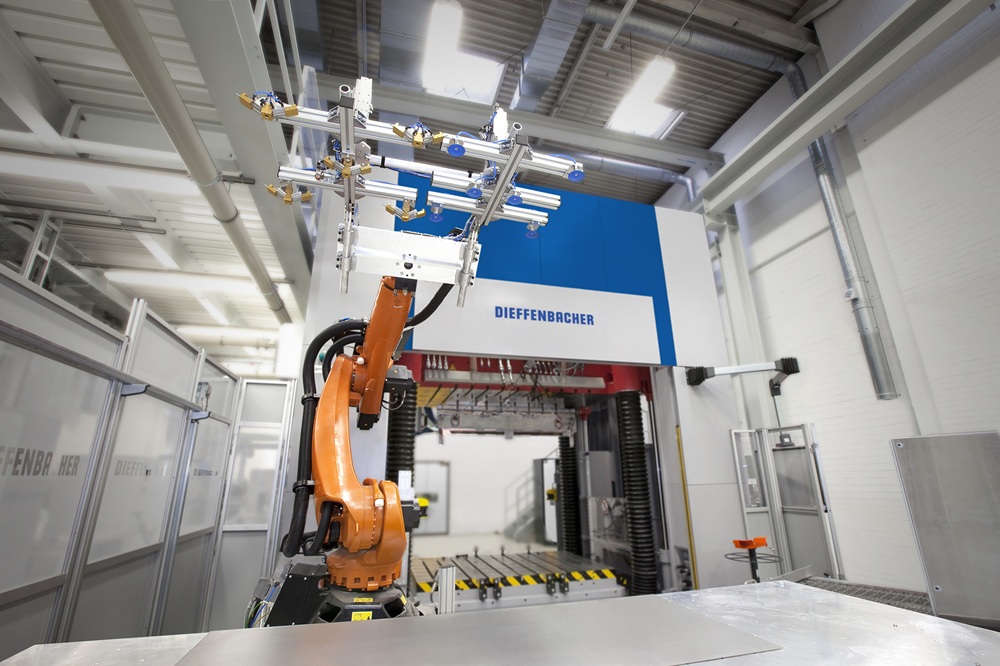
Dieffenbacher has expanded its high-pressure resin transfer moulding (HP-RTM) technology with Ultra-RTM, a pressure-controlled process designed to protect sensitive materials during composite manufacturing while maintaining reliable, cost-effective mass production.
Unlike conventional processes that rely on fixed press pressures or predefined pressure curves, Ultra-RTM uses sensors integrated into the mould to monitor cavity pressure in real time. This allows precise control of the process, preventing component defects and protecting tooling.
“Instead of relying on fixed press pressures or predefined pressure curves, Ultra-RTM uses pressure, position and temperature sensors integrated into the RTM mould to monitor cavity pressure online and in real time,” confirms Marco Hahn, director of sales for Dieffenbacher’s Forming Business Unit.
While conventional HP-RTM injection pressures can reach 140 bar, this can damage pressure-sensitive materials such as low-density foam cores, honeycombs and complex preforms. Ultra-RTM operates at significantly lower cavity and injection pressures, both below 30 bar.
Originally developed by Germany’s Fraunhofer Institute for Chemical Technology ICT, the process uses sensor technology and intelligent press control to monitor, adjust and limit cavity pressure. Dieffenbacher developed the associated hydraulic press control technology to make it production-ready.
Active pressure management enables sensitive sandwich cores and complex preforms to be infiltrated without collapsing or shifting. It also prevents sudden pressure peaks, minimises void formation and promotes uniform fibre impregnation, making the process particularly suitable for lightweight automotive and aerospace components.
Ultra-RTM is available on Dieffenbacher’s TailoredPress, which combines a monolithic press design with Evoris control technology and an energy-efficient drive. The system is automation-ready and can incorporate Evoris Intelligence digital applications, including anomaly detection, reports and energy monitoring.
More information www.dieffenbacher.com