

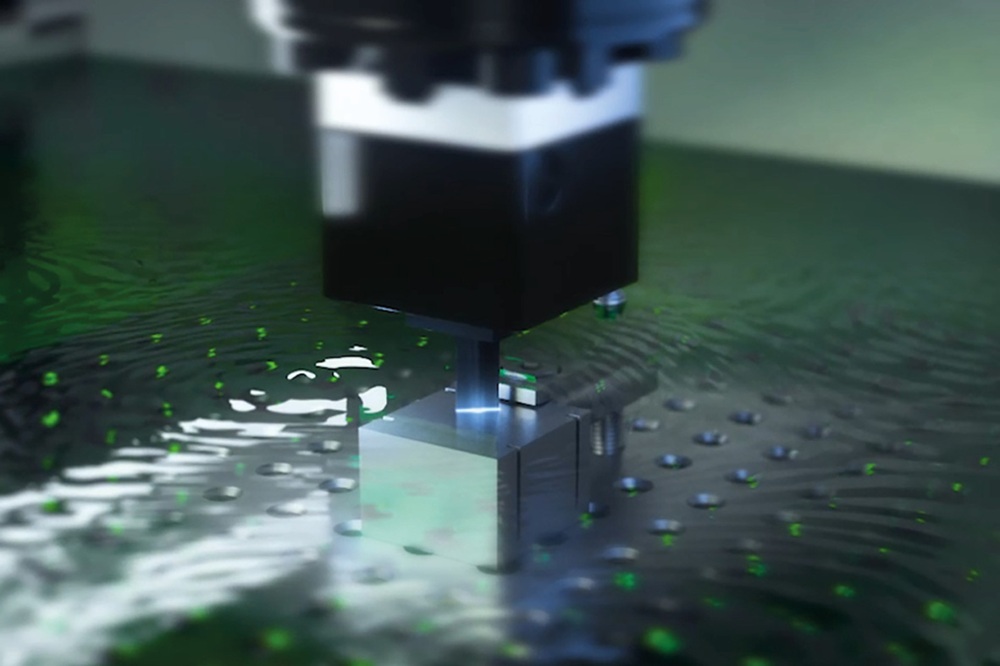
Advances in microelectronics are improving die-sink EDM performance, with compact generators enabling faster machining, more precise spark control and improved surface finishes.
Since the 1970s, semiconductor technology has transformed electronic devices, and similar progress is changing EDM. Early generators relied on analogue systems that could produce inconsistent sparks and required skilled operators to maintain precision. Modern systems use feedback-driven pulse management to control spark energy and intensity.
Generator location is another factor in machining performance, explains Martin Spencer, managing director of United Machining UK: “By keeping generator modules cool and close, today’s die-sinking machines achieve a higher level of thermal and electrical stability.”
Traditionally, EDM generators were housed in separate cabinets, connected to the spark gap by several metres of cable. Modern, compact designs allow the generator to be positioned much closer to the electrode, shortening the electrical path and reducing inductance and capacitance.
This enables faster, more precise voltage control, improving erosion rates while limiting heat transfer to the workpiece. The result is a smoother surface finish and a reduced heat-affected zone (HAZ).
On patented die-sinking EDM platforms, compact, high-speed generators can be mounted directly on the Z axis or behind the rear wall of the work pan, just centimetres from the electrode. For mould manufacturers, this configuration can reduce cycle times by up to 20%, while helping preserve workpiece integrity during finishing operations.
Further developments are likely to combine hardware advances with increasingly sophisticated control software. Artificial intelligence, digital twins, predictive algorithms and adaptive spark control could deliver further improvements in precision and productivity.
Ultimately, bringing the generator closer to the spark helps manufacturers gain greater control over the EDM process, with benefits for machining speed, surface quality and dimensional accuracy.
More information www.machining.com