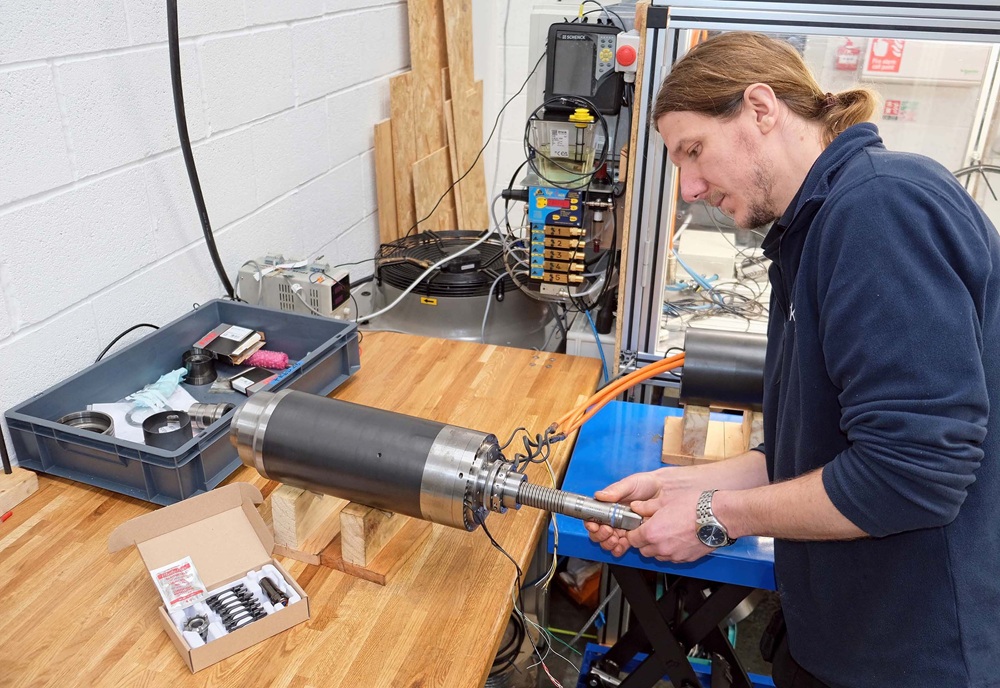
Kugel Rotary Services, a rapidly growing machine tool spindle repair and refurbishment
company, moved in August 2024 from Sandiacre to new premises more than five times the
size in nearby Hucknall, Nottinghamshire. The independent firm is one of only a handful in
the UK to offer such a maintenance service across the full range of spindle types and sizes
on the market, covering those produced by both specialist manufacturers and machine tool
builders. Kugel customers enjoy monetary savings of up to 50% compared with obtaining
the service from the spindle manufacturer.
It is not commonly known outside this specialist sphere of activity that certain key elements
of most spindles produced in Europe are made to the manufacturers’ designs by one of
three third-parties, of which OTT-JAKOB Spanntechnik, located in southern Germany, is the
largest. Kugel exclusively sources spares from this company, including the pulling head
(drawbar), the clamping unit (the gripper in front of the spindle nose taper), and the rotary
union (which attaches to the back of the pulling head to provide through-tool coolant
delivery).
Understandably, there is a close relationship between Kugel, OTT-JAKOB and the latter’s
exclusive sales agent in Britain and Ireland, tool holder specialist GEWEFA UK, based in
North Bradley, Wiltshire. It is a three-way relationship that was established when Kugel was
set up in 2017 by managing director Stuart Vere and business partner Kevin Ewing, both of
whom previously worked in a similar spindle and ballscrew renovation firm. Ewing’s son-in-
law Alexander O’Neill and son David are also involved.
So too is Silke Moss, who also worked in the earlier refurbishment company’s offices and is
now the main link person between Kugel, OTT-JAKOB and GEWEFA UK.
“The services GEWEFA provide are amazing,” she says. “They are exceptionally helpful with
providing speedy quotes and trying to shorten delivery times when we receive urgent
orders. OTT-JAKOB personnel also take a direct interest and have visited us. We can always
contact them directly with technical queries and for problem solving. The whole relationship
is based on mutual trust.”
The scope of Kugel’s activities is wide, centring mainly on spindles manufactured in Europe.
GMN, Kessler, Fischer, Gamfior, Setco and Steptec are some of the specialist spindle
manufacturers whose products are routinely rebuilt, while DMG Mori and Heller are two
machine tool builders whose in-house produced spindles are often overhauled. Japanese
and other Asian versions tend to use different internal components, but some are easier to
repair without the need for replacement parts. Recently, a Mazak spindle underwent
refurbishment by Kugel.
“We have a wide customer base, with 90% of our work currently coming from blue-chip
companies in the automotive and aerospace sectors,” explains Vere. “They have production
lines comprising numerous machine tools. If one goes down due to a spindle failure, the line
stops. A situation that would just be an inconvenience to a subcontractor down the road
becomes an all-out emergency, with serious financial implications.
He continues: “The machine OEM or independent spindle manufacturer may well offer a
service exchange and supply a refurbished spindle from stock. However it is an expensive
option, added to which Brexit often delays the paperwork and increases costs further. We
can rebuild a spindle in a similar lead-time at typically between one half and three quarters
of the cost.”
The range of different spindles serviced by Kugel is vast, coming from many different
machine tools including vertical and horizontal machining centres, borers, grinders, honing
machines and lathes, for which both work spindles and B-axis tool spindles are repaired.
Rotary tables and trunnions are also returned to as-new condition in Hucknall. Similarly
wide is the variety of spindle sizes and specifications that are worked on, from a small
120,000 rpm high-frequency spindle for a die grinding customer, through HSK-A63 and HSK-
A100 face-and-taper contact tool interface spindles and their taper-only contact BT 40 and
50 equivalents, to a special 300 kg, 4000 rpm, two-in-one rough- and finish-grinding spindle
for a specialist grinding machine manufacturer near London.
The present trend towards digitalisation in manufacturing and collection of large volumes of
data for analysis means that sensors are often built into modern machine tools, including
the spindle. Information on how long it has run since new or the last refurbishment, how
many tool changes it has completed, at what range of temperatures it has operated,
vibration levels during use and other service-critical data is becoming more readily available.
It heralds an age in which industry will move away from urgent spindle repairs after failure
towards routine preventative maintenance, which can be carried out during shutdowns or
less busy periods.
Even if machines are older and do not benefit from the wealth of operational big data that
their newer counterparts have, there are opportunities to train manufacturers’ maintenance
staff and even machine operators to listen to the sound of the spindle, feel for vibration and
perform other checks that could pick up signs of impending problems. Kugel is increasingly
in discussion with customers using legacy machines about training programmes and the
possible use of sensors for spindle monitoring as a basis for predictive servicing.
Trying to manage these scenarios and help prevent a spindle seizing up completely, hence
significantly simplifying its restoration, is currently very much an area of interest and activity
for Vere. However, with so many older spindles in service around the UK that are likely to
continue operating for a couple of decades, Kugel’s emergency repair service is set to
continue growing for the foreseeable future alongside nascent scheduled maintenance
activities.
More information www.gewefa.co.uk