Combined Engineering Services (CES) was born following the 2018 merger of Brecon Designs (formed in 2007) with another local engineering company, Infinite Engineering Design. Since then, managing director Steve Willams and his team have seen continued growth.
From humble beginnings with a facility housing little more than a turret mill, manual lathe and wire eroder, CES now has substantial CNC machining capability. This allows the company to manufacture tooling, jigs and fixtures, along with the design and build of special-purpose machines. The aim of CES is to build lasting customer relationships by working with integrity to provide cost effective solutions, providing mutual security for both parties.
CES made its first step into CNC milling by investing in an XYZ VM 4000 bed mill, with Willams outlining that it was the ProtoTRAK control that made the company gravitate towards XYZ.
“As with many companies, our first step into CNC was made with great trepidation but we gelled with ProtoTRAK control,” he confirms. “Since that first machine, we now have seven more XYZ bed mills with different capacities and generations of controls, along with a flat-bed lathe that also has the ProtoTRAK CNC.”
This progressive and forward-thinking business located just off the ‘Heads of the Valleys’ in South Wales has now made further investment to enhance its capability and help to improve productivity.
Chris Bow, design director at CES, explains: “The bed mills have served us well and continue to do so, but it became apparent that we needed to try something different on our next machine tool purchase to remain competitive. When we’re not successful in winning work following a quote, we always look at why didn’t we win the job. These investigations led us to look at our machining capability.”
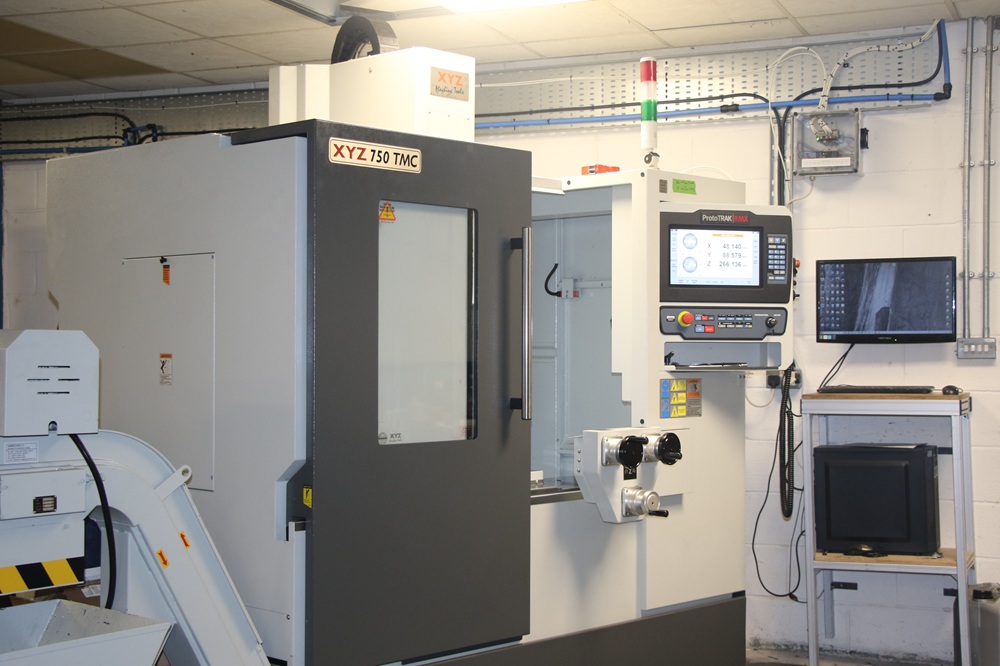
He continues: “We arranged a visit to the XYZ head office in Devon to look at several options. On our return we concluded – following the advice provided by the XYZ sales team – that the 750 TMC with its enclosed layout would be a good fit for our business.
“We knew the TMC would allow us to improve material removal rates and reduce cycle times due to its 11 kW BT40 spindle. In addition, the travels of 743 mm in the X axis and 425 mm in Y, mated with the 20 station BT40 tool changing carousel, would open up the opportunity to load a number of parts on the bed at the same time. In turn, this would push us towards lights-out machining and subsequently help us achieve the goal of lowering our manufacturing cost per part.”
Chris continues with the justification of the purchase by adding: “Another improvement for the business was better staff utilisation due to less operator input during component manufacture. The potential to walk away from the machine for the whole of the process brings its own increase in efficiency, creating more capacity within the workshop and helping to reduce takt time when we build one of our special-purpose machines”.
Now the new machining centre is up running, CES is benefitting from the flexibility that the XYZ TMC range offers. Having taken advantage of the optional front-mounted electronic handwheels, all the programmers and operators at CES can jump on the machine and use it in a manual capacity for simple machining operations if required.
The transition to the XYZ TMC from existing bed mills at CES was easy due to the resident conversational programming in the control. Having made an investment in CADCAM software, CES is now in a position to use all of today’s latest technology, both on the ProtoTRAK 15” touchscreen RMX control or through CADCAM to manufacture parts quickly and cost effectively.
XYZ’s TMC (Toolroom Machining Centre) brings the added versatility of a tool-change system, while maintaining the familiarity of the latest version of the ProtoTRAK control system. The use of the RMX ProtoTRAK CNC provides a high level of familiarity for exiting users of XYZ bed mills. For those not familiar, its touchscreen interface and easy-to-use programming tools make the control suitable for low-to-medium production batch sizes. Combining that with a fully enclosed machining envelope and either a 12- or 20-station automatic tool changer, make the XYZ TMC a great choice machine for any business looking to step up productivity.
“The one thing that we didn’t see coming when the machine was installed was the enthusiasm from the team of machinists here at CES,” reports Chris. “They all have a desire to use the machine and help the business reap the benefits of this new technology. Due to software enhancements – such as the ‘defaults’ setting where operators can set the control features to their own liking, the TRAKing feature to put them in control by winding handwheels to execute the program, and the fact the machine has been fitted with a swarf conveyor to cut down on machine cleaning time – all the team have shown willingness to get involved.
“This is helping the company move forward and be more competitive when it comes to quoting for work as the enthusiasm from the team means they’re now looking at manufacturing parts in a different way and employing production methods that were not possible on our older machines. It’s not just the machine that’s making a difference here at CES but the staff too.”
Today, the workshop team at CES is able to offer a complete range of services from CNC milling and turning, through EDM to metal finishing and machine building. The company’s acquisition of the adjoining unit in 2021 allowed it to expand into clearly defined work areas, giving a more controlled production flow from workshop through build and inspection.
More information www.xyzmachinetools.com