

CT for process control in AM

Metal additive manufacturing (AM) company Sintavia has installed a Nikon Metrology computed tomography (CT) system at its facility in Florida, US to help control the AM process.

Using powder-bed AM with electron and laser-beam melting, Sintavia currently manufactures components from Inconel 718 and 625, aluminium, titanium, cobalt-chrome, stainless steel and other proprietary powders.
AM allows special internal designs to be realised, such as conformal cooling channels, lattice networks, hollow members and other complex geometries. Both additive and traditional manufacturing can result in microscopic voids and gaps within the structure, which can cause stress fractures and reduce the longevity of a component’s lifecycle. All of these internal features can only be inspected non-destructively with CT scanning.
Sintavia has installed a 450 kVA micro-focus CT (micro-CT) system from Nikon Metrology. By converting 2D pixels to 3D voxels, supplying a full 3D density map of the samples, the technique presents information in a visual, easy-to-interpret format and shows any departure from the CAD model. It is said to be straightforward to detect and measure powder residues blocking channels, porosity, contamination, cracking, warping, and dimensions such as wall thickness to an accuracy within tens of microns. Given a 100 mm sample and a detector 2000 pixels across, the limiting resolution would be 50 µm, for example.
Micro CT is now much faster and more suitable for production-line use, while CT scanning of similar parts can be automated using loading and unloading equipment. Scan times down to a few tens of seconds per part are possible.
For further information www.nikonmetrology.com

£2m orders at MACH

In its 50th anniversary year, Hurco took 34 machine tool orders valued at £2.5m during the recent MACH 2018 exhibition in Birmingham.

In total, 11 machines were demonstrated on the company’s stand, including five different five-axis machining centre configurations. Managing director David Waghorn says: “We are delighted with the level of orders, which was undoubtedly helped by having 30% more visitors to our stand compared with two years ago. This is particularly pleasing as the organiser reported a visitor increase to the show of only 5%.”
For further information www.hurco.co.uk

Zero-point clamping system unveiled

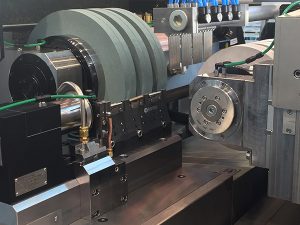
Introduced at last month’s MACH 2018 by 1st MTA was a new zero-point clamping system from V-Tech (pictured). For clamping workpieces on CNC machining centres, this pneumatic quick-change system features 24 kN retraction of the clamping pin in each receiver, and a positioning accuracy of better than 5 µm.

Mechanical vices, clamping chucks and bars, and special workholding fixtures, can be accommodated in the receivers, while positioning slots allow precise 90° indexing. The self-clamping mechanism, which uses high-power springs to secure the workpiece and fixture, ensures that the force is still applied after the air has been disconnected. Pneumatic power is only required again for release. Clamping bases are available to hold one, two, four or six receivers, which are 135 mm in diameter but only 41 mm high, so little Z-axis travel is lost.
With regard to rotary tables, on show was Kitagawa’s latest TT150 tilting-type compound table with 150 mm faceplate. The TT150 is designed to be interfaced directly with a machining centre control or operated via a MAC mini controller. Also featured was the heavy-duty GT series models that deliver clamping torques up to 2800 Nm.
Elsewhere on the stand, 1st MTA demonstrated a Chick Indexer SubSystem (ISS), showing how more components could be presented to a machining centre spindle by adding a fourth axis. Another Chick product on show was the latest lightweight version of its One-Lok clamping system, which is pitched as a superior alternative to the conventional wind-up vice.
To further support its workholding offer, 1st MTA presented permanent electromagnetic clamping systems and materials handling products from Tecnomagnete, while MillTec Grip magnetic workholding systems were displayed for five-axis and five-sided metal-cutting applications.
For further information www.1mta.com

36-session programme at Subcon

Rolls Royce CTO Paul Stein will deliver the keynote presentation at Subcon (5-7 June, NEC), one of many highlights of this year’s programme that also features sessions on digitalisation, robotics, prosthetics, motorsport, smart materials and technology transfer.

The 2018 conference is a three-day, two-theatre, six-stream, 36-session programme that is free to attend for all Subcon visitors.
A key theme of the conference is cross-sector collaboration and technology transfer with Dr Caroline Hargrove, CTO of McLaren Applied Technologies, talking about how technological expertise in motorsport can be spun out into other sectors. Furthermore, BAE Systems’ Dr Henry White, will be showing delegates how technology from the defence sector can be applied to the world of sport.
For further information www.subconshow.co.uk/conference

Electric sheet lifters for press brakes

Gasparini has introduced its new press-brake electric sheet lifters, which are completely controlled by the CNC. The lifters are available in single- or dual-axis versions, with optional interpolation for better sheet tracking and support.

In dual interpolated axis configuration, the device continuously follows the part during bending, reducing the risk of scratches and counterbends. A counterbend can occur during the bending of very large, heavy or thin plate. The overhang generates a torque that makes the sheet bend around the die edge under its own weight. To overcome this issue, the sheet lifter supports the plate during the entire bending cycle.
An optional optimisation of the bending process consists of raising the ram before lowering the sheet lifter. This operation avoids, in case of a U-shaped bend, the return flange getting caught on the punch. When the ram goes up, the plate is lifted and then falls down, with potential damage to the part, tools and operators.
Sheet lifters are available in two sizes, providing a torque of 600 or 1200 Nm for the largest and heaviest sheets. Parts that needed two operators, can now be bent by just one person, in complete safety and without physical strain. In many cases, the use of forklfts and overhead travelling cranes may also be reduced.
Extended stroke allows bending angles as closed as 70° to be achieved. Height can be adjusted from -30 to +170 mm, to match dies with openings as wide as 100 to 160 mm. The resting surface is equipped with ball transfers and allows the installation of several options such as brushes, anti-scratch cladding, rulers, adjustable stops and telescopic extensions.
For further information www.gasparini.it