

Bandsaw basics: vertical versus horizontal

When it comes to metal cutting, choosing the right bandsaw configuration (vertical or horizontal) can significantly impact efficiency and precision in workshop operations, as Addison Saws points out in this blog.

Vertical bandsaws offer excellent control for intricate cuts, including the creation of curves. Users can also tilt the table for greater manoeuvrability in bevel cuts. Applications include sheet, plate, tube, solids and castings, providing the ability to cut metal, wood and plastic.

Vertical bandsaws excel in applications that demand finesse and accuracy. They are commonly used in workshops where customized and detailed work is a priority, such as in crafting prototypes or intricate components.

Horizontal bandsaws are designed for more robust cutting-to-length tasks. They cut through thicker materials quickly and with less manual effort, especially automatic or CNC models.

Horizontal bandsaws produce straight and mitre angle cuts on large pieces of material. They are a staple in industrial settings where speed and volume are critical, such as in metal fabrication shops and steel stockholders.

When deciding between a vertical and horizontal bandsaw, consider the nature of current and any potential future work. For detailed, intricate cuts, a vertical bandsaw is the best choice. Generally, the operator is in control of the motion of material through the blade, either freehand or with an adjustable guide. For straight, set mitred, or high-volume cuts, opt for a horizontal bandsaw. Its efficiency and consistency are better for repetitive tasks involving large materials.

Selecting the right bandsaw is crucial for optimising manufacturing processes. Whether a user needs the wide ranging flexibility of a vertical bandsaw or the power of a horizontal production machine, understanding their individual features will provide a steer to the right investment.

More information www.addisonsaws.co.uk
Netzsch relies on automatic sawing centre

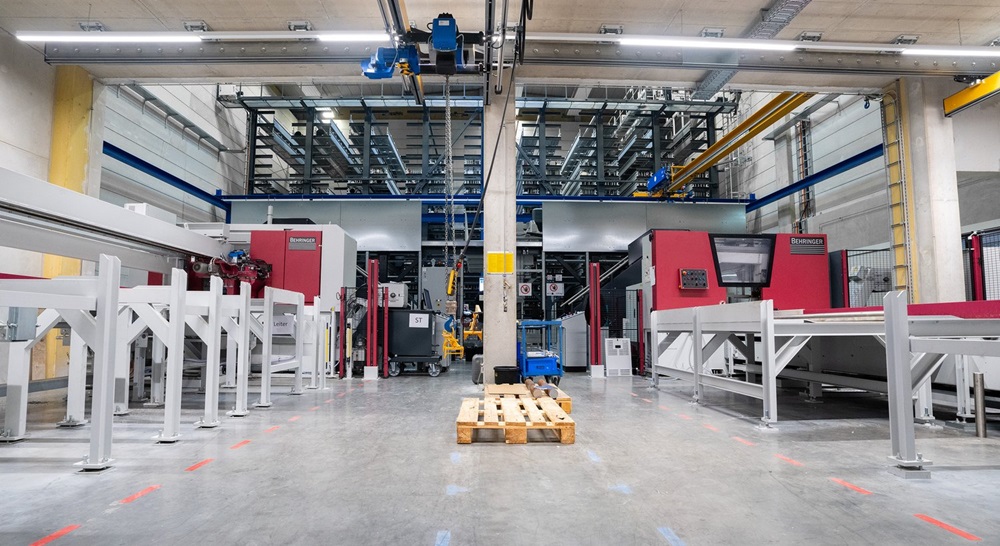
As a global specialist for pumping complex media, Netzsch Pumpen & Systeme GmbH, headquartered in Waldkraiburg, specialises in the development, production and sale of positive displacement pumps. For the manufacture of its pumps, semi-finished products in various grades with diameters of up to 540 mm are cut from whole bars and tubes. These saw cuts are then fed to subsequent turning/milling production processes.

The old sawing centre at Netzsch consisted of two stand-alone automatic bandsaws from Behringer and many individual cantilever-arm storage systems, which took up an entire production hall. The overhead crane was used to unload the raw material from the lorry, store the bars in the manual long-goods store and feed the saw. In addition, the materials were not catalogued.

“The manual labour required was enormous – our employees invested a lot of time searching for the required material on the shelf, transporting it to the saw and measuring it by hand,” says Markus Hanslmaier, project manager for production planning at Netzsch.

Today, Netzsch takes advantage of two Behringer automatic bandsaws. The HBE411A Dynamic and HBM540A are characterised by precise saw cuts and reliability in unmanned operation. This is ensured by the basic design of the two bandsaws in portal construction, the use of vibration-damping cast components, their saw feed system with servo motor and the reliable chip disposal system.

As a result, costs can be reduced during the sawing of semi-finished products by minimising processing allowances. Particularly with regard to the range of materials, which often includes expensive heat-treatable steels and duplex steels through to titanium and nickel-based alloys, there is a high savings potential. Moreover, the manual labour required by operators has been drastically reduced.

More information www.behringer.net

High-speed disc saws for forged material

The world of forging is highly intricate, involving numerous applications and constant evolution. Ficep says its caters to this sector with a range of machinery designed to meet all production needs: including an array of high-speed disc saws. These machines are suitable for many applications, particularly those requiring the cutting of bars, tubes, ingots or blooms. 

The ‘S’ series sawing machines include various models: horizontal, inclined and vertical saws, with cutting capabilities from below or above. All these machines can cut round and square solid bars, while vertical ones can also cut rectangular/flat bars.

Vincenzo Rubat Baleuri, sales manager of the forging division at Ficep, says: “Our machines guarantee repeatability, cutting precision, squareness and regularity of the sawn surface. This high standard is a real strength, achieved through careful design, optimal blade guidance and robust motor power.”

The ‘SP’ series stands out for its high-speed cutting of pipes.

“This range has been designed with special attention to sizing the crucial components to minimize blade vibrations,” he adds. “Special care has been given to fine-tuning the software managing the cutting parameters during the work cycle. This involves dynamically adjusting the blade rotation speed and the head feed during the pipe’s inlet-outlet phase, where the metal section engaged by the blade is greater compared with the central part [where thickness is minimal]. This also reduces cutting time. Our lines overcome the limitations of traditional disc or band saws, increasing productivity through their speed, precision, cut quality and reduction of production waste.”

Ficep can also combine its range of bar loaders with both automatic magazines and AGV shuttles for laser-guided transfer of bar bundles from steel stock to the machine roller-way.

More information https://ficepgroup.com

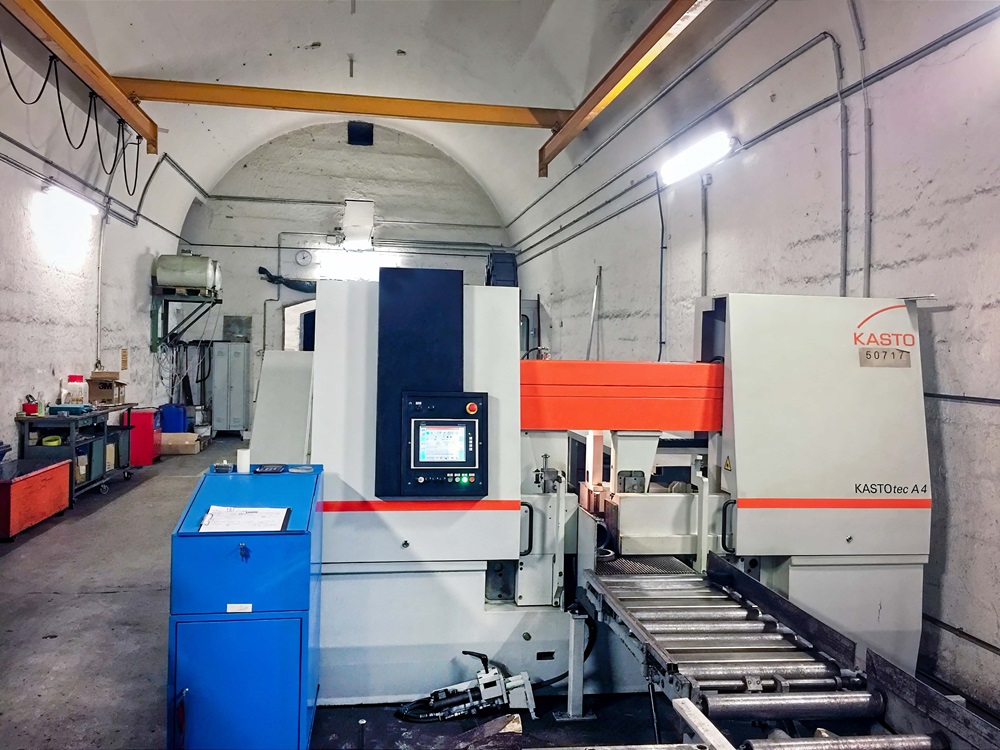
Tube stockholder remains loyal to Kasto

Sawing equipment manufactured by German company Kasto has been used by Austrian tube stockholder Karl Mertl Handelsges in Schwechat since 1970, when it installed an EBS 400 U hacksaw that is still in use today for maintenance and repair. The company is currently managed by the third and fourth generations of the Gruscher family, with both daughters active in management, as well as son-in-law Jürgen Spannraft, who has been CEO since 2019.

In a 30,000 m² warehouse, the 90-employee stockholder stores 8000 tonnes of steel tube, which is mainly 7 m long, from 3 to 660 mm in diameter and of wall thickness from 0.5 to 100 mm. Kasto bandsaws and a modern hacksaw cut the stock to length for delivery to customers throughout Europe.

When an old manual storage system with 1012 cassettes was bursting at the seams, Mertl built a new warehouse and installed a Kasto Unicompact automated honeycomb storage system equipped with 2633 cassettes and served by an overhead gantry crane. Additionally, extra automatic bandsaws provided increased cutting capacity and efficiency. The system is connected to Mertl’s ERP system so that orders may be processed without human intervention.

“It was not a difficult decision to opt for Kasto for this round of investment,” recalls Marie Gruscher. “By then, we were already familiar with the quality of the products and service. Kasto’s recommended solution was also the best fit for our requirements and we were able to connect it seamlessly to our packaging machine.”

She adds that the new facility not only provides increased storage but also better operational safety, as goods come to the person and not the other way around.

More information www.kasto.com

Better productivity and safety with automation

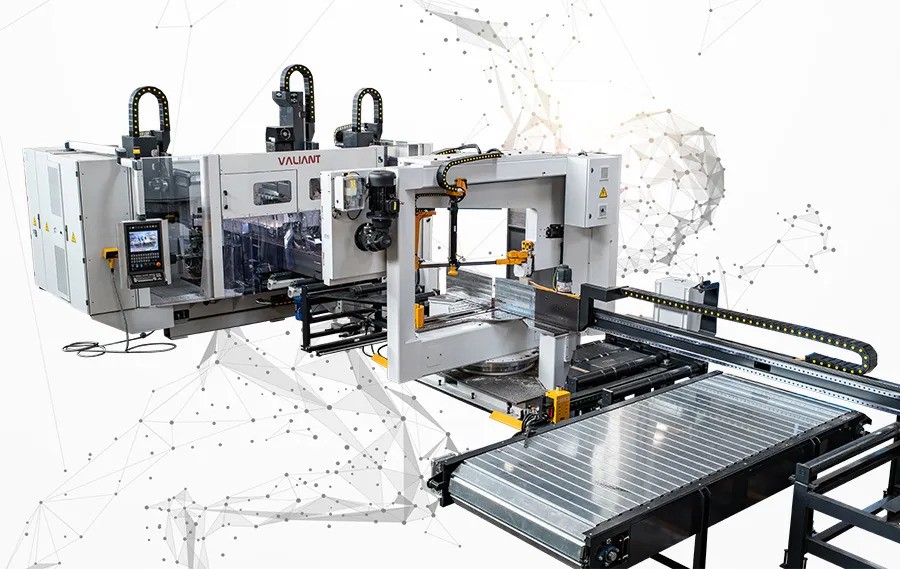
In the steel construction realm, efficiency and automation stand as cornerstones for achieving top-tier quality standards promptly and reliably. Ficep, a global specialist in automated steel processing, meets these imperatives through its integrated solution featuring the Valiant drilling unit and the Katana bandsaw.

The Valiant + Katana system shines particularly bright in its swift process execution, empowered by automation and technology. This amalgamated approach reduces total processing time, outperforming scenarios reliant on specialist labour for finishing stages.

The process maintains a high level of control and predictability, aiding in streamlined production planning. With Valiant, processes such as drilling, automatic marking and milling operations come into play, leaving only welding ahead of the final painting phase. On the cutting front, Katana enables operators to execute both straight and mitred cuts up to 60° quickly.

These saws boast construction features tailored for high-speed performance, while upholding stringent cutting quality standards. Horizontal and vertical hydraulic clamps maximise workpiece stability, while robust motor power and bandsaw blade rotation speeds ensure efficient operations. Automated handling phases further enhance productivity.

The production momentum of this integrated system hinges on Ficep’s direct-drive spindles, channelling 100% of the motor power to the tool.

Notably, the integrated system’s installation stands out for its simplicity, requiring no expensive civil works. This translates to significant time and cost savings for customers, enabling quick production commencement and minimising downtime.

The Valiant + Katana system’s most significant advantage lies in its potential for full automation. With remote control via a mobile app, operators can monitor and manage the system from anywhere, optimising production efficiency even beyond regular working hours and during downtimes.

More information www.ficepgroup.com