

World’s largest RTM press system revealed

Langzauner, a pioneer in advanced hydraulic press systems, has achieved a breakthrough in aerospace manufacturing technology through its collaboration with the University of Sheffield Advanced Manufacturing Research Centre (AMRC). AMRC’s Composites at Speed and Scale (COMPASS) is a major boost to aerospace R&D in the UK, providing a new innovation facility that will initially house Boeing’s research project to de-risk and develop high-rate sustainable structures.

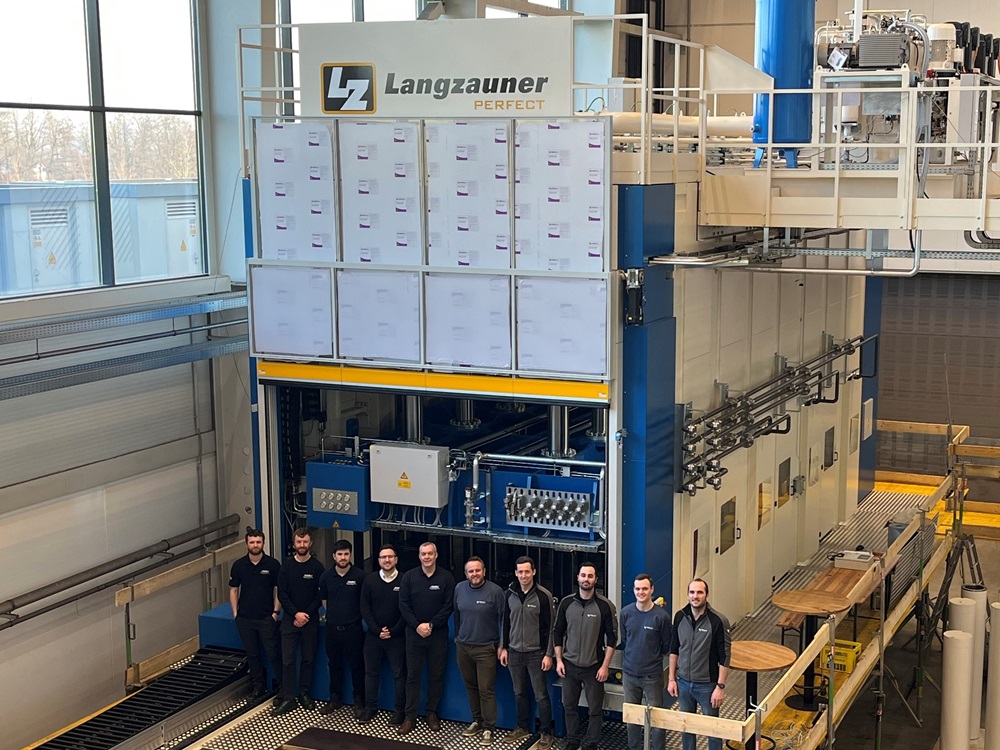
At the heart of this innovation is Langzauner’s newly developed resin transfer moulding (RTM) press system, said to be the largest-of-its-kind globally for integral aero-structural parts. Using this state-of-the-art press system, the project aims to reduce large component process times by a factor of 10 – from approximately 40 hours to just four hours – while maintaining high quality standards.

Darren Wells, senior technical fellow for large composite structures at the University of Sheffield AMRC, says “When we created the specification for such a groundbreaking piece of equipment, we knew we’d set the bar very high in what was achievable. Langzauner’s solution not only meets all of our targets but exceeds in many of them meaning this press will be at the forefront of high-rate composite manufacturing research for years to come.”

The press system features a 10,500 x 3500 mm platen size and delivers high precision with adjustable pressing force up to 2400 T.

The system also offers: press force regulation accuracy of 0.1%; a sliding table system accommodating 180 T mould mass; plate parallelism control within hundredths of a millimetre; individual cylinder control with active parallelism management; and gap injection functionality with two-axis rotation capability. The system is fully integrated with IIoT capabilities, enabling data collection for artificial intelligence and machine learning applications in factory-scale process optimisation.

More information www.amrc.co.uk
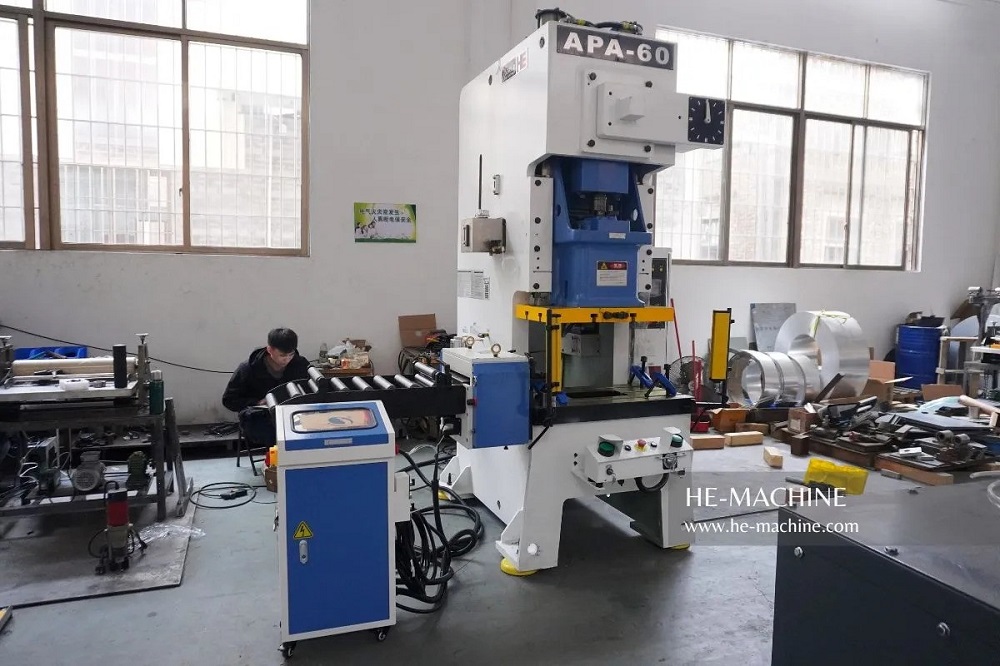
Fully customised licence plate production line

With years of experience in the licence plate production line industry, HE-Machine is
committed to offering customised turnkey solutions to clients worldwide. A recent example
sees the precise collaboration of five machines: decoiler, straightener, automatic laminating
machine, servo feeder and gap-frame press. The implementation of this project has led to

the successfully optimisation of the production process, improving both efficiency and
product consistency.
The smooth unfolding of raw materials is crucial for the successful operation of a production
line. The HE-Machine decoiler handles various specifications of metal coils, ensuring stable
material unwinding.
Next, the straightener plays an essential role. Any bending or warping in the metal materials
during production can negatively impact the quality and accuracy of subsequent processes.
The straightener, designed for precision levelling, effectively eliminates these issues.
After straightening, the automatic laminating machine applies a protective film to the metal
surface, enhancing both durability and surface quality. The auto laminating process reduces
manual intervention, increasing production efficiency while ensuring uniform coating on
every licence plate.
As the production process moves forward, the servo feeder plays a crucial role in precisely
feeding the material into the next stage. Using a servo motor drive system, the servo feeder
ensures that the metal material is delivered accurately to the next process, ensuring smooth
progression in stamping, and other operations.
Finally, the gap-frame press provides the stamping force required for the production line.
Equipped with multiple mould sizes and a conveyor system, the press precisely performs the
stamping, minimising defects and ensuring the efficient production of high-quality licence
plates.
More information www.he-machine.com

Dedicated press for fuel cell applications

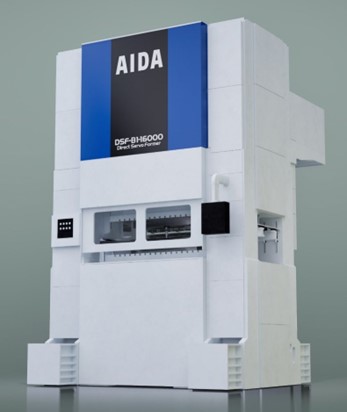
Aida Engineering is now selling its new BEX series presses as dedicated machines for forming metal separators for the bipolar plates used in fuel cells and electrolysers (water electrolysis devices). With a design based on the Aida high-rigidity, high-precision UL series, BEX series presses are intended for the high-precision forming of thin plates.

Fuel cells, used in fuel cell vehicles and home energy-use fuel cells, are power generation devices that extract the electricity generated by electrochemical reactions between hydrogen and oxygen. Furthermore, the development of electrolysers is also progressing in preparation for a future hydrogen-based society. In turn, demand for the bipolar plates required for these devices is expected to increase.

Separators are critical components for bipolar plates, and they have narrow, tightly-spaced channels that allow hydrogen and oxygen to pass through them. Mass production is possible using cold-forming presses to form metal plates, such as stainless steel plates. High-precision product accuracy is required when forming metal separators, and there were many issues that arose because the designs of conventional presses made it difficult to achieve the needed product accuracy.

Aida participated in a bipolar plate subcommittee at a European research institute and studied the various elements required of presses in order to form metal separators. This led to the development of the BEX series.

Although BEX presses have a one-point design for accommodating centrally-concentrated forming loads at the centre of the press, they also provide a wide area to accommodate multi-stage forming. Rigidity is approximately two times better than Aida’s UL series presses.

More information www.aida.co.jp/en

30 million strokes in just over two years

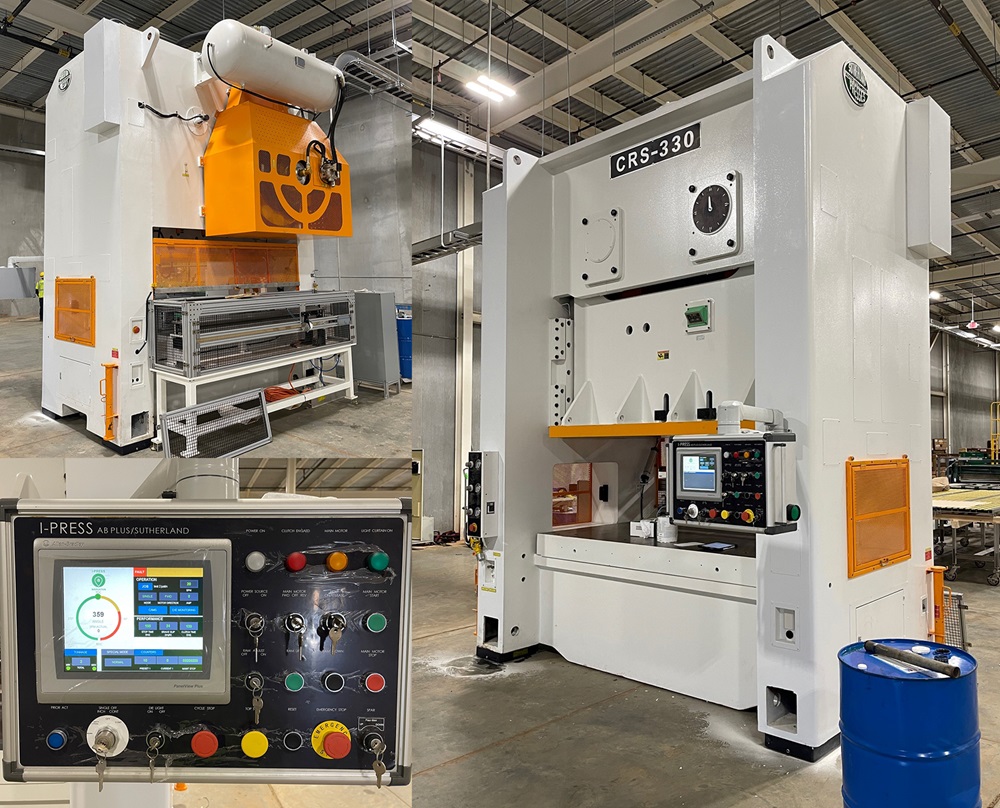
Sutherland Presses says that one of its valued customers in Jalisco, Mexico, has achieved remarkable results with two of its 200-ton mechanical presses, setting a benchmark for reliability and performance. In just over two years, the presses have completed 30 million strokes, operating with minimal downtime.

Running 24 hours a day from Monday to Saturday, the machines achieve approximately 180,000 strokes daily. This performance has allowed Sutherland’s customer to meet its output targets on a consistent basis and confidently present production volumes to its own clients.

A significant factor behind this success is continuous communication with the service team at Sutherland Presses and adherence to a rigorous preventive maintenance schedule. Certified technicians, armed with advanced diagnostic tools, deliver meticulous maintenance services that have already helped companies reduce their downtime by more than 40%.

Also integral to success has been the I-Press control and automation system. This system enhances operator guidance with over 130 monitored press faults and provides on-screen sequential steps for resolution, ensuring smooth operations. It offers expanded job memory capacity for storing over 200 jobs with alpha-numeric job names and remote connectivity for assistance and monitoring. High customisation and expandability options without costly chip replacements, along with upgrades unlocked directly from software, make it a useful tool.

I-Press also includes programmable cams, a die monitor I/O for detailed control configurations, tonnage monitoring to protect tooling, and on-screen fault diagnostics and troubleshooting for quick issue resolution.

More information www.sutherlandpresses.com

Ifm and Schuler agree digital co-operation

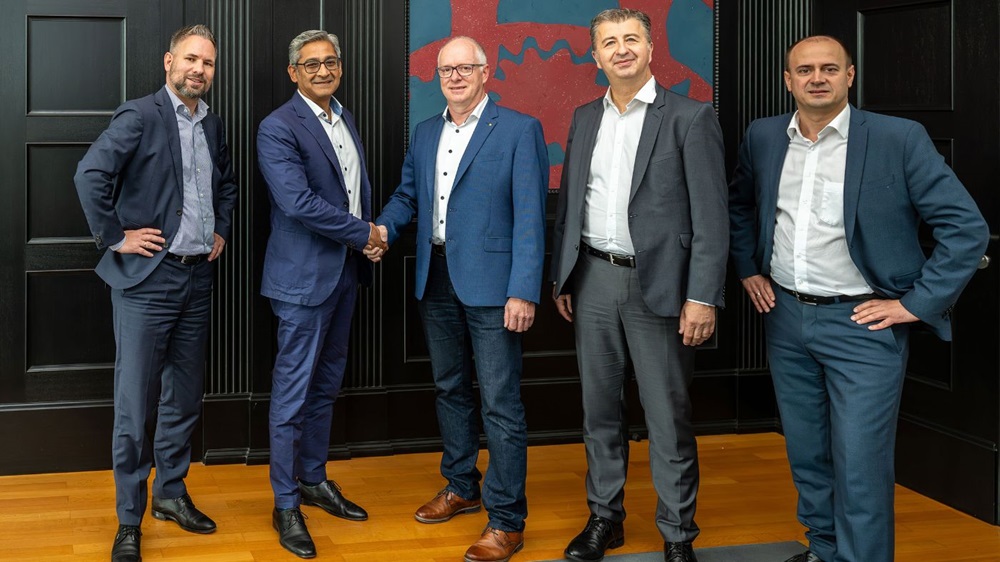
To monitor and improve quality in press shops through digitalisation, Ifm and Schuler Group have struck a co-operation agreement. The aim is to offer customers more transparency and increase efficiency in sheet metal forming.

Sheet metal forming presses are among the most important machines in all industries in which the processing of sheet metal takes place. The Schuler Group has 180 years of experience in forming technology and is the world’s market leader. Using digital solutions such as Track & Trace, Visual Die Protection or DigiSim, the company offers numerous tools that support digitalisation in press shops. Ifm SmartStamp expands this offering with a software tool that detects tilting, eccentricity and the resulting tilting moment on forming presses within milliseconds.

“If the ram tilts too far, the press guides are subject to excessive strain and will incur damage in the long term,” explains Christoph Schneider, vice president of product management applications at Ifm.

The tool protects the press from excessive wear and damage and helps to improve availability. SmartStamp is integrated into the Moneo IIoT platform, and now also into the Metris platform from Andritz, Schuler’s parent company.

“Thanks to combination with the data from our cloud-based digital solutions, customers benefit from interoperability and, consequently, even higher transparency in the press shop,” emphasises Rohitashwa Pant, chief digital officer of the Schuler Group.

The co-operation agreement provides for collaboration in sales. It is immaterial which system customers use when they start to digitalise. They can expand their digitalisation solution with the other system at any time.

More information www.schulergroup.com