

Razor sharp export approach leads to £4m order

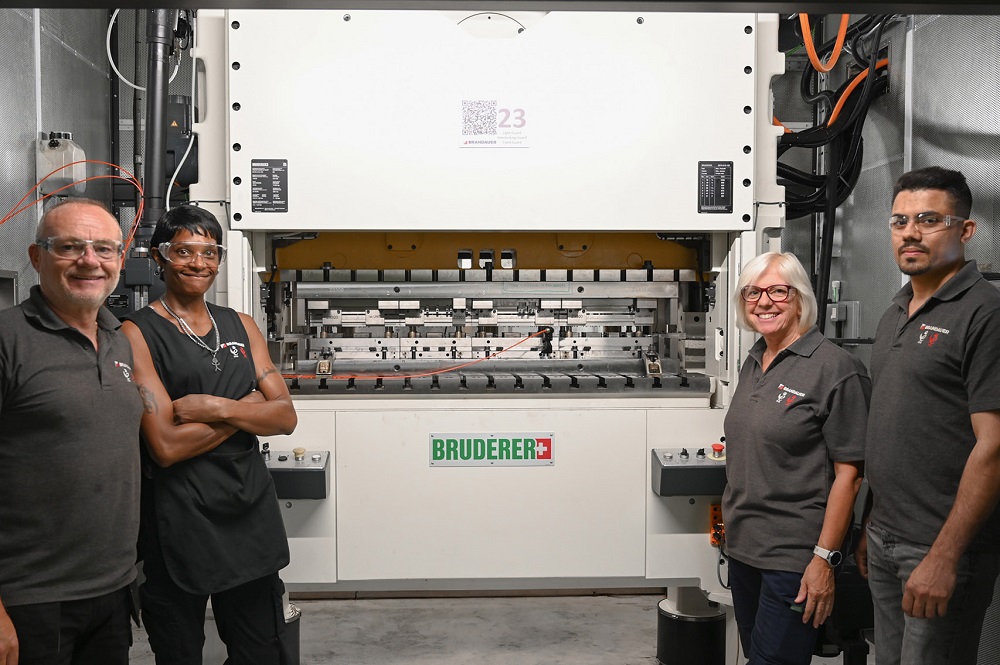
A Birmingham, UK-based manufacturer has sealed a £4m export order that will see it play a crucial role in developing the male grooming products of the future.Brandauer, which employs 64 people at its factories in Newtown and Aldridge, will stamp ultra-thin stainless-steel components for use in disposable razors produced by Lord International in Egypt.The deal has initially created two toolmaker positions.

Rowan Crozier, CEO of Brandauer, says: “In 2020, we pivoted into producing precision parts for healthcare companies and one of our biggest growth markets was making a critical ‘frame’ that went into razors for a customer in the Middle East.From early successes here, we decided to tap into support from the Department for Business and Trade to spread the word about our capabilities, which directly led to the opportunity in Egypt.”

He adds: “The two contracts combined will generate close to £1m of revenue every year, whether that’s tooling for blade blanks or for the fames we stamp and supply for final assembly into razors.”

Diversification has been a critical part of the Brandauer ‘DNA’ for more than 163 years and during that time the company has evolved from manufacturing pen nibs to consumer electronic products, core automotive products and now to today’s eclectic mix of micron-tolerance components for electrification, construction and healthcare.

The move into the male grooming arena has seen it invest nearly £800,000 into the creation of three dedicated production cells and the development of complex four-module progression tooling for Lord International.

New presses, ancillary equipment and a fully automated turnkey line have all been installed and this means the firm now designs the tooling needed to manufacture the frames and a cell capable of producing up to 500 razor frames every minute.

More information www.brandauer.co.uk
Maxiforja starts production on large forging press

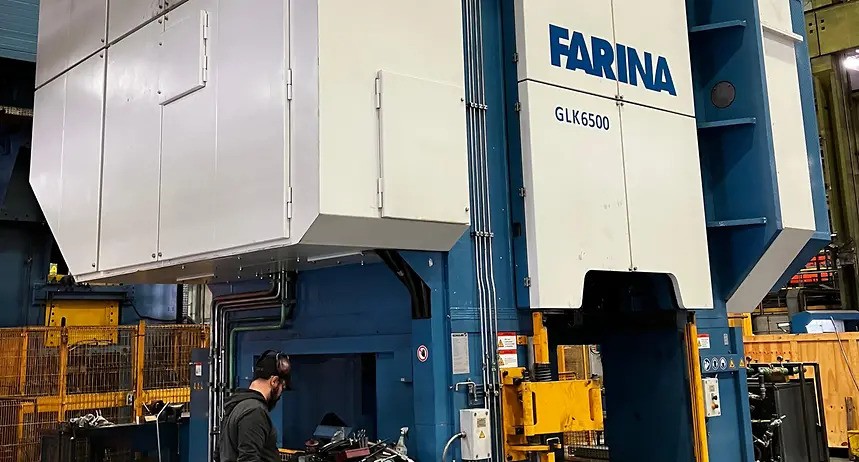
Founded in 1963, Maxiforja located in Canoas, Brazil, serves numerous manufacturers of heavy trucks and agriculture equipment.In order to expand production capacities for large knuckles up to 40 kg, the company has installed a record-breaking 6500 tonne forging press from Andritz Schuler, which has now gone into operation.

“This is the world’s largest forging press featuring a kinetic energy recovering system [KERS],” reveals Nicolas Drevon, director global forging at Andritz Schuler. “Thanks to KERS, the power demand will decrease by up to 40% compared with conventional forging presses in this size.” 

This energy reducing technology helps Maxiforja to reach its sustainability goals. At the same time, the company benefits from high quality and productivity thanks to the state-of-the-art technology offered by the new line.

The GLK 6500 type press was developed by Andritz Schuler’s Italian subsidiary Andritz Farina and built at the site of Prensas Schuler in Brazil. Apart from KERS, the line also features a Scotch Yoke working directly in the slide, which allows for a compact design and improved component accuracy. Maxiforja already operates forging presses ranging from 800 to 4000 tonnes capacity, but for the first time decided to invest in Andritz Schuler technology.

Andritz Metals is – via Andritz Schuler – a global supplier of technologies, plants and digital solutions in metal forming. The product portfolio also includes automation and software solutions, process know-how and service. In the metals processing segment, the business area offers innovative, sustainable solutions for the production and processing of flat products, for welding systems and furnaces with its own burner solutions, as well as services for the metals processing industry.

More information www.schulergroup.com

Automatic clamping system for heavy dies launched

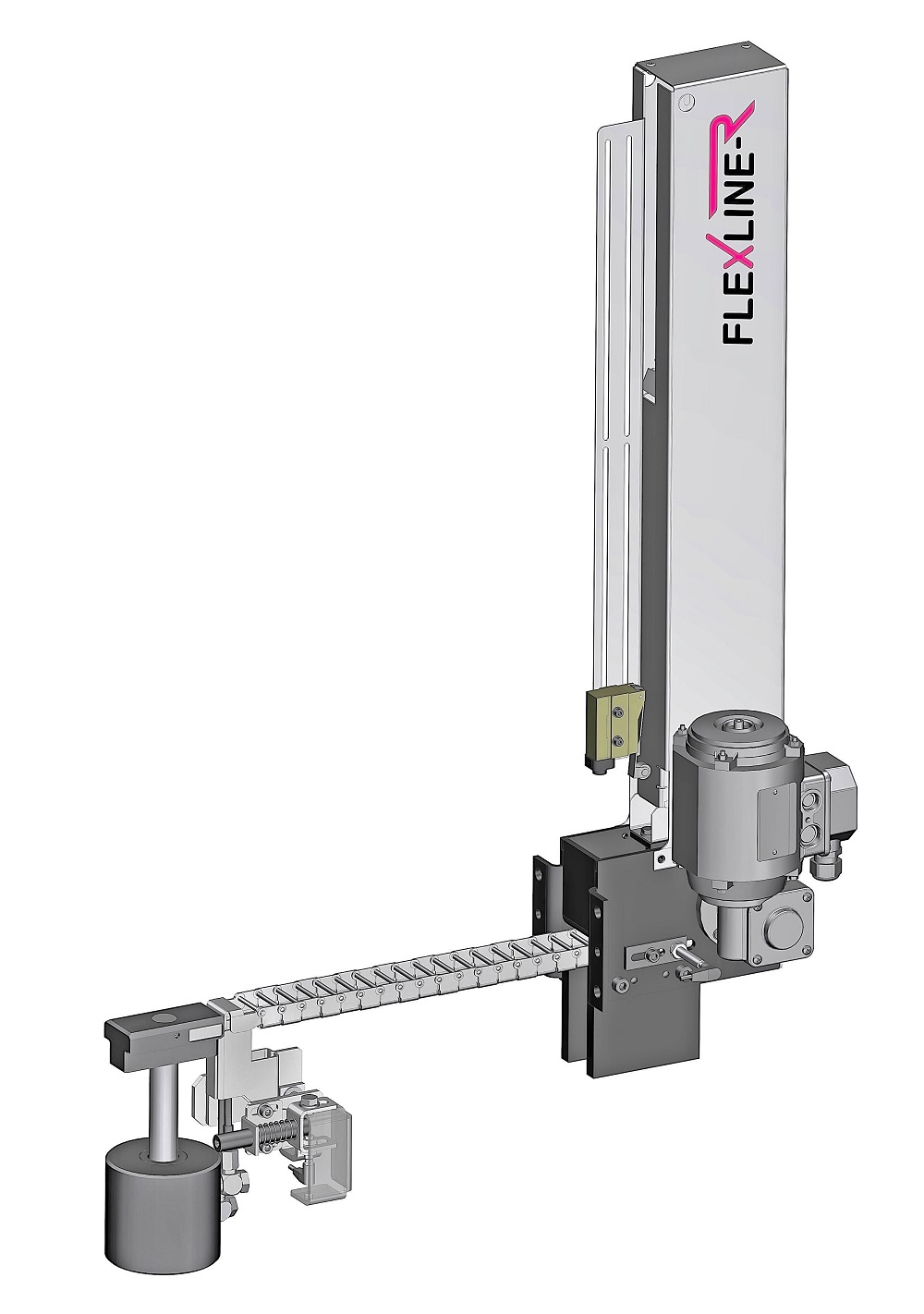
Work-holding and handling equipment manufacturer,Roemheld, has introduced a robust, adaptable system for automatically and rapidly clamping dies of various sizes to a press ram. Flexline R is suitable for quick setups on automated press lines and other applications requiring frequent die changes. Numerous variants can be configured to suit individual customer requirements.

Based on the company’s Flexline system, the new product has been further developed to accommodate higher loads and demanding operating conditions. It is equipped with a stainless steel pull-push chain that replaces the previous plastic version, plus reinforced stops and reliable sensor technology, while offering improved emergency protection. The chain case and all brackets and sheet metal parts are also made of stainless steel.

Multiple units, commensurate with the weight of the die, are mounted at regular intervals along the face of the ram at the T-slot positions. The electromechanically-driven pull-push chain in each unit automatically moves an integral hollow piston cylinder from the park position to the die edge. Additionally, electric and hydraulic power is delivered to the clamping element via the chain, eliminating the need for a separate energy supply.

Improved position monitoring is a result of having a high-precision magnetic field sensor to detect the die location, while an inductive sensor reports the position of the clamping element on the die. Optionally, the end position of the chain can be verified using a sensor integrated in the chain case.

New also are reinforced brackets for position monitoring to ensure maximum operational safety. An emergency release on the drive motor provides additional protection in the event of an accident. If necessary, the die can be released manually.
More information www.bit.ly/47MkJz7

PXL press heralds new era of mobility at SEAT

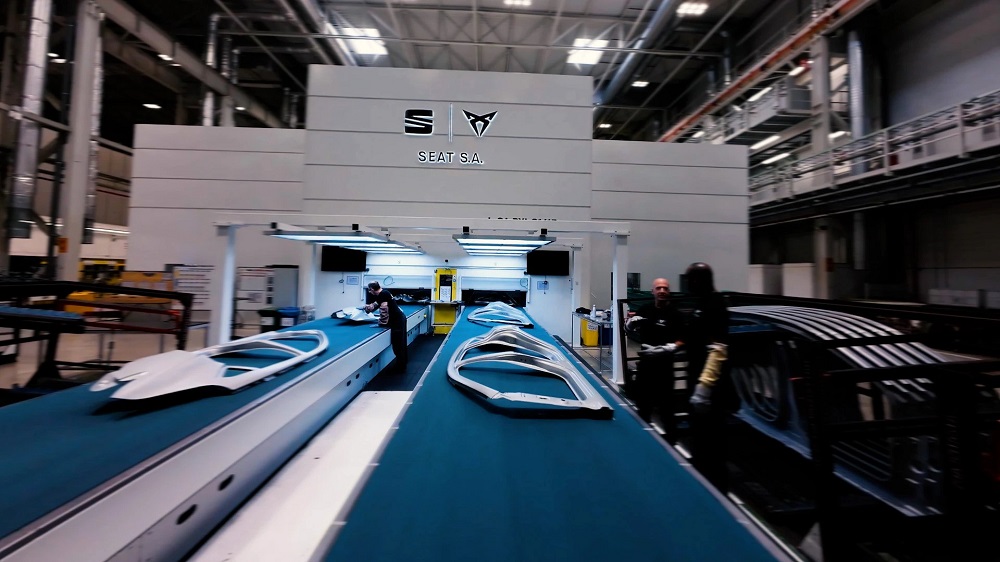
The road to electrification takes a lot of different aspects into consideration. Such a transformation can be seen in the design of car models, staff training, and in the modernisation of facilities and processes. This is the case with the new PXL press system at the plant ofSEAT and CUPRA in Martorell, which is more efficient, powerful and connected.

Among the most modern in the world, the six presses that form part of the PXL system will be used to produce up to 4 million body parts of the CUPRA Raval and Volkswagen ID Polo per year. At present, the presses are already stamping parts for the company’s current production models.Featuring the latest technology, the PXL press system stands out for its high productivity.

“Thanks to its 15 strokes per minute, we can stamp more parts in less time, with maximum efficiency,” explains Alicia Molina, director of Production Process Engineering at SEAT and CUPRA.

This efficiency is further enhanced by a reduction in the time required to change the dies, allowing up to 15 changes per day to manufacture different parts. 

“By fully automating this process, we’ve managed to decrease the time it takes to change dies to just five minutes between finishing the last part in a series and starting production of the first in the next one,” reveals Jose Arreche, director of the SEAT & CUPRA plant in Martorell.

Given the complexity of moving and anchoring such powerful, heavy machinery, the construction of the press system was a major technical feat. In order to withstand its 81,000 kN of force, the system sits atop a 9 m deep pit and 20mdeep concrete pile foundations, which is equivalent to the height of a seven-storey building.

More information www.seat.com

Press provides 60% more production at Weldmac

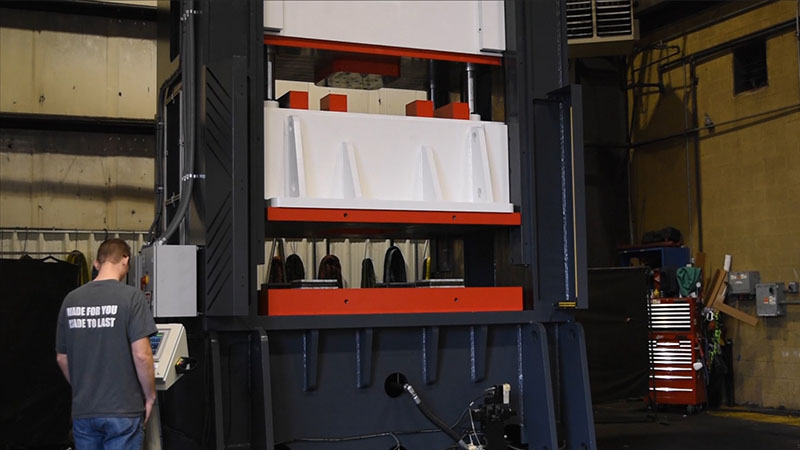
Established in 1968, Weldmac Manufacturing is a job shop that offers laser cutting and welding for stainless steel, aluminium, titanium, Inconel, Hastelloy and other alloys, as well as machining, press-brake forming, hydroforming and spinning. The company’s latest machinery purchase, a custom 800 T triple-action hydraulic press from Beckwood, supplements its existing 150 and 450 T triple-action presses.

“At double the tonnage of our other triple-action presses and with a larger bed size, we’ve already increased capabilities by 50%,” says Weldmac president Marshall Rugg. “Ease of use due to programmability should push capabilities to a 60-70% increase. Operator capability enters into it, but the controls on this press only will make jobs easier for a good manual press operator.”

The triple-action press consists of a punch or forming tool on the main draw ram, a clamp ram in the middle, and a knockout cylinder and/or bed cushion on the bottom. The clamp ram, which offers individual tonnage control on each cylinder, is engaged throughout the forming process to control material flow and reduce wrinkling and tearing within the part. By giving operators the ability control material flow, they achieve greater success in forming parts.

Proportional control valves regulate the bed cushion, enabling dynamic control through four different travel zones. Through the HMI and recipe settings of the press, the operator can specify a desired bed cushion force at any position within each zone.

“We excel at building complex components and assemblies, and that work continues to increase,” says Rugg. “We’ve added customers that usually come to us with one problematic part or assembly, and that leads to more business. When we do a good job, a new customer gives us more things to do. New press capacity and capability helps us handle that.”

More information www.beckwoodpress.com