

NDT for aerospace

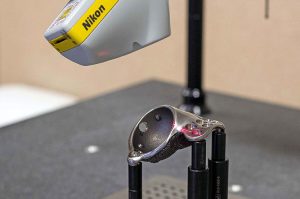
Creaform has announced that it will extend its expertise in NDT to the aerospace industry. By expanding access to its inspection solutions, the company aims to better enable airlines, as well as MRO service companies, to more efficiently perform the evaluations of in-service aircraft safety, while cutting costs and saving downtime.
“As predictive maintenance becomes more prominent, aviation maintenance professionals and aircraft MRO providers are increasingly on the lookout for innovative methods that enable quicker and safer decisions to be made on the outcome of part defects,” says Steeves Roy, NDT product manager at Creaform. “The mapping of external surface defects on aircraft parts, which can prove difficult to obtain using traditional methods – namely hail damage, bird impacts and lightning strikes on the fuselage and wings – can be assessed with 3D scanning. When paired with advanced inspection tools, such a solution cuts down on the operator’s impact on measurements, shortens time to get the final report and reinforces decision making.”
To ensure that the solution matches aviation maintenance industry requirements and properly reflects market needs, Creaform is partnering with major aircraft manufacturers for beta testing. The surface inspection solution dedicated to aerospace applications is set for release in October 2017.
Well-known for its NDT solutions offered to the oil and gas industry, Creaform’s NDT product solution is comprised of its flagship HandyScan 3D portable metrology-grade 3D scanner and its Pipecheck NDT software, both of which allow automatic on-site inspection, detection and characterisation of pipeline defects. With traceable and repeatable inspection data and results, operators can access critical information for making safer decisions.
For further information
www.creaform3d.com

Total service to industry

Midland Metrology Ltd is a long-standing specialist that has been providing a “total service to industry”, ever since its establishment by current managing director Bob Coles
in October 1988. The company is best known for stocking and supplying metrology application solutions such as optical profile projectors, CMMs, hardness testers and various other inspection, test and
calibration tools.
“We sell both new and used metrology equipment to sectors that include automotive, aerospace, medical and oil and gas,” says Coles. “The company prides itself on being able to respond to customer enquiries quickly, offering ready solutions to their problems. We can provide a fast and friendly service with an efficient turnaround of items in our calibration laboratory. The lab also provides a comprehensive inspection service for the measurement of customer components, which includes full detailed spreadsheet reporting.”
The company’s 4,000 sqft facility at Coventry features a dedicated showroom and dimensional temperature controlled laboratory. Equipment can be bought or sold and, as a concentrated specialist, Midland Metrology can source competitively priced solutions from a number of manufacturing brands.
Stock includes basic equipment such as micrometers, calipers, bore gauges, depth gauges and height gauges, while more sophisticated machines and equipment include profile projectors, video measuring machines, a full range of portable hardness testers, CMMs and roundness testers.
More recently, the company has introduced a range of brand new black granite products, and is now able to supply granite tables and surface plates, granite squares and tri-squares, straight edges, vee blocks, and parallels.
For further information
www.midland-metrology.co.uk

Rotary tables for Optiv CMMs

Hexagon Manufacturing Intelligence has extended the accessory range for the Optiv Performance 663 and Optiv Performance 664 CMMs by adding two new CNC rotary tables and Optiv Dual Rotary CNC stacked rotary tables as options.
The use of the integrated CNC rotary axis increases overall inspection performance when measuring rotationally symmetrical parts. Such workpieces can be measured in a single set-up, as features distributed around the circumference of the part can be rotated into a position which is optimal for multi-sensor measurement. PC-DMIS measuring software takes the rotation of the workpiece co-ordinate system relative to the machine co-ordinate system into account. As a point of note, the Optiv Dual Rotary option allows the entire rotary axis to swivel on an additional axis so the sensors can reach geometries which are inclined to the longitudinal axis of the workpiece.
The tactile measurement of prismatic workpieces on a rotary table or stacked rotary table also offers improved efficiency as complex geometries become easily accessible with only a few simple styli configurations. This reduces the number of probe changes, as well as the number of axis movements.
Two sizes of CNC rotary table are available, offering maximum torques of 2 or 10 Nm, and centred load capacities of 900 or 1800 N. Depending on the version, self-centring, three-jaw chucks for diameters between 2 and 125 mm are optionally available. With the Optiv Dual Rotary option, two rotary tables are combined to enable two-axis rotations.
For further information
www.hexagonmi.com

Faro arm boosts jet hydroplane project

The current world water speed record of 510.45 km/h was set by Australian Ken Warby in 1978. The four decades since then represent by far the longest period that the record has remained unsurpassed.
Harbouring the ultimate intention of bettering this impressive mark is ‘Longbow’ project leader, David Aldred, who says: “A jet hydroplane can be described as a pure thrust gas turbine or rocket powered boat, with a hull designed in such a way that when high speeds are achieved, the craft only has a few square inches of its surface in contact with the water surface, which in turn reduces hydrodynamic drag to a minimum.”
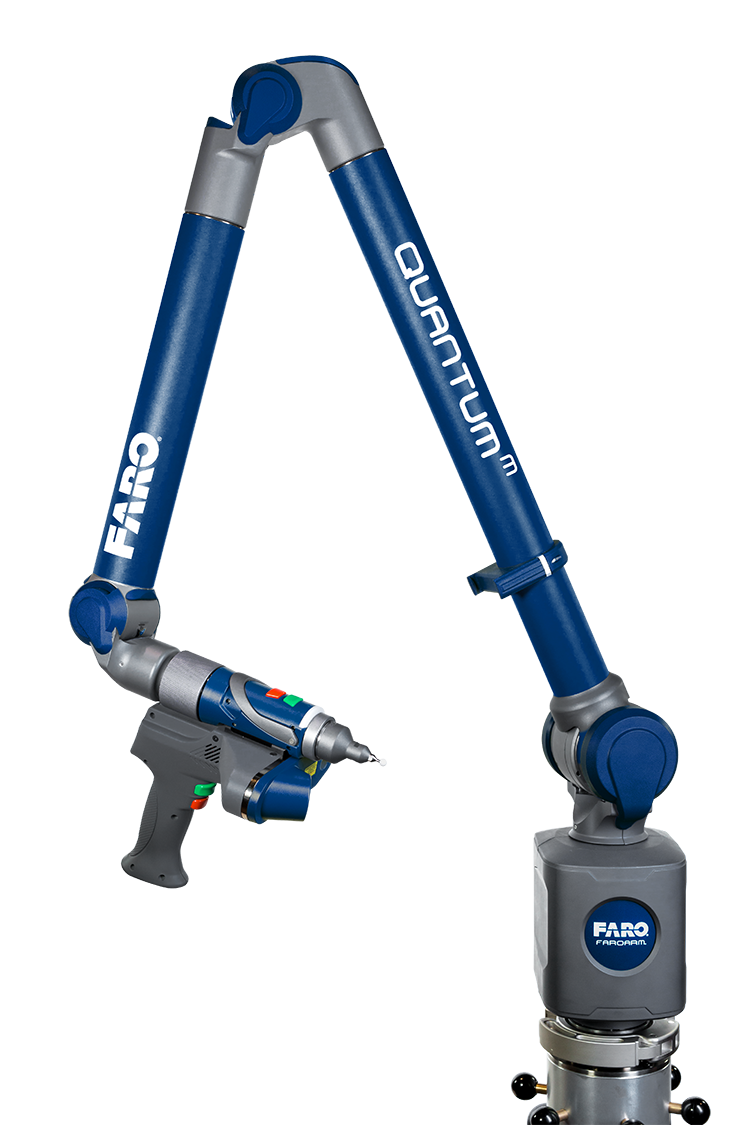
A major contributor to the Longbow project is Kevin Hardcastle, design engineer and founder of Aximo Ltd. To enable Hardcastle to produce the required drawings for analysis of the driver cockpit from the buck already fabricated, the assistance of Manchester Metrology’s laser scanning services was enlisted. Given the project’s demanding accuracy requirements, Neil Blakeman of Manchester Metrology used a Faro Edge ScanArm HD to scan the driver’s tub and capture the required data for conversion into a NURBS format.
“We decided to use the Faro Edge ScanArm HD as it has an accuracy specification of ±25 μm,” says Blakeman. “The arm combines the flexibility and functionalities of a Faro Edge measuring arm with a high-definition Laser Line Probe HD, giving us an ideal contact/non-contact portable measurement system.
“Also, as each of Longbow’s team of experts and technical contributors have ‘day jobs’ and give their time voluntarily, it was important to use a technology that could capture and process the required precise data in a timely fashion,” he adds.
For further information
www.faro.com

Mitutoyo seals the deal at CDK

When Yeovil-based CDK Seals won an order for the production of metal components from a new aerospace customer, this manufacturer of seals for the food, pharmaceutical and petrochemical sectors, had to employ new production equipment and methods.
Historically, CDK has produced its seals from a variety of PTFE composites on specialist machines. However, the new £100,000+ order required a three-part assembly featuring steel, aluminium-bronze and PTFE parts. These components include both a concave and convex part, as well as a housing that makes for an assembled measurement of 80 mm diameter and 60 mm height. A major issue for CDK was that the 1500 assemblies, with a total of 4500 parts, had to be machined to a 0.03 mm tolerance. Unfortunately, the company’s micrometers could not measure many of the complex features, especially the curved surfaces. This situation was particularly pertinent for a 4 mm diameter cross-drilled hole that is positioned on one of the
concave surfaces.
After assessing the market options, CDK engineers visited Mitutoyo and it was agreed that the Crysta Plus M433 CMM could provide the solution.
“Mitutoyo installed the machine and did the programming for the three seal components, so we could be up and running instantly,” says managing director Dave Paget. “The training was straightforward and we have the CMM networked to a PC, so we can store any subsequent programs off-line. Mitutoyo also provided a series of 3, 2 and 1 mm diameter ruby probes.
These small probes enable us to get inside the 4 mm diameter drilled hole and check the concentricity as well as the angle of the hole that has a critical tolerance of ±0.1°.”
For further information
www.mitutoyo.co.uk