

Sodick took best-of-breed EDMs to EMO

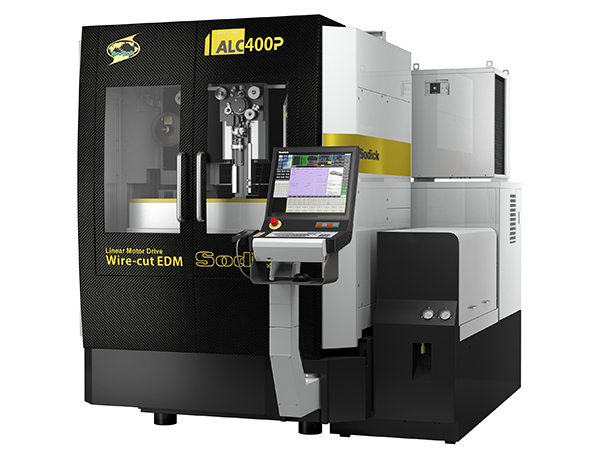
From its largest ever stand at EMO, Sodick said it took best-of-breed technology to the exhibition, with European debuts for the ACL400P high accuracy wire EDM and the ALC800G large-capacity premium wire machine. These newcomers were accompanied on the stand by two of Sodick’s most advanced EDM ‘big beasts’, the AG80L die sink and ALC800G wire machine, while automation options were demonstrated by the AG60L die sinker with robot.

The new ALC400P ultra-high-precision wire EDM incorporates as standard an inverter-type dielectric chiller which monitors and maintains the dielectric temperature to within ±1°, minimising the thermal effect inside the work area. An additional thermal sensor is installed inside the work tank for even more accurate temperature control.
As a further benefit, the CNC controller incorporates 2D pitch compensating software which automatically compensates pitch error in positioning every square of 10 x 10 mm. In addition, cross-type roller guides help provide high rigidity, high accuracy and longer life.
Elsewhere on the stand was the new ALC800G large-capacity premium wire EDM, which becomes the largest standard machine in the range with its 1250 x 1020 mm work tank and maximum workpiece weight of 3000 kg.
Incorporating the latest digital innovations in generator technologies and the use of advanced electrode materials, the ALC range provides major advances in cutting speed, accuracy and surface finish – made possible through Sodick’s in-house development and manufacture of all critical technologies, including linear motors, discharge power supply, NC unit, motion controller and ceramics.
For further information www.sodick.org
EDM with less electrode wear

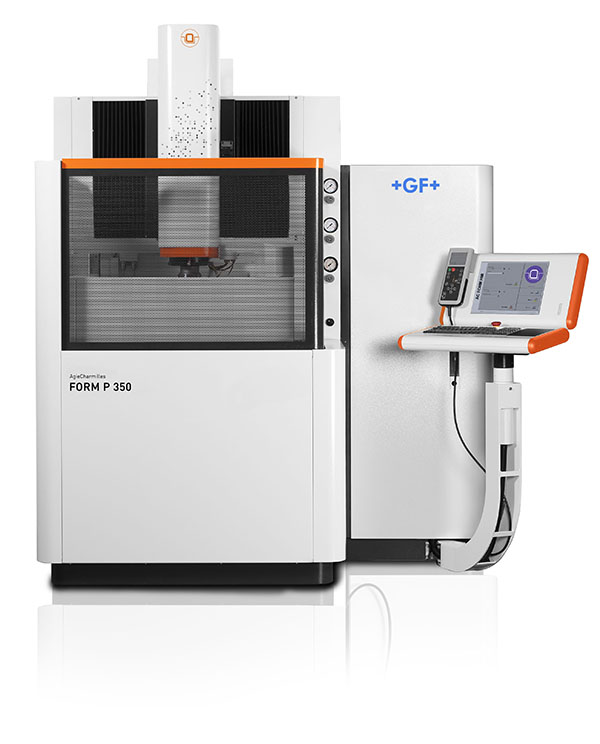
The Form P 350 die-sink EDMs from GF Machining Solutions feature precision-enhancing qualities and integrated technologies that are said to boost productivity and profitability.

Featuring a compact C-axis construction, fixed table and cast-iron frame, offers stability and force reduction to maintain a precise spark gap between the part and electrode. Regardless of part weight or dielectric volume, the machines deliver consistently high accuracies and surface finishes of Ra 0.1. Furthermore, integrated glass scales preserve repeatability and eliminate the need for recalibration and errors due to backlash and wear.
GFMS Form P 350 machines are equipped with the company’s intelligent power generator and Tecform module, which optimises each pulse to reduce electrode wear and generate high-quality surface finishes. Segment-dedicated technology eliminates the need to adjust the generator’s parameters.
The company’s iQ technologies control the erosion of graphite and copper electrodes, and help reduce costs. Real-time spark characteristic analysis and setting adjustment for pulse efficiency ensure wear-free spark erosion, precision, efficiency and greater control over the cost of the electrode, says the company.
Of note, the console’s AC Form HMI is based on Windows. Interactive graphics illustrate operations such as measurement and machining cycles for ease of use, while providing descriptions of machining targets, automatic selection of optimal technologies and dynamic parameter adaption.
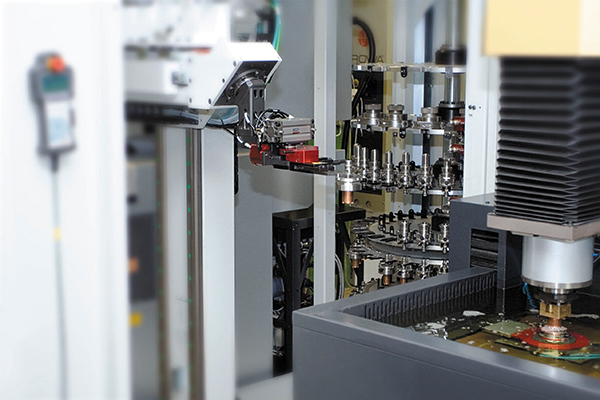
GFMS Form P 350 machines are supplied with a four-position linear tool changer for System 3R macro tooling. An optional rotary tool changer can be specified that increases the number of electrodes to 160. The machines can also be paired with a System 3R WorkPartner 1+ robot for unattended night and weekend operations.
Offering X-, Y- and Z-axis travels of 350 x 250 x 300 mm, the machine accommodates workpieces up to 700 x 460 x 275 mm in size.
For further information www.gfms.com/uk

GBM opts for Mitsubishi EDM

At Mattighofen, Austria-based GBM Kunststofftechnik und Formenbau GmbH, a newly installed Mitsubishi MV2400R Connect is making a genuine difference to this forward-thinking mould shop. Mitsubishi EDM machines are available in the UK from HK Technologies.

In total, some 35 injection moulding machines can be found in the halls of GBM. Be it parts for cars, medical devices or telecommunications equipment, there is very little that GBM cannot mould in plastic.
“Among the areas that is currently developing very strongly is vehicle charging equipment,” reveals managing director Roland Barth. “Extremely complex shapes are created for this, to produce wall boxes for example.”
As a result, the company recently purchased a Mitsubishi MV2400R Connect with travels of 600 x 400 x 310 mm in X, Y and Z, which is being used almost exclusively to produce injection moulds. In addition to machine’s fast cutting speed, the quality of the surfaces is an important factor for the Austrian firm.
“For us, the investment was important so that we could produce moulds faster than ever before, with surfaces that do not have to be reworked,” says Barth. “We want to continue growing and the machine will support us in our efforts.”
Barth deliberately opted for a larger machine, which is also equipped with the new D-CUBES interface. “Here I see a lot of potential for exploiting totally new possibilities in the future, particularly when producing moulds for our injection machines.”
For further information www.mitsubishi-edm.de/en

Enhanced Erowa LoadMaster range

Erowa’s recently enhanced LoadMaster range, which is available in the UK from REM Systems, builds on the ability to offer the automatic loading and unloading of workpieces up to 4000 kg.

Equipped with a 360° swivel function, any position in the magazine and on the machine tool table can be reliably reached. According to the company, customers equipped with an Erowa system can typically increase productivity by a factor of five using various manufacturing technologies, including die-sink EDM.
Raw material billets, part-machined components and cast workpieces can be transferred using LoadMaster thanks to its novel kinetic system with very limited space requirement. The magazines are designed to stack vertically, with the storage positions arranged over two, three or four levels, saving on floor space and subsequently cost. Each level is optimally configured for typical workpiece sizes.
REM Systems’ managing director Ian Holbeche says: “The new LoadMaster allows manufacturing businesses that produce larger, and therefore heavier components, to increase their productivity. Typically, this might be large press-tool plates, multi-cavity injection moulds, valves and pipe fittings, as well as structural and propulsion components for aircraft.”
Operator set-up stations are integral components of LoadMaster production lines, with access via sliding doors or walk-in stations. Versions are available featuring lifting units, with rotating and tilting table, or with indexing table. The set-up positions are also accessible via overhead crane.
Erowa’s overall process control system assists the operator in the daily production flow, with clear displays of system status. Notably, the transfer unit moves between the magazines and machines on solid rails, while the grippers optimally support various application scenarios: ‘TwinFork’ double grippers for faster chip-to-chip times or ‘MultiFork’ end effector for the loading and unloading of different pallet sizes.
For further information https://remsystems.co.uk/

TEK4 building new technical centre

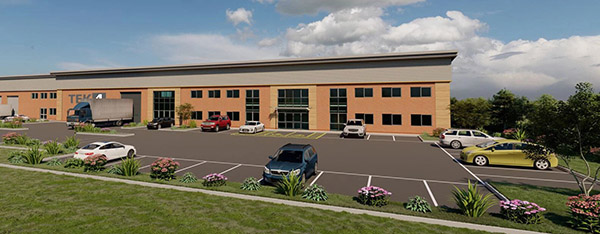
TEK4 plans to open a brand new, purpose-built technical centre in late summer 2019.

The facility is located in Blaby, Leicestershire, just six miles from the company’s current site. TEK4’s new centre will offer good accessibility, with the M1 motorway just 10 minutes away.
Enhanced customer facilities will be at the heart of the operation, which is set to be five times larger than TEK4’s existing site, providing the capacity to deliver up to 10 machines per month. Among specially designed areas will include those for research and development, and another for running trials and demonstrations. A temperature-controlled inspection area will also feature. The new development will facilitate continued growth at TEK4, enabling it to exceed customer expectations.
TEK4 was founded by Jason Duffin in 2002, who continues to run the business alongside a team of engineers and support staff who have underpinned the company’s success. Duffin has spent his working life developing special process technology for gas turbine component manufacture. He co-founded MJ Technologies Ltd, and was MJT’s managing director until 2001 before he left to establish TEK4. MJT subsequently became the Winbro Group.
TEK4 specialises in fast-hole drill (FHD) or high-speed drill (HSD) EDM machines for drilling straight and shaped cooling holes in aero and IGT blades, vanes, segments and other components. Solutions combine EDM and laser systems for FHD and ceramic coating ablation; laser for drilling and cutting operations; and ECM for the STEM drilling of deep cooling holes in gas turbine components.
For further information www.tek4.co.uk