
ABL brings sliding-head turning in-house

The first sliding-head turn-milling centre to be installed at the Ferndown, Dorset factory of Air Bearings Ltd (ABL) is a Citizen Cincom L20-VIIILFV. Notably, the machine has brought in-house the production of nearly all shaft-type components, saving around £8000 per month previously spent on subcontract Swiss-type turning. As a consequence, the machine paid for itself within 18 months.

ABL only purchases top-end machine tools to meet the levels of precision required and ensure the rotational motion of its air bearing spindles to within a couple of microns. The shaft assembly, with its six key parts, is especially critical.

ABL’s senior production controller Dave Stacey says: “Take the collet, for example, which is produced from 13 mm diameter tool steel bar. The concentricity of the front bore to the taper is tied up to 30 µm TIR. Dimensional tolerances on diameter and length need to be within 50 µm, or sometimes 25 µm to allow post machining to sub-micron accuracy, while there is a 6 µm limit in the bore.

“Originally, before our decision to use subcontract services, these collets were machined in-house in two operations – turning and boring on a fixed-head lathe and then drilling of eight radial holes on a machining centre,” he continues. “This time-consuming process led to our pre-finishing department only producing the quantity needed, which could be as low as 15-off, yet external heat treatment and stress relieving before final finishing still cost £250 a time, irrespective of component quantity.

“Now, with single-hit turn-milling of the collets on the Cincom L20, we run off typically 500, representing three months’ supply, at a fraction of the cost of subcontracting them out, added to which we can take full advantage of the fixed-cost heat-treatment service.”

For further information
www.citizenmachinery.co.uk

Mazak expands UK-made machine portfolio

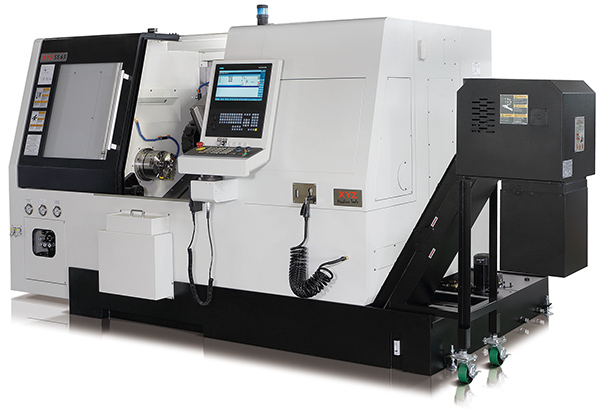
Following a series of major investments at its Worcester-based manufacturing plant, Yamazaki Mazak has commenced the production of a number of models from its Quick Turn series of turning centres. The models include the Quick Turn 350, 350MY and 350MSY, taking the total number of UK-made Mazak machine tools to eight.

Previously manufactured at the company’s manufacturing facility in Minokamo, Japan, Mazak says the Quick Turn 350 series offers high-performance turning from a compact footprint. Models now manufactured at Mazak’s Worcester site include the standard Quick Turn 350, as well as those with milling and Y-axis functionality, (MY), and milling, second spindle and Y-axis capability (MSY).

Jason Butler, sales director – UK & Eire sales & service division at Yamazaki Mazak, says: “While the past 18 months have certainly been among the most challenging in living memory for UK manufacturing, Mazak’s strategic investment plan has remained undeterred. We are now seeing the benefits of focused spend throughout our European manufacturing plant, which has allowed us to increase the volume of models manufactured here by over a third.

“The Quick Turn 350 series is an incredibly diverse family of machine tools, and is closely aligned to the machining needs of customers here and in mainland Europe,” he continues. “As society continues its journey to fully reopening, our European Technology Centre remains open to both existing and prospective customers. For those unable to travel in person, we have also invested in a virtual ‘digital twin’ of the ETC, which features an interactive overview of all machines currently installed.”

For further information
www.mazakeu.co.uk

Okuma expands automation solutions

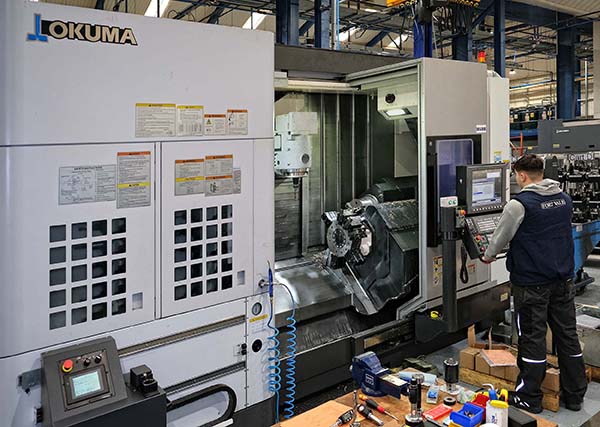
To enable all companies an easy step into automation, Okuma is now offering a new combination of lathe and robot system. Users can benefit from a flexible automation solution with high cutting performance on the entry-level Genos L3000-e Standroid, which is available in the UK from NCMT.

The Genos L3000-e with Standroid is a horizontal universal lathe equipped with flat guides and a solid turret design. Okuma’s new model is a package version completely equipped and ready to use. A comprehensive accessories package is standard, containing an integrated motor spindle with three-year spindle warranty, NC tailstock, chip conveyor and a tool-holder package, as well as a three-jaw hollow chuck. The proven Thermo-Friendly Concept developed in-house ensures high workpiece accuracy.

Okuma’s Standroid robot system is part of the Okuma Roid series and is specifically for the automation of small and medium-batch sizes. As it comes with the new Roid Navi system with dialogue user interface, no prior robot knowledge is required. The intelligent OSP-P300LA Okuma control software makes it easy to operate, also leading to shorter set-up times. Additionally, the machine and the robot are both integrated into the proven Collision Avoidance System (CAS), which makes the whole system safe to operate without exception.
With the Genos L3000-e Standroid, Okuma is offering an automation solution that enables an easy step into automated production for all company sizes.

“A small footprint and optimised operation makes the Genos L3000-e Standroid a dedicated tool to increase productivity and maximise machine utilisation,” states Jakob Simon, automation specialist at Okuma Europe GmbH.
Deliveries in Europe will start next month; pre-orders can be placed now.

For further information
www.ncmt.co.uk
JEB takes-off with new turning centre

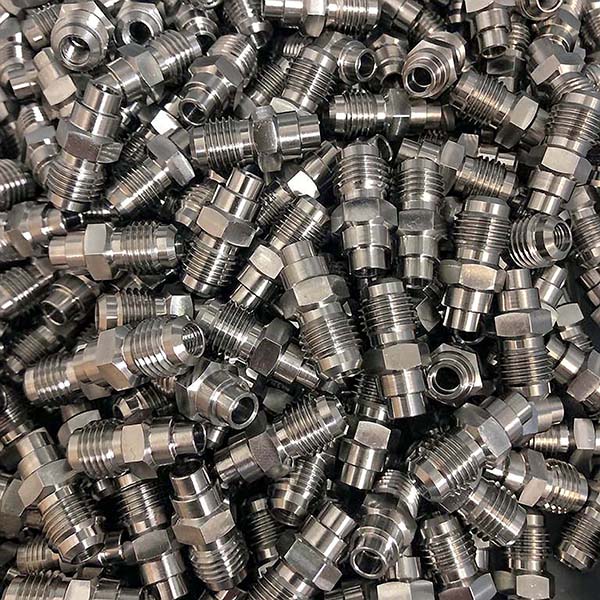
When JEB Precision won an order to manufacture a complex component for an aerospace air handling system, the Northwich-based subcontract manufacturer recognised that its existing production method required an upgrade in order to improve productivity. The solution arrived in the shape of a Nakamura-Tome AS200L-MYS turning centre from the Engineering Technology Group (ETG)
The S130 grade stainless steel parts were required in batches of more than 100 per month, but the existing five set-up process on multiple machines was an unsustainable long-term solution.

With six turning centres from ETG on-site, JEB Precision was already familiar with the extensive solutions available, but this was to be the first Nakamura-Tome machine.

Discussing the project, JEB operations director Michael Bebbington recalls: “Although our Hardinge turning centres are very capable machines, the Nakamura-Tome AS200L-MYS is a twin-spindle machine with milling capability and Y-axis machining that is built on a very robust platform. By investing in this technology, we were immediately able to reduce set-ups, increase throughput, improve process reliability and quality, and free capacity on our other machine tools.”

Before the arrival of the Nakamura-Tome AS200L-MYS CNC turning centre, the 83 mm diameter by 23 mm aerospace part demanded an extensive seven-hour set up time across several machines, although the combined cycle time was only 30 minutes.

The Nakamura-Tome AS200L-MYS at JEB Precision features a Hainbuch collet chuck in the main spindle and a Hainbuch expanding mandrel on the sub-spindle for ID clamping to ensure complete machining in a single operation. The part is machined complete in just 20 minutes on the Nakamura-Tome AS200L-MYS and, in the early days of gaining familiarity with the twin-spindle workhorse, JEB had slashed 30% off its programming time, a figure that is destined to improve as the company enhances its understanding of the machine.

For further information
www.engtechgroup.com

CAM system features PrimeTurning

A collaboration between CAM software component provider ModuleWorks, cutting tool manufacturer Sandvik Coromant, and HCL Technologies, creator of CAMWorks, has produced one of the first commercial implementations of the PrimeTurning methodology in a CAM system.

Invented and patented by Sandvik Coromant, PrimeTurning increases machining efficiency by offering turning in all directions. Sandvik Coromant worked together with ModuleWorks to implement the PrimeTurning method as a software solution that can integrate into any CAM system. With support from ModuleWorks, HCL Technologies has now integrated this solution into CAMWorks, offering PrimeTurning as a native CAM strategy for improving efficiency and job throughput in machine shops.

The PrimeTurning method enables CAMWorks to achieve faster material removal rates and higher productivity than with conventional turning methods. ModuleWorks also developed optimised G-code generation for PrimeTurning with versatile parameterisation. Integrated into CAMWorks, this delivers fast and flexible job set up for the diverse range of CoroTurn Prime turning tools.

Julia Meyer-Hendricks, senior key account manager at ModuleWorks, says: “This three-way collaboration is an excellent example of how Industry 4.0 encourages heterogenous partnerships for developing innovative new manufacturing solutions. We look forward to continued co-operation and further advances in the technology.”

Marko Stugbäck, product manager at Sandvik Coromant, adds: “ModuleWorks has the experts and resources that enabled us to turn the PrimeTurning method into a software solution for the CAM market. It’s great to see HCL implementing this technology in CAMWorks. These types of collaborative efforts are exactly what the industry needs to ensure continued ingenuity that enhances the productivity and quality of automated manufacturing.”

For further information
www.moduleworks.com