

Sustainable impact calculator for refurbished spares

At this year’s Drives and Controls Exhibition, part of Smart Manufacturing Week (NEC, Birmingham, 4-5 June 2025), Netherlands-headquartered JC-Electronics is launching a sustainable impact calculator that enables customers to view the CO2, resource and cost savings of refurbishing HMIs, rather than replacing with new. 

Parts obsolescence has long-posed a challenge for industry, often leading to unnecessary waste when older components are discarded prematurely. Coupled with mandatory reporting procedures for the largest organisations under the EU’s Corporate Sustainability Reporting Directive (CSRD), businesses are being driven to find new ways to improve their sustainability credentials and reduce carbon emissions.

Chief commercial officer Caspar Botter explains: “Many companies struggle with the product lifetime management policies of the big OEM machinery manufacturers and feel forced to spend considerable time and expense on new upgrades. At the same time, they are being encouraged to reduce their use of raw materials and consider reuse where feasible.”

He continues: “We want to show customers that there’s an alternative through the purchase of refurbished industrial automation spare parts. When they choose JCertified refurbished electronics, they save on water, raw materials and the CO2 needed for the production of new electronics and benefit from a two-year warranty. When combined with our new sustainable impact calculator, we can give our customers clear, at-a-glance information on the cost, CO2 and resource savings that can be achieved.”

In a comparison between a typical mid-sized HMI and a refurbished unit, JC-Electronics can demonstrate that the refurbished part saves 80% of CO2 equivalent, 99% of metals and minerals use, and 86% of water use.

More information www.jc-electronics.com/uk

Boost collaboration between design and production

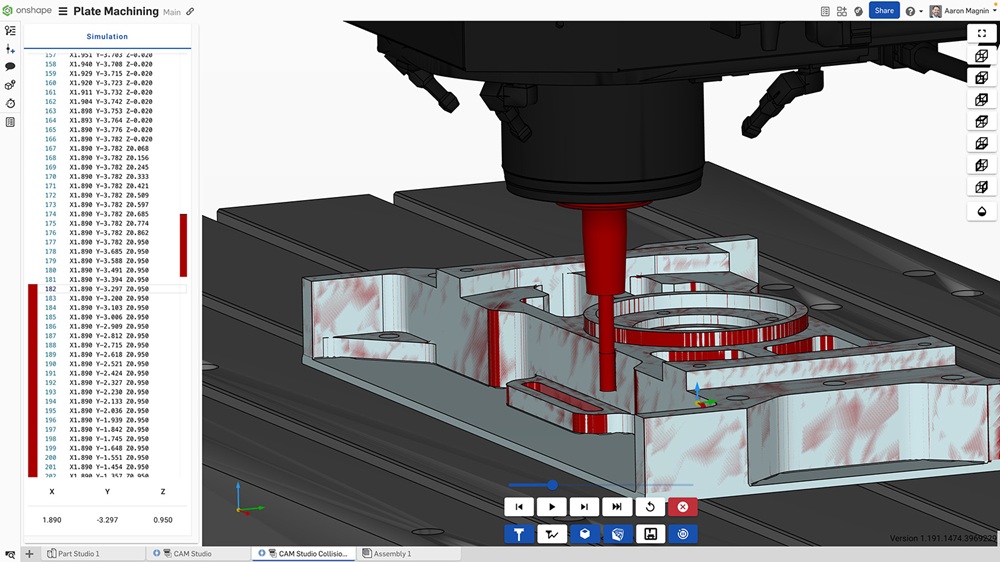
A new addition to Onshape’s suite of cloud-native features is promising to streamline the connection between design and production workflows. PTC, a UK authority on digital transformation and design, has launched CAM Studio Beta, which integrates CAD, CAM and product data management (PDM) to give design and manufacturing teams the opportunity to plan, simulate and collaborate on machining processes. The release offers a complete design-to-manufacturing solution, enhancing productivity and creating new opportunities for manufacturing brands across the globe.

“With the release of CAM Studio directly into Onshape’s cloud-native platform, users gain built-in version control and centralised storage for their manufacturing strategies,” says David Katzman, general manager of Onshape and Arena at PTC. “This ensures seamless collaboration, eliminates the risks of file-based workflows and provides traceability throughout the design-to-manufacturing process. CAM Studio reinforces our commitment to empowering teams with tools that enhance productivity and drive innovation.”

CAM Studio supports 2.5 and basic 3-axis machining, with the most common manufacturing strategies and machines. For users with advanced manufacturing needs, CAM Studio Advanced will offer enhanced capabilities, including advanced 3, 4 and 5-axis machining strategies.

Other features and benefits of Onshape CAM Studio include faster access to the latest manufacturing information while utilising Onshape’s built-in PDM functionality for G code and tooling strategies, as well as streamlined communication and easy sharing between CAD designers and manufacturing engineers. Furthermore, all stakeholders work from a single source of truth, saving time and money while also reducing manufacturing errors.

Among additional advantages, no additional software installations, licensing costs or administrative costs are necessary. Users also gain from cloud-native accessibility anytime, anywhere.

More information www.ptc.com

Essential insights to drive manufacturing growth

SYSPRO has released new research to support executives in mid-sized manufacturers considering the value of implementing an Enterprise Resource Planning (ERP) system in their business. Manufacturing organisations require practical tools to drive growth and cultivate a data-driven culture that empowers decision-makers throughout the supply and value chains.  

“In today’s digital age, effective data management, security and storage have become critical for any significant 21st century manufacturing business,” says Nick McGrane, managing director of NexSys, a SYSPRO company. “And yet, many manufacturers are struggling with legacy systems that fail to support their long-term growth aspirations.”

This information was revealed during a webinar hosted by SYSPRO, which discussed the company’s new e-book: ‘A Guide to Successful ERP System Implementation’. This e-book, compiled by market intelligence and strategy firm Frost Sullivan, is a treasure trove of essential information on investment considerations, avoiding pitfalls and best implementation practices. It provides the knowledge that various companies have identified as essential to ensure sustainable value. By asking 10 essential questions, companies can evaluate whether an ERP solution can unlock their full potential in the foreseeable future.

“As manufacturers and distributors expand their operations, the complexity of their processes tends to increase, placing additional strain on both systems and personnel. This shift in expenditure underscores the growing recognition of technology as a critical driver of efficiency and competitiveness in the manufacturing and distribution sectors,” says McGrane.

The e-book is available for free download from the link below.

More information www.bit.ly/3Z0edl1

Lighting up productivity gains at Smithstown

Opening its doors with just four toolmakers 50 years ago, Smithstown Light Engineering is now a business with three manufacturing sites and over 165 employees. Working with the world’s leading medical device and orthopaedic companies, Smithstown uses hyperMILL CADCAM software from Open Mind Technologies to streamline its throughput and maximise efficiency.

Working with clients such as Stryker, Boston Scientific, Zimmer Biomet and Cook Medical, the company provides a turnkey service from concept and design through prototyping, machining and validation of medical components and orthopaedic implants. With over 14 million components manufactured annually, the Irish manufacturer adopts stringent quality measures that are a necessity for precision medical device parts used in life-saving surgery.

CEO Gerard Henn alludes to why the County Clare company opted for hyperMILL: “There are so many different CADCAM options in the marketplace, but Open Mind made it much easier for us to work forward with hyperMILL, explaining the facets, features and how we could optimise our machining strategies and cutting paths.”

He adds: “Open Mind were very enthusiastic and got behind us. They understood what we were trying to achieve, and it’s been a positive relationship all the way through. We’d recommend Open Mind to any companies interested in upskilling their internal workforce – the partnership has been extremely positive.“

Smithstown Light Engineering supports orthopaedic and medical device companies in Ireland and around the world. It also provides instrumentation for surgical procedures, making it a very medical-focused enterprise

“With Open Mind’s support, we now have a great understanding of hyperMILL,” concludes Henn.

More information www.openmind-tech.com

Lantek helps Kanyana provide top service

Kanyana Engineering has followed a policy of providing unique sheet metal services at its Greenfields, Western Australia manufacturing facility since its formation in 1997. As part of its pursuit of excellence, managing director Graham Dawe understood that software and the integration of the company’s systems was crucial to his plan.

“I had experience from a previous computer business and wanted a fully integrated CADCAM and ERP system,” he explains. “With Lantek, this was all possible and we went for the full suite of Lantek Expert, Flex 3D and Integra straight away. We can take DXF files and 3D models directly from the customer and use the system to nest parts, program the lasers, and calculate a consistent and accurate price for the job.”

Stock material is stored within the system as are remnants from previous jobs so the company knows what is available, what has been earmarked for a job and what needs to be ordered. Via its tracking number, Kanyan can trace material down to the individual sheet used, producing material certificates for the customer.

“We can even switch materials, should the sheet we’ve allocated be under five tons of material, picking another of the same specification from the top of the pile and substituting its tracking number to maintain traceability.”

Once a quotation becomes an order, all the details and history of the job are released to the workshop ready for manufacture. Lantek’s MES software keeps control of where parts are in the shop, the time taken for each operation, and any lost or damaged parts which require remanufacturing. Live information is collected via workshop PCs and iPads on the laser machines, the press brakes and in the six fabrication bays. More information www.lantek.com