

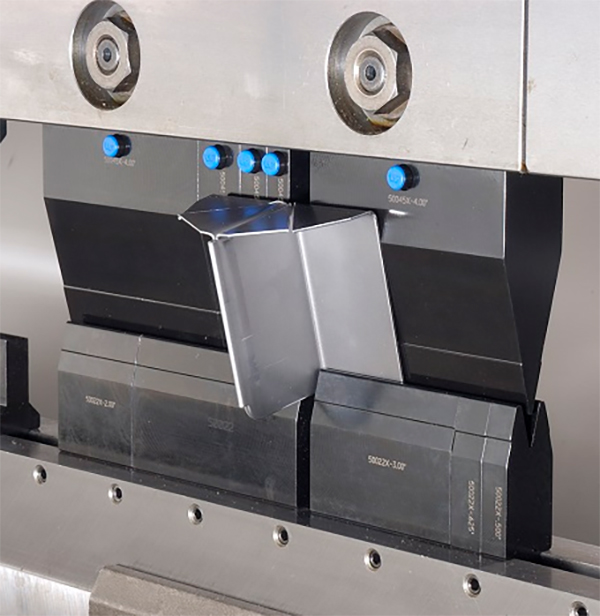
High-accuracy press brake from Haco Kingsland

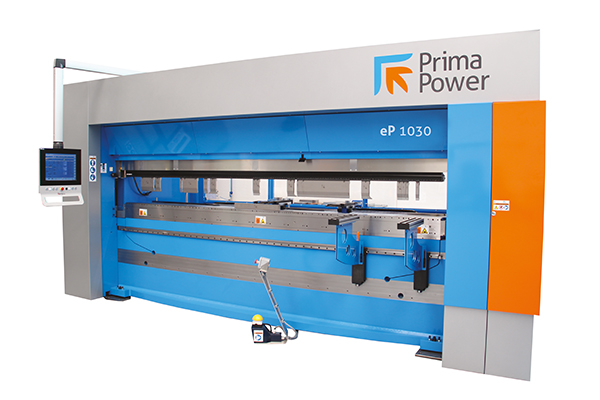
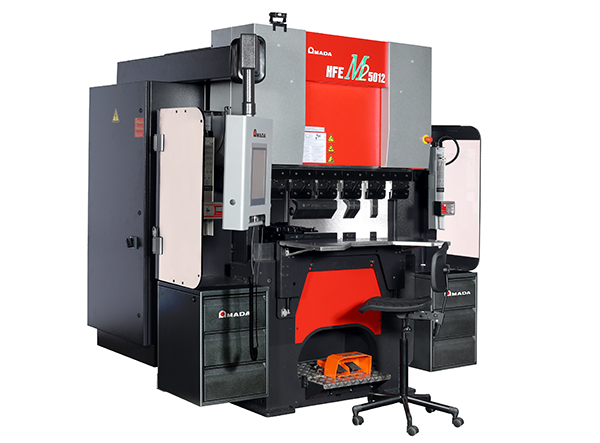
According to Haco Kingsland, the company’s new PressMaster series hydraulic CNC press brakes feature the full integration of high-level machine, control, software, safety and tooling technology for the benefit of short set-up times, high part accuracy and safe operation without compromising productivity.

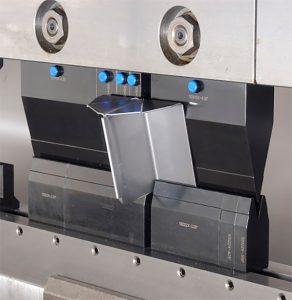
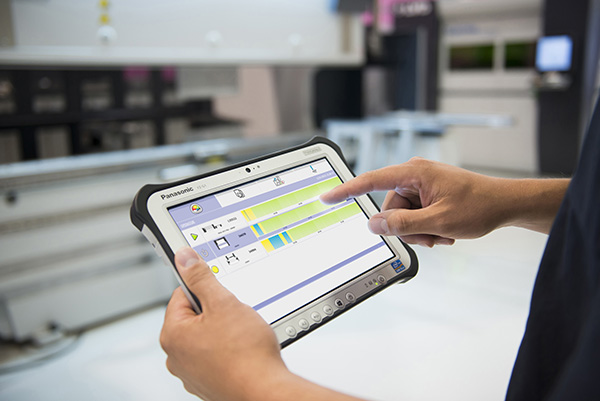
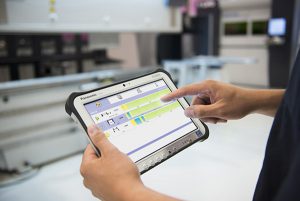
The Multi Touch FastBend MT Premium control offers automatic tool search during the part design process, along with instantaneous calculation of bending sequence and NC program. PressMaster press brakes can be optionally equipped with the company’s ‘Smart Tool Locator’ system, which indicates the correct tooling position as well as tools that are active during the bending process.
Lazersafe’s IRIS optical safety guard system guarantees safe operation, controlling the entire area around the top tooling and discontinuing the fast downward movement of the beam instantaneously when detecting any safety hazard in the protected area.
Further features include a new standard tooling system that is said to offer high accuracy and durability. Vertical loading together with novel self-seating and self-aligning characteristics work together to facilitate short set-up times.
The symbiosis of these technologies is designed to provide customers with flexible press brake operation offering short set-up times and components featuring ±0.1 mm dimensional and ±20’ angle precision tolerances.

For further information www.kingsland.com

New address for Salvagnini press brakes

Salvagnini recently staged a ribbon-cutting ceremony for Salvagnini Robotica, the group’s new division for the development and manufacture of press brakes and associated robotic applications in Brendola, near Vicenza. The plant is situated just 8 km from Salvagnini’s headquarters in Sarego.

With a factory floor space of 4000 sq m, the new facility is devoted entirely to the manufacture of B3 press brakes, which currently come in 14 models, from 2 to 5 m in length, and from 60 to 400 tons force capacity. According to the company, the next step in the development of these machines is full robotic automation. With this in mind, Salvagnini says that its Roboformer technology is currently in development in Sarego.
Among recent announcements, the Salvagnini B3.ATA press brake has been upgraded with numerous automated devices that make it adaptive to different materials and products, while also offering completely autonomous operation in accordance with the company’s Industry 4.0 concept. The machine’s application extends from stand-alone operation to an integrated part of the Salvagnini FMC FlexCell which, for example, allows configuration with an L5 fibre laser-cutting system and P2lean panel bender.
For further information www.salvagninigroup.com

AFRC forges new path for UK manufacturing

The University of Strathclyde’s Advanced Forming Research Centre (AFRC) has made a £2.3m investment in new kit as it seeks to enhance the competitiveness of the UK’s automotive, aerospace and medical manufacturing sectors. A radial forge from Austrian company GFM GmbH has been purchased, making it the only machine of its kind available in the UK for R&D and demonstration purposes. The AFRC will use it to trial and prove the viability of new ways of manufacturing parts for hip implants, automotive transmissions and aerospace components, among other products.

Radial forges are much more common in Germany and Austria, where they are frequently used in manufacturing parts for the automotive industry. However, a large upfront investment has curbed their adoption in the UK. Developed specifically for the AFRC, the radial forge will enable manufacturers to try new alloys and other materials in a range of applications. Featuring two pairs of hammers, the forge allows engineers to incrementally develop more complex shapes, improve materials, work at lower temperatures and create parts that are nearer net shape.
The machine also offers induction heating, which allows it to control how parts are being heated, be more flexible, and produce components more quickly. With a maximum forging force is 1500 kN, the machine can work with parts of up to 950 mm in length and a diameter of 125 mm. Cold working internal and external tolerances of ±0.15 and ±0.25 mm are offered, as well as hot working tolerances of ±0.25 and ±0.5 mm, respectively.
Dr Alastair Conway, senior manufacturing engineer at the AFRC, says: “By working with a range of materials and proving the advantages that the process offers over traditional hammer and drop forges, we hope to show our manufacturing industries how they can compete more effectively
on the international stage.”
For further information www.gfm.at

Process monitoring of press hardening

Higher and more consistent quality of the formed vehicle part, the potential for shorter cycle times and better control over the entire manufacturing process. This is what customers can expect from AP&T’s new in-line process monitoring system for press hardening.

Pyrometers and infrared cameras are used to measure the material’s temperature both before and after pressing. The pyrometer registers the absolute temperature at a certain point, while the infrared cameras are used to read the heat distribution on the part’s surface. All of this takes place without any of the equipment coming into physical contact with the material. It is crucial that the blank is heated up, formed and cooled down at exactly the right temperatures to ensure that the finished vehicle part obtains the desired material properties. The higher the degree of precision, the better and more consistent the result.
In-line process monitoring has been developed by AP&T to meet the demands of both the press hardening process itself, and customers, and it satisfies car manufacturer standards such as CQI-9.
Press hardening technology enables sheet metal parts to be manufactured with low weight and high strength, which results in lighter, safer and more energy-efficient cars. AP&T is a supplier of complete production solutions for press hardening, and has installed close to 100 press hardening lines globally since the beginning of the 2000s.
For further information www.aptgroup.com

Portable press brake launched by Bystronic

Bystronic has launched a press brake that can be moved around by fork lift truck. Despite a footprint of less than 3 sq m, the machine offers a bending capacity of 80 tonnes over 1.5 m.

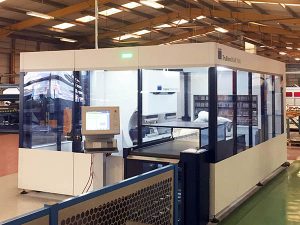
ByAutonom 4020 mit ByTrans 4020 Extended

Called Xpert 80, the press brake joins the smaller 40-tonne, 1 m Xpert 40 model. Both are able to boost productivity by avoiding the need to use a large, slower press brake to bend small components. Output can be increased further by relocating the machines next to a laser cutting cell, another press brake or other machine tool.
The Xpert 80 press brake can bend material up to 20 mm thick and may be equipped with multiple tools. ByMotion drive control, a Bystronic development, ensures that the machine’s upper beam and back gauges are accelerated quickly without compromising precision. Bending speeds of up to 25 mm/s are attained.
Ergonomic design features include drawers built into the side of the machine for housing bending tools and other equipment within easy reach of the operator. A height-adjustable folding table at the front of the machine can be used as a working surface or storage area. Power consumption is low due to the machine’s energy-conserving design and start-stop technology employed in the drive train.
Upper and lower tools self-seat during clamping as the operator presses an icon on the machine’s touch-screen control. Tool positions are automatically calculated as part of the program, while flashing LEDs on the front of the upper beam instruct the operator where the tools need to be mounted to correspond with the 3D movements of the back gauge.
For further information www.bystronic.com