
Electromechanical vice for series production

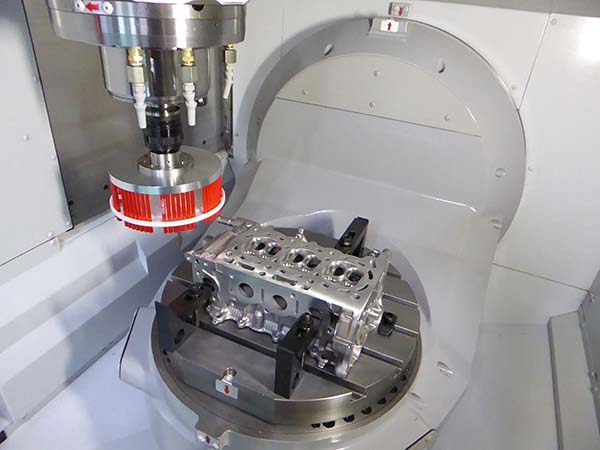
A new, high-precision, electrically actuated vice for securing workpieces on vertical, horizontal, five-axis and mill-turn machining centres is now available from Roemheld UK. It is possible to integrate the operating functions of the Hilma AS 125 E into the machine’s CNC system or regulate them via a separate control.

The Industry 4.0-compatible vice is equipped for automatic jaw change, making it suitable for unattended machining involving the robotic loading and unloading of components, as is often found in series production environments. Users can manufacture entire families of parts without manual intervention.

Roemheld’s AS 125 E lowers operating costs by eliminating the need for hydraulics or pneumatics, and by retaining the holding force without the power supply connected thanks to the self-locking mechanical spindle. The motor precisely adjusts the tightening torque, so the holding of thin-walled components and other delicate workpieces can take place without damage. The vice is also suitable for applications where the risk of contamination by hydraulic oil must be avoided.

Guido Born, the product manager in Germany responsible for the launch, says: “Beta tests in production applications have shown that the electric vice lends itself well to the accurate retention of parts, as the pressure may be finely controlled to suit the workpiece material and geometry.

“The automatic jaw change has been particularly impressive,” he adds. “One user told us that the system paid for itself quickly and plans further investments. Electromechanical designs are now being developed for other proven clamping systems in the Roemheld range and will be released in the near future. Additionally, we are planning further innovations such as using sensors in our hydraulic work-holding systems to help determine clamping force.”

For further information
www.roemheld.co.uk

Next-generation tube laser

LVD is introducing the TL 8525 to its line of tube laser cutting machines. The new generation tube laser, designed from the ground up, comes equipped with a number of high-performance features to optimise tube cutting for even the most complex of applications. With a large 8500 mm infeed length, the TL 8525 can process tubes up to 250 mm round or square. Standard machine features include a 45° 3D tilt-axis cutting head for bevelling, six-position front loader, and a wide X-axis cutting head range of 1190 mm to maximise material usage.

The TL 8525 is built for high productivity. Notably, a substantial 400 mm Z axis permits the cutting of larger profiles, while a completely new welded steel structure provides high rigidity and dynamics. A pre-mounted chuck and steady rest facilitate quick and easy machine installation and start-up.

LVD’s TL 8525 maintains the compact footprint of other TL models and offers the advantage of accessibility on all sides of the machine. As loading and unloading is handled on one side, the machine can fit in a small space or against a wall.

To provide versatility for the widest range of use to cut round, square, rectangle or other profiles, no matter the complexity, LVD says that the TL 8525 is equipped with key features typically offered as options on comparable tube laser cutting machines.

For instance, a 45° 3D tilt cutting head is standard. This multi-axis cutting head delivers: high-precision bevel cutting in round, square, rectangular and irregular-shaped tubes; cuts complex profiles and channels; and can be used for weld preparation cuts in thick-walled tubes.

For further information
www.lvdgroup.com

Free cyber protection report

Manufacturers that network their machines and systems are at risk from security vulnerabilities and attacks on their IT infrastructure. This was determined by the Fraunhofer Institute for Production Technology IPT in the course of scientific investigations for the white paper ‘Cybersecurity in Networked Production’, which has now been published in English. The Aachen-based scientists now want to further develop the cross-industry ‘Production Security Readiness Check’ in an AiF-funded research project together with SMEs.

Download the free report at https://is.gd/icanel

High-power laser cutting

Bodor has launched its BodorGenius 12 kW laser head, as well as the world’s only tailor-made 22 kW laser. The former optimises Bodor’s stable and efficient laser cutting solutions, while the latter accelerates its progress on advanced 10 kW+ laser cutting technologies.

According to Bodor, the company has now sold in excess of 500 laser cutting machines with a power output of 10 kW or above. Bodor says it understands that efficiency and stability are important to clients who purchase high-power laser cutting machines. Therefore, the company has launched the new BodorGenius 12 kW laser head and the world’s only tailor-made 22 kW laser.

The self-developed BodorGenius 12 kW laser head achieves IP65 protection level thanks to dual protection of the optical path: one on-chip protective lens and two under-chip protective lenses to protect the internal cavity from external pollution. The optical path and air path are optimised to reduce the interference of stray light and airflow fluctuation, which avoids unnecessary interference and ensures stable cutting quality.

The world’s only tailor-made 22 kW laser, researched and developed under strategic co-operation between Bodor and Maxphotonics, offers continuous and stable output of 22 kW power, flat-top beam distribution, and anti-high-reflection protection technology. As a result, Bodor says it can increase overall laser cutting efficiency by 20% and produce first-class cutting results, even on highly reflective materials.

For further information
www.bodor.com

Made-to-measure 3D laser beams

Researchers at the National Robotarium, hosted by Heriot-Watt University in Edinburgh, have secured £586,000 to develop 3D laser beams with changeable shapes. The innovation is set to transform the manufacturing industry, making it easier and cheaper to produce products that require highly precise manufacturing, such as medical equipment and mobile devices. Funding from the EPSRC, part of UK Research and Innovation, will support the R&D of the lasers for industrial applications, accelerating the commercialisation of the technology for the benefit of businesses and the wider UK economy.

For further information https://is.gd/ajavub