Globally renowned as a leading designer and manufacturer of high-fidelity sound system equipment, such as turntables, streaming systems, amps and speakers, Linn Products employs approximately 160 people at the company’s impressive Glasgow headquarters. Rather than pursue a business model of planned obsolescence, due to the modular nature of Linn Products’ hardware and software, all of the company’s systems are upgradeable. In addition to the ability to evolve, the enduring quality and longevity of the company’s systems ensures the best sound possible for the lifetime of each product.
Quality permeates every aspect of Linn’s activities. To ensure the build quality of the company’s products – and to guarantee their sound reproduction and clarity – in addition to long lasting performance, the company’s staff perform painstaking inspection routines throughout all stages of manufacture.
In order to reduce the company’s reliance on subcontractors, further increase the autonomous nature of its manufacturing operation and provide even greater control over the quality of its components, Linn Products recently made several investments in advanced machine tools.
These investments included the purchase of a bespoke manufacturing cell from Mills CNC. The fully automated system includes a Doosan DVF 5000 five-axis machine tool and a Fanuc six-axis industrial robot. The impressive new cell now runs unattended overnight and at weekends, and has provided significant productivity gains.
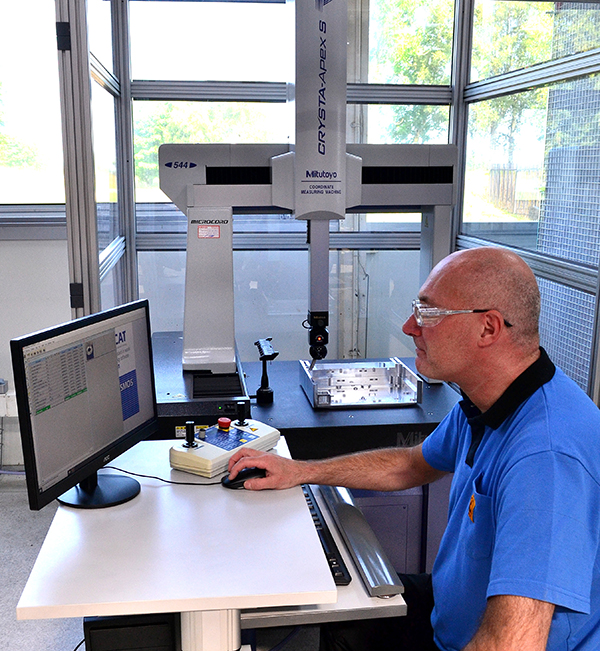
Due to the enhanced accuracy capabilities and the high-yield nature of Linn Products’ new manufacturing plant, Chris O’Brien, director of operations, searched for an advanced CMM that had the ability to keep pace with the company’s increased production of precise components. Following a successful and practical demonstration at Mitutoyo’s East Kilbride showroom, an order was placed for a recently launched Crysta-Apex S series CNC CMM.

Explaining Linn Products’ passionate quality philosophy and the purchase of the Crysta-Apex S, O’Brien says: “Ever since Linn Products was stablished in 1973, we have constantly pushed technology forwards in the pursuit of perfect sound. From our very first product, the iconic Sondek LP12 turntable, we have been at the forefront of audio technology.
“All of our high-fidelity sound systems are assembled by hand at our Glasgow factory, and each one bears the name of the person who made it,” he continues. “Our systems are engineered to extraordinarily tight tolerances. To help ensure the continuing quality of our products and guarantee their prolonged performance, all systems are subject to painstaking inspection and testing at each stage of manufacture. Then, prior to despatch, we thoroughly test every product to ensure that it delivers outstanding performance.
After bringing the machining of many of its previously outsourced components in-house, Linn Products needed to source a highly efficient and accurate means of providing inspection.
“Having considered other options, a demonstration of a Crysta-Apex S at our local Mitutoyo showroom proved that it was the ideal advanced CMM for our demanding needs,” says O’Brien. “As it had the ideal size to accommodate our components, we ordered a Crysta-Apex S544 model with a capacity of 500 x 400 x 400 mm.
“Following our new Mitutoyo CMM’s trouble-free installation, our engineering staff were trained in its operation,” continues O’Brien. “As the CMM’s operating system and software are so logical and intuitive, our staff could soon perform a range of inspection routines. Although, when needed they can request help over the telephone from Mitutoyo’s technical staff. Our Crysta-Apex S series machine is now making a significant contribution to Linn Products’ quality management systems.”

Mitutoyo CMMs come in a wide range of sizes and accuracy classes, enabling them to cover practically all precision 3D measuring applications. A large variety of contact and non-contact probes are available, allowing users to perform a wide range of different measurement routines. Complementing Mitutoyo’s CMM hardware, the company’s powerful, yet easy-to-use analysis software allows the interpretation of all measurement results in the timely manner that is so essential for keeping pace with today’s fast-paced production speeds.
The Crysta-Apex S series of high-accuracy CNC CMMs guarantee a maximum permissible length measurement error of E0,MPE = (1.7+3L/1000) μm [500/700/900 series]. In addition, the CMMs deliver a maximum drive speed of 519 mm/s and a maximum acceleration of 2309 mm/s2, resulting in an increase of almost 100 mm in drive distance per second when compared with general-purpose CNC CMMs.
Designed to deliver high rigidity, Mitutoyo’s Crysta-Apex S series CMMs feature unyielding structures. The Y-axis guide rails, which are attached to one side of the granite surface plates, help the machines to maintain high levels of accuracy over years of use. The CMM’s air bearings are located on the bottom faces of the guide rails; also on the front, rear and upper surfaces of the X-axis slider unit. This arrangement helps to minimise vibration, even during high-speed, high-acceleration movements, and ensure stable linear motion. The high-speed and high-acceleration qualities of Crysta-Apex S CMMs dramatically reduces measuring times, says Mitutoyo.
In addition to being a CMM suitable for use in pristine quality departments, thanks to the use of a temperature compensation system, Crysta-Apex S CMMs are able to guarantee the accuracy of measurement under temperature conditions of 16 to 26°C. The temperature compensation system is based on permanently installed temperature sensors located on each scale, working together with sensors placed on the workpiece.
For further information
www.mitutoyo.co.uk